Fulltext
The full text of this article is available on PDF
Journal of Kermanshah University of Medical Sciences
Peer-reviewed Medical Quarterly
Authors
Background & Objectives: Positive end expiratory pressure (PEEP) can reduce atelectasis after general anesthesia by lung expansion and increase in alveolar pressure. Considering high incidence of atelectasis after open heart surgery and presence of reports on usefulness of PEEP in decreasing its incidence, this study was done to evaluate the effects of PEEP on incidence of atelectasis after CABG.
Materials and Methods: Sixty patients (48 males) were divided into two groups of experiment and control (30 patients in each group). Two groups were similar with regard to age, sex, duration of cigarette smoking, aortic clamping time, cardiopulmonary bypass time, anesthesia time, ejection fraction, intubation time. The experiment group received 5-10 cm/H2O PEEP after operation. The control group did not receive BEEP. The diagnosis of atelectasis was made using a combination of radiographic findings, WBC counts, temperature, Pao2, Paco2 and O2 saturation. Data were analyzed using t-test and chi 2.
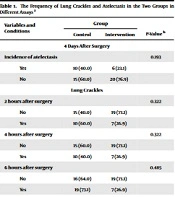
Results: Incidence of atelectasis in experimental group was 26.7% (8 patients) and in control group 56.7% (17 patients). The difference was significant (P<0.02). Mean Pao2 and Paco2 in the first and second days after surgery in experimental group were significantly higher than in the control group. There was no significant difference in mean temperature or o2 saturation.
Discussion: Use of PEEP after CABG can decrease the incidence of atelectasis in intensive care unit.
© 2003, Journal of Kermanshah University of Medical Sciences. This open-access article is available under the Creative Commons Attribution-NonCommercial 4.0 (CC BY-NC 4.0) International License (https://creativecommons.org/licenses/by-nc/4.0/), which allows for the copying and redistribution of the material only for noncommercial purposes, provided that the original work is properly cited.
Mamalyga ML, Lobacheva GV, Alshibaya MM. Recovery of Respiratory Function After Coronary Artery Bypass Graft Surgery Using Pep-Therapy. Multidiscip Cardio Annal. 2019;10(1):e82822. doi: https://doi.org/10.5812/mca.82822
Moradian ST, Saeid Y, Ebadi A, Hemmat A, Ghiasi MS. Adaptive Support Ventilation Reduces the Incidence of Atelectasis in Patients Undergoing Coronary Artery Bypass Grafting: A Randomized Clinical Trial. Anesth Pain Med. 2017;7(3):e44619. doi: https://doi.org/10.5812/aapm.44619
Atashkhoei S, Yavari N, Zarrintan M, Bilejani E, Zarrintan S. Effect of Different Levels of Positive End-Expiratory Pressure (PEEP) on Respiratory Status during Gynecologic Laparoscopy. Anesth Pain Med. 2020;10(2):e100075. doi: https://doi.org/10.5812/aapm.100075
Afrasiabi A, Hasanzadeh S, Negargar S, Ghaffari M, Ansarin K. The Effects of Incentive Spirometry on Pulmonary Volumes and Arterial Blood Gases After Coronary Artery Bypass Surgery. J Kermanshah Univ Med Sci. 2006;10(1):e81706. doi:
Jafari H, Bagheri-Nesami M, Khosravi S, Habibi MR, Ali Mohammadpour Tohamtan R. The Effect of Breathing Exercises on Respiratory Condition After Coronary Artery Bypass Surgery. J Nurs Midwifery Sci. 2023;10(3):e139183. doi: https://doi.org/10.5812/jnms-139183
Last Update: 3 weeks ago
Last Update: 3 weeks ago
Last Update: 3 weeks ago
Last Update: 5 hours ago
Last Update: 7 hours ago
Last Update: 4 days ago