
1. Background
Pulmonary complications are common following cardiac surgery and can lead to increased morbidity, mortality, and healthcare costs (1-3). These complications range from transient arterial hypoxemia to acute respiratory distress syndrome (4, 5). Atelectasis is the most common respiratory complication following cardiac surgery. The prevalence of this complication has been reported to be 32.8% (6). Some studies have even reported it in nearly all patients (7). Some consider atelectasis as a complication, while some introduce nonlobar atelectasis as a stress concentrator, causing alveolar injury and inflammation in the surrounding lung tissues (8). Also, some researchers have reported atelectasis as a major cause of hypoxemia and shunting after cardiopulmonary bypass (9).
Various parameters are considered as potential risk factors for respiratory complications, including sternotomy incision, effects of general anesthesia, topical cooling, extracorporeal circulation, and mechanical ventilation (10, 11). Although there are no definitive methods for preventing respiratory complications, mechanical, surgical, and anesthetic interventions can reduce the complications and systemic inflammation.
One of the most important methods for reducing pulmonary complications is supportive care with protective ventilation strategies (12). Overall, mechanical ventilation in atelectasis is of great significance; in fact, protective ventilation strategies can reduce atelectasis in patients undergoing surgery (10, 13). Adaptive support ventilation (ASV) is a closed-loop mode, regulating the inspiratory pressure to achieve a tidal volume, which minimizes the work of breathing based on the Otis equation. In addition, it switches between control, assisted, and spontaneous breathing, relative to the patient’s spontaneous respiratory effort (14).
The ASV mode has been compared with different weaning strategies, including pressure-regulated volume control (PRVC) and synchronized intermittent mandatory ventilation (SIMV). Some studies have reported faster weaning and fewer complications in this mode (15-17), while others have reported no advantages for it (18). The ASV mode delivers a tidal volume and a respiratory rate, presumably selected by the patient’s brain. In addition, ASV calculates the dead space and delivers the breaths with a tidal volume more than the dead space (19). Based on this hypothesis, ASV can reduce the incidence of atelectasis. In general, a limited number of studies have assessed the effect of ASV on atelectasis. Therefore, in this study, we aimed to assess the effect of ASV mode on atelectasis in patients undergoing cardiac surgery.
2. Methods
In this quasi-experimental study, 123 patients undergoing cardiac surgery were randomly allocated into intervention and control groups. The study was conducted in a 10-bed intensive care unit (ICU), and patients mostly received 1:1 nursing care. Considering the atelectasis ratio reported in the study by Yanez-Brage (1-tailed alpha, 0.05; power, 0.85) and distribution of the experimental and control groups (17.3% and 36.3%, respectively) (20), the sample size required for the present study was calculated to be 56 in each group. Regarding a 10% attrition rate, a sample size of 62 subjects was considered adequate for each group.
Patients, who were admitted during 2011 - 2013, were assessed in terms of the inclusion criteria. The preoperative exclusion criteria were as follows: 1) chronic obstructive pulmonary disease; 2) age < 18 years and > 80 years; 3) ejection fraction < 30%; and 4) atelectasis on chest X-ray. Also, the postoperative exclusion criteria were chest tube drainage > 300 mL/h, reoperation due to surgical complications, need for high-dose inotropes and intraaortic balloon pump, and surgeon’s order to postpone extubation.
Patients in the intervention group were weaned with ASV, while patients in the control group were managed using SIMV and pressure support. Anesthesia and surgical protocols were similar in both groups. Anesthesia was induced and maintained using midazolam, fentanyl, and propofol, and paralysis was achieved by atracurium. The patients were intubated after anesthesia induction and ventilated during surgery.
The following setting was applied in the operating room: tidal volume of 8 - 10 mL/kg, positive end-expiratory pressure (PEEP) of 5 cmH2O, and respiratory rate of 12 breaths per minute. During cardiopulmonary bypass, ventilation was stopped and continuous positive airway pressure of 5 cmH2O was applied. Surgery was performed, using the standard procedure through median sternotomy. Following surgery, the patients were transferred to the ICU and managed by experienced nurses.
The standard protocol for care was applied for the patients, except mechanical ventilation. Fast-track extubation was employed for all the patients, and they were ventilated using Hamilton GS ventilator (version 2.1X, Hamilton Medical, Rhazuns, Switzerland). Patients in the intervention group were ventilated and managed, based on the manufacturer’s protocol (Figure 1). On the other hand, patients in the control group were ventilated using SIMV with a tidal volume of 8 mL/kg ideal body weight, PEEP of 5 cmH2O, and respiratory rate of 15 breaths per minute.
After 20 minutes, ABG measurement was performed, and the ventilator setting was adjusted based on the ABG parameters. Patients in the control group were subsequently changed to the pressure support ventilation mode. Then, the pressure support was reduced with respect to the exhaled tidal volume. All the patients were extubated directly from mechanical ventilation. Following extubation, oxygen was administrated based on the SpO2 measurement.
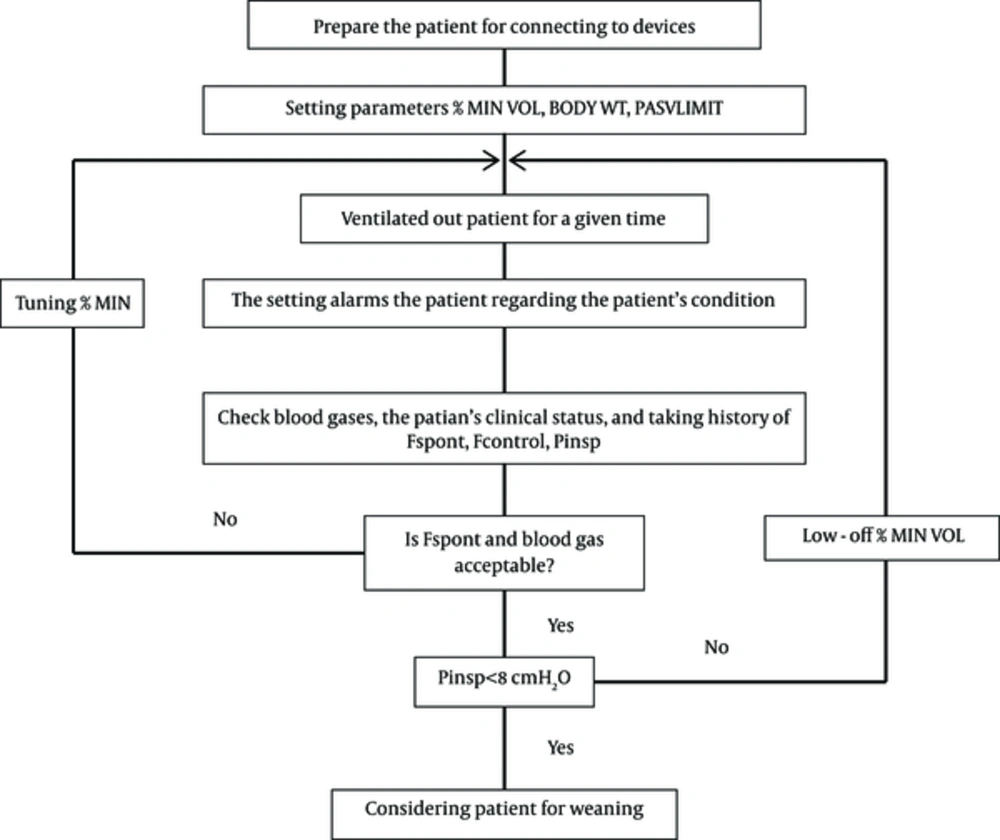
Figure 1.
The Weaning Process Algorithm in the Adaptive Support Ventilation (ASV) Mode
The groups were compared in terms of the incidence of atelectasis, duration of mechanical ventilation, length of ICU and hospital stay, ABG parameters, frequency of changes in the manual ventilator setting, number of alarms, and number of ABG measurements. Atelectasis was assessed using daily chest X-rays, which were interpreted by an anesthesiologist, blinded to patient grouping. The absence or presence of atelectasis (not its severity) on chest X-ray was the diagnostic criterion.
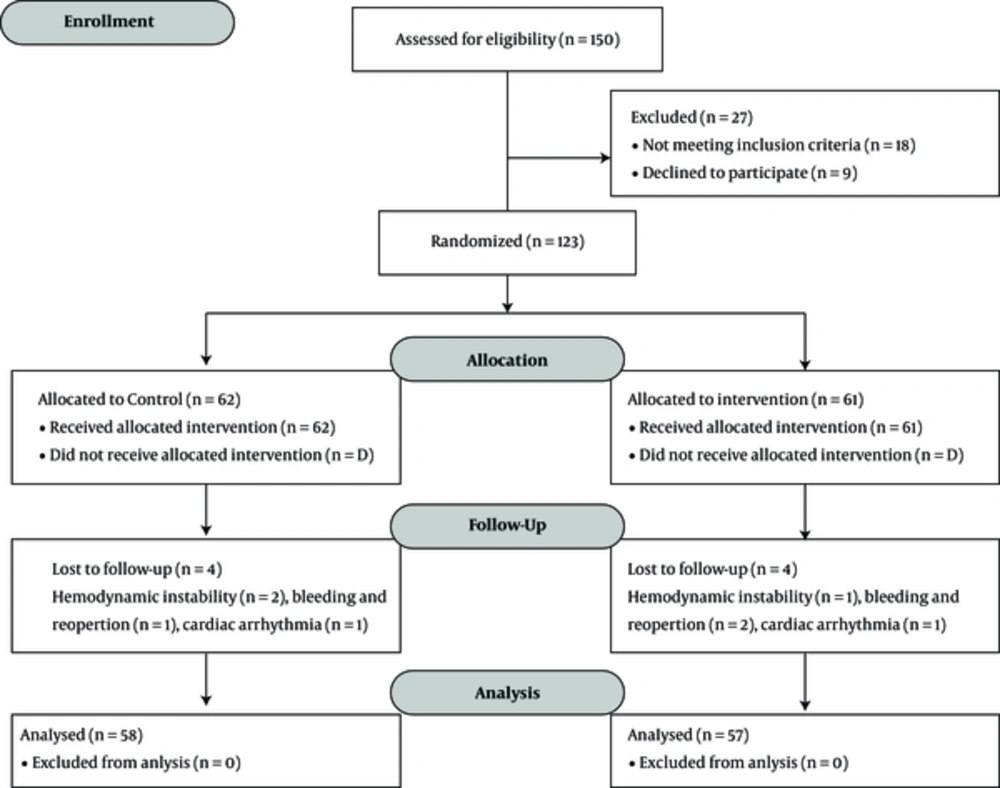
Figure 2.
The Study Flow Diagram
2.1. Statistical Analysis
In the present study, parametric continuous data are expressed as mean (SD), non-parametric data are presented as median (interquartile range), and categorical data are presented as number (%). Independent t test, Mann-Whitney U test, Chi square, and Fisher’s exact test were used to analyze the data. P value less than 0.05 was considered statistically significant.
3. Results
In total, 123 patients were included in the present study, 3 of whom were excluded due to hemodynamic instability (1 from the intervention group and 2 from the control group), 3 due to bleeding and reoperation (2 from the intervention group and 1 from the control group), and 2 due to cardiac arrhythmia (1 patient from each group). Finally, 57 patients in the intervention group and 58 patients in the control group were studied.
The mean (SD) age of the participants was 60.74 (10.28) and 58.97 (10.62) years in the intervention and control groups, respectively; there was no significant difference between the groups in terms of age. Other characteristics of the patients are listed in Table 1. Based on the findings, there was no significant difference between the groups regarding the demographic characteristics.
Table 1.
Demographic Characteristics of the Groups (Pre- and Postoperative Data)a
| Variables | Intervention Group | Control Group | P Value |
|---|---|---|---|
| Age, y | 60.74 ± 10.28 | 58.97 ± 10.62 | 0.36 |
| BMI, kg/m2 | 26.28 ± 3.67 | 27.34 ± 3.94 | 0.16 |
| Male/female | 43/14 | 47/11 | 0.06 |
| Cardiopulmonary bypass time, (min | 73.91 ± 24.56 | 76.34 ± 30.20 | 0.67 |
| Frequency of smoking | 12 | 18 | 0.28 |
| Ejection fraction, % | 48.42 ± 6.95 | 49.82 ± 8.24 | 0.32 |
| Diabetic/non-diabetic | 23/34 | 20/38 | 0.51 |
| HTN/no HTN | 39/18 | 30/28 | 0.10 |
| Forced expiratory volume in 1 second, % | 85.11 ± 23.29 | 89.14 ± 26.54 | 0.39 |
| Forced vital capacity, % | 95.13 ± 20.93 | 100.20 ± 24.42 | 0.23 |
aValues are expressed as mean (SD).
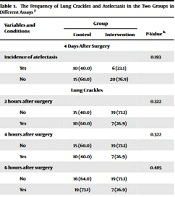
The incidence of atelectasis was 12 (35.3%) and 22 (64.7%) in the intervention and control groups, respectively (P = 0.04). Duration of mechanical ventilation and ABG parameters were not significantly different between the groups. The results are presented in Table 2. In addition, use of ASV was associated with fewer mechanical ventilation adjustments (5.66 ± 2.07 vs. 8.06 ± 2.91) and alarms (10.24 ± 3.42 vs. 14.53 ± 4.81).
Table 2.
Intraoperative Parameters of the Patients
| Parameters, min | Groups | P Value | |
|---|---|---|---|
| Intervention | Control | ||
| Duration of operation | 276.93 ± 42.96 | 283.53 ± 45.19 | 0.42 |
| Duration of bypass | 65 ± 21.65 | 58.25 ± 23.26 | 0.12 |
| Duration of aortic clamping | 42.65 ± 18.24 | 39.26 ± 18.49 | 0.35 |
Table 3.
Comparison of Extubation Time and Length of Hospital Stay Between the Intervention and Control Groups
| Parameters | Groups | P Value | |
|---|---|---|---|
| Intervention | Control | ||
| Time to extubation, min | 296.15 ± 169.17 | 348.80 ± 150.04 | 0.08 |
| Length of ICU stay, h | 33.93 ± 9.24 | 36.29 ± 10.71 | 0.20 |
| Length of hospital stay, day | 6 ± 1.45 | 6.69 ± 2.04 | < 0.001 |
| Early extubation (< 8 hours), No. (%) | 53 (93%) | 51 (87.9) | 0.35 |
Table 4.
Comparison of Arterial Blood Gas (ABG) Measurements and hemodynamic parameters between the Intervention and Control Groups
| Parameters | Groups | During Mechanical Ventilation | P Value | During Spontaneous Ventilation | P Value | After Extubation | P Value |
|---|---|---|---|---|---|---|---|
| pH | Intervention | 7.38 ± 0.54 | 0.08 | 7.35 ± 0.04 | 0.24 | 7.40 ± 0.05 | 0.36 |
| Control | 7.40 ± 0.06 | 7.36 ± 0.05 | 7.39 ± 0.05 | ||||
| Arterial carbon dioxide tension, mmHg | Intervention | 35.14 ± 5.07 | 0.18 | 37.77 ± 4.65 | 0.13 | 34.79 ± 3.66 | 0.11 |
| Control | 33.84 ± 5.41 | 36.38 ± 5.08 | 36.77 ± 3.49 | ||||
| Arterial oxygen tension, mmHg | Intervention | 114.47 ± 49.65 | 0.24 | 99.37 ± 35.51 | 0.17 | 71.67 ± 20.61 | 0.33 |
| Control | 124.47 ± 40.91 | 107.46 ± 26.94 | 77.96 ± 23.02 | ||||
| Arterial bicarbonate concentration, mmol/L | Intervention | 20.86 ± 2.71 | 0.58 | 20.91 ± 2.32 | 0.46 | 22.26 ± 2.21 | 0.63 |
| Control | 24.00 ± 2.4 | 20.57 ± 2.52 | 22.03 ± 2.34 | ||||
| Heart rate, beats/min | Intervention | 85.56 ± 16.47 | 0.21 | 86.16 ± 13.64 | 0.97 | 82.26 ± 13.98 | 0.11 |
| Control | 86.16 ± 13.64 | 86.26 ± 15.13 | 82.22 ± 13.70 | ||||
| Systolic blood pressure, mmHg | Intervention | 110.62 ± 15.33 | 0.22 | 118.22 ± 11.82 | 0.33 | 118.66 ± 12.75 | 0.81 |
| Control | 107.16 ± 16.71 | 116.76 ± 13.71 | 116.28 ± 13.38 | ||||
| Diastolic blood pressure, mmHg | Intervention | 64.16 ± 12.91 | 0.21 | 67.21 ± 8.07 | 0.42 | 69.11 ± 8.78 | 0.51 |
| Control | 61.22 ± 12.10 | 67.67 ± 9.34 | 67.72 ± 9.34 | ||||
| Peak airway pressure, cmH2O | Intervention | 18.91 ± 4.09 | 0.03 | 14.80 ± 2.79 | 0.001 | - | |
| Control | 20.74 ± 5.12 | 17.48 ± 4.94 | - |
4. Discussion
The results of the present study showed that the ASV mode could reduce the incidence of atelectasis, while it had no impact on weaning time and number of ABG measurements. These results are in accordance with previous studies, which reported faster weaning with ASV, compared to other modes such as SIMV, PRVC, and pressure-controlled ventilation (PCV) (15, 18, 21). Also, in this study, use of ASV had no effects on the duration of mechanical ventilation; this finding is consistent with a study by Dongelmans et al. (22).
In the majority of performed studies, use of the closed-loop mode could decrease the mechanical ventilation time (17, 21, 23). However, in a recent meta-analysis, closed-loop ventilation did not affect the weaning time in patients undergoing surgery (24). The present study was performed at a specialized center with experienced ICU staff, who had updated information about care for cardiac surgery patients. Several studies have also shown that the closed-loop mode does not reduce the weaning time, especially in centers with experienced staff (25).
In the current study, the protocol indicating weaning with ASV was not superior to weaning with ASV, selected based on nurses’ experience. The results of this study indicate that there is no need to apply difficult weaning protocols for stable patients who have no history of pulmonary problems; in fact, these patients can be weaned without any complications (26). In some centers, if patients are not weaned using the closed-loop ventilation mode, they will be weaned as the clinician’s experience dictates. Overall, most patients are easily extubated after 30 minutes (15). In a recent study, use of decremental target minute ventilation during ventilation with ASV resulted in shorter mechanical ventilation in cardiac surgery (14).
In the current study, the number of manual setting changes and alarms decreased. These results are consistent with previous studies (17, 18). The reduction in both alarm and manual setting changes is important. In fact, increased number of alarms may lead to alarm fatigue, which is an important concern for patient safety (27-29). Most alarms in the control group were related to apnea backup during spontaneous breathing. In the ASV mode, the alarm was automatically managed by the ventilator, and consequently, we could not hear it.
During apnea, the ventilator automatically changes into the control mode. When the patient’s spontaneous breathing is not sufficient for the mandatory minute ventilation (MMV), extra controlled breaths are delivered to achieve the expected MMV. In the context of nursing staff shortage, a mode with less manual changes can be helpful. In other words, use of the closed-loop mode leads to a more efficient use of the available facilities.
The number of ABG measurements was similar in the groups. Previous studies have reported fewer ABG measurements with the ASV mode. In this regard, about 5 to 6 ABG estimations for mechanical ventilation management were reported in a previous study (17). The reported ABG measurements in the present study are attributed to the length of hospital stay. In our center, 2 ABG measurements are regularly performed during mechanical ventilation, and use of noninvasive monitoring through pulse oximetery and capnography is emphasized.
In the present study, the incidence of atelectasis reduced in the intervention group. In general, studies assessing the effect of ventilation mode on atelectasis in patients undergoing cardiac surgery are limited. Some studies have reported the positive impact of protective strategies such as open lung ventilation on pulmonary function (10). A recent study reported that direct extubation in high-flow nasal cannula post-cardiac surgery does not lead to improvements in respiratory function or atelectasis (30).
In the present study, during the spontaneous phase in the control group (SIMV mode), the patients experienced at least 1 episode of apnea and returned to the SIMV mode. In addition, during spontaneous ventilation, inappropriate setting of pressure support could induce low volume ventilation and contribute to atelectasis. It should be noted that in the ASV mode, MMV is mandated by the ventilator.
If the patient’s respiratory rate is not sufficient for MMV, the ventilator delivers controlled breaths for achieving the expected MMV. Also, if the patient’s inspiratory effort is not sufficient, the amount of pressure support is increased for having at least a tidal volume of 2.2 mL/kg to prevent atelectasis; therefore, this strategy could reduce atelectasis (19). Atelectasis also plays an important role in respiratory failure following surgery. In addition, low-end expiratory volume and cyclic opening/closing of the unstable alveolus could cause pulmonary injuries (17).
In the current study, application of the ASV mode was associated with decreased hospital stay, while the length of ICU stay was similar in the groups. In this regard, Yazdannik et al. reported reduced length of hospital stay in patients who were ventilated using ASV (16). On the other hand, Zhu et al. did not report any difference in the length of hospital stay (17). Overall, atelectasis affects the course of recovery and may cause increased morbidity and length of hospital stay.
One of the limitations of mechanical ventilation is the problem of blinding the subjects. The present study was performed in a specialized heart center. Therefore, patients with severe comorbidities are not candidates for surgery, and most patients are weaned from the ventilator as early as possible.
4.1. Conclusion
The present results showed that use of ASV in cardiac surgery patients could reduce atelectasis, number of alarms, and manual ventilator changes. Nevertheless, this mode did not reduce the weaning time.