
Fulltext
Full-text is available in PDF format.
Journal of Motor Control and Learning
An International Journal of Movement Science
Authors
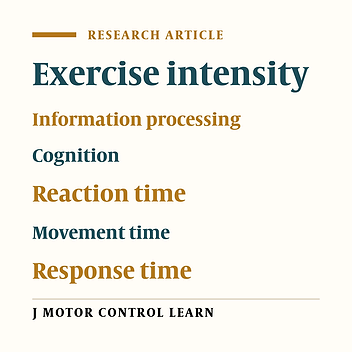
Background: Information processing and cognition can be enhanced in various ways. The present study investigated the role of three intensities of aerobic exercise (low intensity [LIE], moderate intensity [MIE], high intensity [HIE]) on information processing speed using a response time paradigm.
Methods: Twenty-seven adult male and female volunteers (16, male; 11, female) ages 18 to 26 years (Mean age = 21.9 years) were randomly assigned to LIE, MIE, and HIE exercise groups. Exercise was performed on a bike ergometer. Participants took part in single choice (SC), multichoice (MC), and dual task (DT) performance tasks before exercise and 1 min and 20 min postexercise. Information processing speed was analyzed by calculating total response time (RPT), reaction time (RT), and movement time (MT) on a response time apparatus.
Results: For each performance task, the impact of three intensities of exercise on RPT, RT and MT were analyzed using separate 3 (Group [exercise intensity]) x 3 (Test Block [preexercise, 1 min postexercise, 20 min postexercise]) repeated measures ANOVA. Data analyses indicated: (1) participants in each exercise condition improved RT and RPT on MC (p < 0.001; p < 0.01, respectively) and DT (p < 0.05, p < 0.05, respectively) tasks but not on the SC task and these improvements were observed both immediately (1 min) and short-term (20 min) postexercise.
Conclusions: As RT represents more CNS mechanisms than movement per se, the faciliatory effect of exercise on the speed of task completion involved more speed of cortical processing than speed of movement when completing the task. All exercise intensity levels investigated had a positive impact on the time required to complete MC and DT tasks.
2023 The Authors.This is an open access article under the CC BY license. (http://creativecommons.org/licenses/by/4.0/)
Nazari Radgiglou S, Safarzade A, Shirinbayan V. Comparison of Two Types of High-Intensity Interval Training: Heart Rate Based vs. Speed/Time Based. Asian J Sports Med. 2022;13(3):e123355. doi: https://doi.org/10.5812/asjsm-123355
Shaw BS, Jan Breukelman G, Millard L, Shaw I. Effect of a Prolonged Maximal Bout of Exercise on Visual Performance. Asian J Sports Med. 2022;13(1):e119406. doi: https://doi.org/10.5812/asjsm.119406
keshavarz M, dehghanizade J. The Effects of Gender and Type of Stimulus Presentation on Serial Reaction Time. J Motor Control Learn. 2024;2(4):e146543. doi: https://doi.org/10.29252/ijmcl.2.4.21
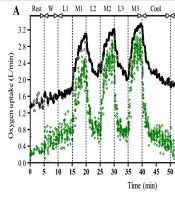
Phiwjinda K, Krootnark K, Pirompol P, Bupha-Intr T. Oxygen Consumption During Moderate-Intensity Interval Exercise in Overweight Young Adults. Asian J Sports Med. 2024;15(2):e142812. doi: https://doi.org/10.5812/asjsm-142812
rashidi M, Rashidy-Pour AL, Vaezi G, Ghorbani R. Effects of high intensity aerobic and anaerobic training on the normal healthy people memory functions. koomesh. 2016;17(3):e151223. doi:
More by these authors
Last Update: 2 weeks ago
Last Update: 2 weeks ago
Last Update: 2 weeks ago
Last Update: 6 days ago
Last Update: 7 hours ago
Last Update: 4 days ago
