
Fulltext
Full-text is available in PDF format.
Journal of Motor Control and Learning
An International Journal of Movement Science
Authors
Background: The transfer of motor skills is one of the central topics in motor behavior and speaks to the effects of learned motor skills on learning or performing other skills. The purpose of this investigation was to examine the transfer of skillful fine or moderately-fine movements to novel tasks requiring similar movements.
Methods: The study involved 43 undergraduate university students in three groups: university musicians, athletes and a control cohort. Two novel motor tasks were performed that required either fine hand movements (pursuit rotor task), or moderately-fine arm movements (underhand dart throw task).
Results: For the fine motor task, musicians performed better than the athletes and the control (p<0.05), but did not demonstrate less movement asymmetry than the other groups, as hypothesized (p>0.05). For the moderately-fine task, the athletes performed better than the other two groups (p<0.05), and in particular, with the dominant arm (p<0.05), as hypothesized.
Conclusion: A lack of shared elements between musical instrument playing skills and the novel fine motor task likely contributed to the relatively low levels of performance with the musicians. Conversely, the presence of more shared elements between sports throwing skills and the novel moderately-fine task likely contributed to greater levels of performance by the athletes.
2022 The Authors.This is an open access article under the CC BY license. (http://creativecommons.org/licenses/by/4.0/)
Shahabi Kaseb MR, Mehranian A, Rezaei K. The Effect of Proprioceptive Neuromuscular Facilitation on Learning Fine Motor Skills: A Preliminary Study. J Kermanshah Univ Med Sci. 2016;20(2):e69701. doi: https://doi.org/10.22110/jkums.v20i2.2922
Atigh A, Akbarfahimi M, Alizadeh M, Mahmoodi Rad M. The effect of musical movement activities on the balance function of autistic children. J Kermanshah Univ Med Sci. 2013;17(8):e74389. doi:
Hansen E. Twenty Seconds of Finger Tapping: A Borderland for Contralateral Transfer of Repeated Bout Rate Enhancement. J Motor Control Learn. 2022;4(2):e144307. doi: https://doi.org/10.52547/ijmcl.4.2.9
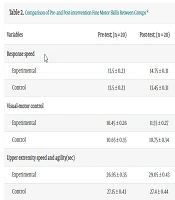
Sabzi AH. The Effect of Selected Motor Games on Fine Motor Skill Development in Children with Developmental Coordination Disorder. J Motor Control Learn. 2025;7(1):e161094. doi: https://doi.org/10.5812/jmcl-161094
Tahmasebi Boroujeni S, Abbasnia A, Doosti M. Training with Non-dominant Limb: A Helpful Strategy for Motor Function and Dual-task Cost in Multiple Sclerosis Patients. J Motor Control Learn. 2023;5(3):e143465. doi: https://doi.org/10.61186/ijmcl.5.3.24
Last Update: 0 months ago
Last Update: 0 months ago
Last Update: 0 months ago
Last Update: 6 days ago
Last Update: 10 hours ago
Last Update: 4 days ago