
Fulltext
Full-text is available in PDF format.
Journal of Nursing and Midwifery Sciences
The Official Journal of Mazandaran University of Medical Sciences
Authors
Context: In Turkey, pain and its management in newborns is within the curriculum of midwifery and nursing education. It is important for midwifery and nursing students to have sufficient knowledge and skills for practice about pain and its management in newborns.
Aims: The present study aimed to find the effect of video‑assisted training given to midwifery and nursing students about pain and its management in newborns on the knowledge level of students.
Setting and Design: This study employed a quasi‑experimental pretest–posttest design in Ondokuz Mayıs University Health Sciences Faculty between 26 and 27 February 2018.
Materials and Methods: Midwifery and Nursing students (n = 182) enrolled by census sampling. In addition to students’ sociodemographic data and information about the state of observing and applying a painful procedure on newborns, the data were collected through a questionnaire form prepared by the researcher which included pain characteristics, symptoms of the newborn, scales, and management. The questionnaire form filled in before the training was repeated following the video‑assisted training given.
Statistical Analysis Used: Data were analyzed using descriptive statistics, Chi‑square test, and McNemar’s test.
Results: It was found that 74.7% of the students who participated in the study observed a painful intervention to newborn and 23.1% performed a painful intervention on newborn. It was found that students’ posttraining states of knowing about newborns’ pain characteristics, behavioral and physiological symptoms, scales used in the assessment of pain in newborns, and characteristics about nonpharmacological and pharmacological treatments used in pain treatment increased when compared with pretraining (P < 0.05).
Conclusion: It was found that students’ states of knowing about newborns’ pain increased after the training given when compared with before training. It is recommended that the content of the subject of pain and its management in newborn period within the curriculum of midwifery and nursing schools should be reviewed and improved by new educational methods.
© 2020, Author(s). This open-access article is available under the Creative Commons Attribution 4.0 (CC BY 4.0) International License (https://creativecommons.org/licenses/by/4.0/), which allows for unrestricted use, distribution, and reproduction in any medium, provided that the original work is properly cited.
Geranmayeh M, Hadian T, Rezaepur A, Akhondzadeh E, Haghani H. Effect of education on midwives' knowledge, attitude and practice about non-pharmacologic labor pain relieving methods. J Inflamm Dis. 2024;15(2):e155613. doi:
Keles NC. The effects of training in breastfeeding counseling on breastfeeding knowledge and attitudes of midwifery students. J Nurs Midwifery Sci. 2021;8(4):e140712. doi: https://doi.org/10.4103/jnms.jnms_175_20
Tural Büyük E. The effect of training program on the knowledge level of midwifery students about child abuse. J Nurs Midwifery Sci. 2019;6(4):e140988. doi: https://doi.org/10.4103/jnms.jnms_54_18
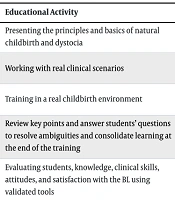
Bakhtiari A, Nasiri-Amiri F, Parvaneh M. Enhancing Midwifery Students’ Knowledge and Skills in Labor Dystocia via Webinar-Based Blended Learning: A Pre-experimental Study. J Nurs Midwifery Sci. 2025;12(2):e158881. doi: https://doi.org/10.5812/jnms-158881
Jafaru Y, Musa MM, Sani GW. Experiences of Nursing/Midwifery Students on Clinical Learning Processes in a Training Hospital in Northern Nigeria. J Med Edu. 2022;21(1):e114517. doi: https://doi.org/10.5812/jme.114517
Last Update: 1 month ago
Last Update: 1 month ago
Last Update: 1 month ago
Last Update: 6 days ago
Last Update: 2 days ago
Last Update: 4 days ago
