
Fulltext
Full-text is available in PDF format.
Journal of Nursing and Midwifery Sciences
The Official Journal of Mazandaran University of Medical Sciences
Authors
Context: Guided self‑change (GSC) is theory‑driven based on cognitive‑behavioral change models such as transtheoreticlal model (TTM) and can be applied with nicotine replacement therapy (NRT) for behavioral change of smoking in chronic obstructive pulmonary disease (COPD) smokers.
Aims: This study aimed to investigate the individual GSC, NRT, and GSC‑NRT on smoking cessation of COPD patients.
Settings and Design: This randomized clinical control trial study was carried out in Imam Khomeini Hospitals in Mazandaran province in 2016–2017.
Materials and Methods: Three‑ group block randomized controlled trial, comparing GSC (n = 20), NRT (n = 20), and GSC‑NRT (n = 20) in smoking cessation and other related variables COPD smokers with follow‑up to 29‑week.
Statistical Analysis Used: Descriptive statistics, Chi‑square, and repeated measures ANOVA test were used to analyze the data.
Results: The GEE model revealed that GSC reduced the odds of quitting smoking rate compared to the NRT group (odds ratio = 0.31, 95% confidence interval: 0.022–0.545, ES = 0.20). Furthermore, the TTM questionnaire, the Fagerstrom test for nicotine dependence, and spirometry variables were evaluated in the three groups. The recovery in nicotine dependency, the exhaled carbon monoxide and spirometry variables was more pronounced in the GSC and GSC‑NRT groups than in the NRT over 29 weeks after the treatments. Cons (PV = 0.009, ES = 0.52), pros (PV = 0.04, ES = 0.12), experiential process (PV = 0.005, ES = 0.18), counterconditioning (PV = 0.04, ES = 0.12), stimulus control (PV = 0.004, ES = 0.19), environmental‑reevaluation (PV = 0.0001, ES = 0.30), and habitual craving (PV = 0.004, ES = 0.19) were significant across the three groups.
Conclusion: The interventions in the GSC and combined GSC‑NRT groups were significantly more effective than in the NRT group in TTM variables, and GSC and combined GSC‑NRT were equally effective in smoking cessation rate.
© 2020, Author(s). This open-access article is available under the Creative Commons Attribution 4.0 (CC BY 4.0) International License (https://creativecommons.org/licenses/by/4.0/), which allows for unrestricted use, distribution, and reproduction in any medium, provided that the original work is properly cited.
Heidari M, Fayazi S, Borsi H, Latifi M. The Effects of Self-Management Program on Exercise Tolerance and Dyspnea in Patients With Chronic Obstructive Pulmonary Disease. Jundishapur J Chronic Dis Care. 2014;3(3):e21708. doi: https://doi.org/10.17795/jjcdc-21708
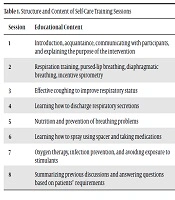
Heidaripor N, Saeedinezhad F, Keykha A. The Effect of Self-Care Training on Spirometric Indices in Patients with Chronic Obstructive Pulmonary Disease: A Clinical Trial Study. Med Surg Nurs J. 2019;8(3):e98348. doi: https://doi.org/10.5812/msnj.98348
Salehi L, Alizadeh L. Efficacy of a Cognitive-Behavioral Relapse Prevention Model in the Treatment of Opioid Dependence in Iran: A Randomized Clinical Trial. Shiraz E-Med J. 2018;19(5):e14170. doi: https://doi.org/10.5812/semj.14170
Jafari M, Shahid S, Abedin A. Comparing the effectiveness of Cognitive Behavioral Therapy and Stages of Change Model on Improving Abstinence Self-Efficacy in Iranian Substance Dependent Adolescents. Iran J Psychiatry Behav Sci. 2012;6(2):. doi:
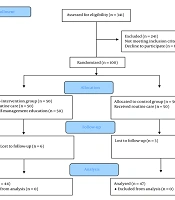
Dehghan Nayeri N, Rafii F, Alinejad-Naeini M, Aghaei S, Heidari-Beni F. The Effect of Self-management Program on Anxiety and Depression in Patients with Chronic Obstructive Pulmonary Disease: A Randomized Controlled Trial. Jundishapur J Chronic Dis Care. 2025;14(2):e148899. doi: https://doi.org/10.5812/jjcdc-148899
Last Update: 1 month ago
Last Update: 1 month ago
Last Update: 1 month ago
Last Update: 6 days ago
Last Update: 2 days ago
Last Update: 4 days ago
