Fulltext
Full-text is available in PDF format.
Journal of Nursing and Midwifery Sciences
The Official Journal of Mazandaran University of Medical Sciences
Authors
Context: Religion and spirituality are considered as sources for adaptation to life-threatening events such as anxiety.
Aims: The purpose of this study was to determine the level of religious attitude and anxiety.
Settings and Design: This is a descriptive study of analytical type. In this study, 102 students were selected by the census method in 3 months.
Material and Methods: The data collection tools were demographic questionnaires, Serajzadeh’s religious attitude standard, and Achilles Berger’s anxiety. Based on Likert scale, there are five options that I totally agree with and disagree with.
Statistical Analysis Used: The normal data from the questionnaire will be examined using Kolmogorov–Smirnov to examine normal distribution. After collecting data and coding, to analyze the data, the central indicators and dispersion including mean, mean, fashion, standard deviation and independent t-test, Pearson correlation coefficient were used using the SPSS-16 software.
Results: The results showed that the mean anxiety level was 4.24 ± 52.12 and religious attitude was 67.97 ± 35.15. The highest mean score was related to beliefs, and the lowest was the post-nursing dimension in religious attitude. Most of the participants showed a high level of anxiety and high religious attitude. There was no significant difference between the dimensions of the religious attitude, and the level of anxiety of the groups (P > 0.05). However with an increase in religious attitude, the level of anxiety has decreased.
Conclusion: The results of this study showed that the religious attitude of the participants in the strong level and the anxiety level was moderate. In this study, it was found that both groups did not have a significant difference from religious viewpoint and its dimensions and anxiety disorder. Furthermore, in studying the effect of variables, it was found that there was no significant relationship between religious beliefs and anxiety levels with the variables. However, the increase in religious attitude has been accompanied by low anxiety.
2018 Journal of Nursing and Midwifery Sciences. This is an open access journal, and articles are distributed under the terms of the Creative Commons Attribution‑NonCommercial‑ShareAlike 4.0 License, which allows others to remix, tweak, and build upon the work non-commercially, as long as appropriate credit is given and the new creations are licensed under the identical terms.
Khazaei H, Rezaei M, Ghadami MR, Tahmasian M, Ghasemi Mobarra A, et al. Relationship between religious values and anxiety among Kermanshah University of Medical Sciences students. J Kermanshah Univ Med Sci. 2010;14(1):e79543. doi:
Salehi L, Solimanizadeh L, BagheriYazdi S, Abbaszadeh A. The relationship between religious beliefs and locus of control with mental health. J Inflamm Dis. 2024;11(1):e155290. doi:
Heydari N, Janghorban R, Akbarzadeh M. The Relationship Between Religious Attitudes and Academic Motivation of Nursing and Midwifery Students: A Descriptive-Analytical Study. Shiraz E-Med J. 2020;21(10):e95005. doi: https://doi.org/10.5812/semj.95005
Qudrat Abas N. Assessing the Anxiety Level in Nursing Students at the Commencement of their Academic Year. J Kermanshah Univ Med Sci. 2017;21(1):e69545. doi: https://doi.org/10.22110/jkums.v21i1.3397
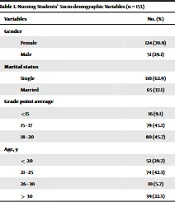
Talebian F, Araghian Mojarad F, Yaghoubi T. The Relationship Between Religion Orientation and Moral Courage: A Study on Nursing Students. J Nurs Midwifery Sci. 2023;10(4):e139916. doi: https://doi.org/10.5812/jnms-139916
Last Update: 1 month ago
Last Update: 1 month ago
Last Update: 1 month ago
Last Update: 6 days ago
Last Update: 2 days ago
Last Update: 4 days ago
