



1. Background
Moral courage is a fundamental aspect of delivering safe and professional care to patients and a pillar for tolerating unethical situations (1). This intrinsic entity motivates individuals who may struggle to act ethically to strive for the ultimate objective, regardless of the potential consequences (2). In essence, moral courage empowers nurses to provide appropriate care not only to patients but also to their families, as well as to the community. Moral courage is a crucial component of ethical practice; however, the existing literature suggests that nurses may sometimes lack the necessary courage to make ethical decisions for various reasons (3). Moral courage is a key factor that influences patient support and represents an individual’s capacity to exhibit moral behaviors when facing moral challenges (4).
Nursing students are among the most crucial groups that require moral education. This is because the future decisions made by nurses in their work environments are closely tied to moral considerations. These decisions not only have an impact on the lives of patients but also influence the quality of the care provided (5). Research has shown that nursing students with higher levels of moral courage demonstrate greater professional commitment, enabling them to advocate for the rights and needs of their patients. Therefore, moral courage has a positive impact on the moral behaviors of nursing students, which is reflected in their ability to apply professional values when making ethical decisions and to overcome potential risks such as social rejection, embarrassment, or even being fired (6).
Another perspective to consider is that all behaviors, values, and decisions are rooted in spirituality (7). Spiritual values play a critical role in shaping individuals’ moral perspectives, providing a deeper understanding of moral issues (8). Since spirituality is a part of people’s value systems, the use of moral courage can lead to the nourishment of spirituality in their lives (9).
Moral courage is an essential attribute of nursing students as it empowers them to act ethically and professionally when facing challenging situations, including ethical dilemmas, substandard practices, or patient safety concerns (6). Investigating moral courage in nursing students can provide valuable insights into the factors that shape their moral courage, such as religious beliefs, psychological performance, or work environment (10). Furthermore, such research can facilitate the development and assessment of interventions aimed at enhancing moral courage among nursing students, such as educational programs, training initiatives, mentorship opportunities, or the development of positive role models. By bolstering the moral courage of nursing students, research endeavors can contribute to the provision of high-quality care, improvement of patient satisfaction, and nurses’ professional growth (11, 12).
Religious orientation refers to a form of adaptation and problem-solving strategy that focuses on an individual’s motivation toward religion rather than just religiosity (13). Religious orientation is defined as a combination of beliefs, behaviors, and religious motivations serving as a defensive shield (14). Spirituality is recognized as a significant enhancer of the performance of personnel within an organization (15). Religious orientation also plays a role in promoting health and reducing job stress (13). Numerous studies have confirmed a connection between spirituality, success, ability to handle stressful situations, and maintaining good health (15-17).
Given these findings, moral courage is considered a crucial requirement in the nursing profession, as the absence of this characteristic can negatively affect the quality of the care provided. Therefore, it is important to identify the factors that contribute to the development of moral courage, particularly among nursing students, as future nurses.
2. Objectives
This study aimed to investigate the relationship between religious orientation and moral courage among nursing students.
3. Methods
3.1. Research Design
This was a descriptive cross-sectional study conducted in the academic year of 2021-2022.
3.2. Participants and Data Collection
The target population consisted of nursing students studying at the Mazandaran University of Medical Sciences recruited by simple random sampling using a table of random numbers. Considering the significance level of 5%, the test power of 80%, and a loss rate of 10%, the number of subjects was set at n = 180.
The inclusion criterion in this study was studying in the third or fourth semester to achieve a bachelor’s degree in nursing. After obtaining approval from the institutional ethics committee and an introduction letter from the deputy of research, the researcher visited the university. After meeting nursing students, the researcher introduced herself and explained the research objectives to the students. Verbal informed consent was obtained, and the links of the Google forms prepared based on a demographic information questionnaire, the religious orientation scale, and the moral courage questionnaire were sent to the students. Different parts of the questionnaires were initially explained, and instructions on how to answer sample questions were provided. Finally, the students completed the questionnaires.
3.3. Instruments
The instruments used for data collection were three questionnaires.
3.3.1. Demographic Questionnaire
This questionnaire was used to record age, gender, academic semester, and grade point average (GPA).
3.3.2. Religious Orientation Scale
This questionnaire was designed by Allport and Ross (18) as a 20-item questionnaire. Eleven items are related to extrinsic religious orientation, and 9 items are related to intrinsic religious orientation. In this scale, extrinsic religious orientation is rated on a 4-point Likert scale as follows: Completely disagree (5), somehow disagree (4), agree (2), and completely agree (1). For the intrinsic religious orientation scale, the rating is as follows: Completely agree (1), somehow agree (2), agree rather than not (4), and completely disagree (5). The lowest score is given to people expressing intrinsic religious orientation (i.e., scores between 9 and 45), and the highest score is given to those with extrinsic religious orientation (i.e., scores between 11 and 55). The reliability of this questionnaire in Iran was tested by Janbozorgi in a group of 235 students in Tehran universities, reporting Cronbach’s alpha coefficient of 0.74 (19). In another study conducted by Mokhtari Hesari et al. on a sample of 100 students studying at Tehran University, the validity of this scale was verified by Cronbach’s alpha coefficient of 0.71 (20).
3.3.3. Moral Courage Scale
The moral courage (MC) scale was developed by Sekerka and Bagozzi. This instrument consists of 15 items rated on a 7-point Likert scale, with each item receiving a score between 1 and 7, ranging from non-true at all = 1, not true = 2, sometimes true = 3, rarely true = 4, often true = 5, true = 6, and always true = 7). This scale consists of five subscales: Ethical factor (items 1 - 3), multiple values (items 4 - 6), tolerance to threats (items 7 - 9), going beyond one’s capacity (items 10 - 12), and moral intention (items 13 - 15). In this scale, the score of each dimension is initially calculated and subsequently divided by the number of items within that dimension to obtain the final score. In order to obtain the overall score, the raw scores of all fifteen items were summed up and then divided by 15 (i.e., the total number of items). The score of each dimension ranged from a minimum of 3 to a maximum of 21, and the total score varied from a minimum of 15 to a maximum of 105 (21).
The reliability of the scale in Iran was verified in 2014 with Cronbach’s alpha coefficient of 0.85. Moreover, in a study conducted by Mahdaviseresht et al., Cronbach’s alpha coefficients for the dimensions of ethical factor, multiple values, tolerance to threats, exceeding one’s capacity, and moral intention were calculated to be 0.76, 0.71, 0.86, and 0.71, respectively. In another study conducted in Iran in 2015, the content validity of the instrument was confirmed by presenting it to 10 experts in nursing ethics, bioethics, and medical ethics (22).
3.4. Data Analysis
Descriptive and analytical statistical methods were employed for data analysis. The indicators of mean, standard deviation, and relative and absolute frequencies were used to express the characteristics of the study subjects. In order to explore the relationship between religious orientation and moral courage, the Kolmogorov-Smirnov test was initially conducted to examine the normality of the data, followed by the Pearson correlation test and the independent t-test. Data were analyzed using SPSS 18.0 software (IBM Corporation).
3.5. Ethical Considerations
This investigation was approved by the Ethics Committee of Mazandaran University of Medical Sciences with the ethics code of IR.MUZUMS.REC.1400.523 on 2021.9.29. In order to obtain informed consent from the participants, the necessary assurances were given to them regarding the confidentiality and anonymity of their information. It was specified that participation in the study was voluntary. All objectives of the research were elaborated, and it was clarified that the results of the research could be made available to the authorities upon request.
4. Results
4.1. Participants
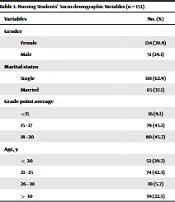
Of the 180 links to the questionnaires submitted, five were not analyzed due to incompleteness. Of the 175 nursing students who completed the questionnaires, most were females (70.9%) and single (62.9%), with a mean age of 24.8 ± 6.30 years. Most of the students (45.7%) had a GPA of 18 to 20 (Table 1).
Table 1.Nursing Students’ Socio-demographic Variables (n = 153)
| Variables | No. (%) |
|---|---|
| Gender | |
| Female | 124 (70.9) |
| Male | 51 (29.1) |
| Marital status | |
| Single | 110 (62.9) |
| Married | 65 (37.1) |
| Grade point average | |
| <15 | 16 (9.1) |
| 15 - 17 | 79 (45.1) |
| 18 - 20 | 80 (45.7) |
| Age, y | |
| < 20 | 52 (29.7) |
| 21 - 25 | 74 (42.3) |
| 26 - 30 | 10 (5.7) |
| > 30 | 39 (22.3) |
4.2. Nursing Students’ Moral Courage and Religious Orientation
The mean score of moral courage (58.74 ± 10.56) was at an average level. As the results showed, the highest mean was related to the moral goals dimension and the lowest mean was related to the tolerance to threats dimension (Table 2).
Table 2.The Mean and Standard Deviation of Moral Courage and Religious Orientation Scores and Their Dimensions
| Variables | Min | Max | Mean ± SD |
|---|---|---|---|
| Moral courage’s components (5 dimensions) | 21 | 79 | 58.74 ± 10.56 |
| Ethical factors | 1 | 6.33 | 3.92 ± 1.32 |
| Multiple values | 1 | 7 | 3.74 ± 1.21 |
| Tolerance to threats | 1 | 7 | 3.40 ± 1.29 |
| Surpassing one’s capacity | 1 | 7 | 4.03 ± 1.18 |
| Moral purposes | 2.33 | 6.33 | 4.47 ± 0.72 |
| Religious orientation’s components (2 dimensions) | 38 | 67 | 52.84 ± 6.06 |
| Extrinsic | 12 | 41 | 28.62 ± 5.12 |
| Intrinsic | 17 | 32 | 24.21 ± 2.74 |
Also, 71.2% of the study participants had average moral courage, 21.8% had low moral courage, and 7% had high moral courage. As for religious orientation and its components, the results showed that the mean score of religious orientation (52.84 ± 6.06) was at a high level. The highest mean belonged to the extrinsic dimension (28.62%), and the lowest score was recorded for the intrinsic dimension (24.21%) (Table 2).
A high level of religious orientation was observed in most of the students (91.1%). Meanwhile, 8% of the students displayed a moderate level of religious orientation, and only 0.9% of them had a low level of religious orientation.
4.3. Nursing Students’ Socio-demographic Factors Associated with Moral Courage and Religious Orientation
The research revealed that students with a GPA of 18 - 20, married individuals, and men over the age of 30 demonstrated the highest scores in terms of moral courage. Similarly, students with a GPA of 18-20, married individuals, and men aged 26 - 30 years exhibited the highest levels of religious orientation. However, no noteworthy correlation was found between moral courage and religious orientation concerning age, gender, marital status, and GPA. In order to investigate this connection further, an analysis of variance (ANOVA) was conducted. The findings indicated that there was no statistically significant distinction between moral courage and religious orientation when considering the demographic variables mentioned above.
4.4. Correlation Between Students’ Religious Orientation and Moral Courage
The current study utilized Pearson’s correlation to examine the relationship between moral courage and religious orientation. The results indicated a statistically significant association between these two variables (r = 0.62, P < 0.05). Specifically, the extrinsic component of religious orientation was found to be meaningfully linked to the ethical component of moral courage, which included multiple values, tolerance of threats, and surpassing one’s capacity (P < 0.05). Additionally, a significant association was observed between the extrinsic component of religious orientation and the multiple values and moral purpose components (P < 0.05), as shown in Table 3.
Table 3.Correlation Matrix for the Link Between Moral Courage Components and Religious Orientation Among Nursing Students
| Moral Courage Components, Religious Orientation Components | Ethical Factors | Multiple Values | Tolerance to Threats | Going Beyond One’s Capacity | Moral Purposes |
|---|---|---|---|---|---|
| Extrinsic | |||||
| Correlation | 0.53 a | 0.47 a | 0.53 a | 0.64 a | -0.09 |
| P-value | 0.0001 | 0.0001 | 0.0001 | 0.0001 | 0.21 |
| Intrinsic | |||||
| Correlation | -0.06 | -0.19 a | 0.08 | 0.09 | 0.35 a |
| P-value | 0.37 | 0.0001 | 0.26 | 0.23 | 0.0001 |
a Significant relationship (P < 0.01)
4.5. Prediction of Moral Courage by Religious Orientation
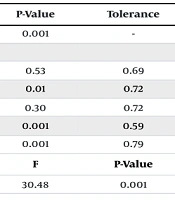
Regression analysis indicated that internal religious orientation could not predict moral courage, so it was excluded from the regression model (P = 0.449 and T = -0.760). However, external religious orientation (P = 0.00 and T = 15/340) demonstrated a significant ability to predict moral courage (P = 0.05). The linear regression model could explain 57.4% of the variance of moral courage, while the remaining 42.6% of the variance could be attributed to other variables that were not examined in this study. The standardized beta coefficient provides an estimation of the contribution of each variable to the model in terms of the standard deviation. In other words, the beta coefficient represents changes in the standard deviation of the criterion variable for each one-unit change in the predictor variable’s standard deviation. Therefore, based on the standard regression coefficient obtained, each one-unit increase in the external orientation score corresponded to a 0.764 change in the standard deviation of the moral courage score (Table 4).
Table 4.Multiple Regression Coefficients and Regression Analysis to Assess the Predictive Value of Religious Orientation for Moral Courage
| Steps | Non-standardized Coefficients | Standard Coefficients (β) | T | P-Value | Collinearity Indicators | ||
|---|---|---|---|---|---|---|---|
| B | Standard Error | Endurance Statistics | Variance Inflation Factor | ||||
| Constant | 17.206 | 5.243 | - | 3.281 | 0.001 | - | - |
| Extrinsic religious orientation | 1.574 | 0.103 | 0.764 | 15.340 | 0.000 | 0.989 | 1.011 |
| Intrinsic religious orientation | -0.145 | 0.191 | -0.038 | -0.760 | 0.449 | 0.989 | 1.011 |
The following shows the step-by-step regression model:
Y = a + b1x1+ b2x2
(extrinsic religious orientation) 1.574 + 17.206 = moral courage
5. Discussion
The objective of this study was to examine the impact of religious orientation on the level of moral courage among nursing students. The findings of the study revealed a statistically significant correlation between moral courage and religious orientation. This finding was consistent with a previous report by Esmaili et al. (23), who affirmed that religious orientation could affect nurses’ moral courage. Additionally, Hu et al. found that psychological empowerment, a component of religion, could enhance moral courage among nursing students (24). Similarly, Taghadosi et al. conducted a study on 170 nurses working at hospitals affiliated with the Kashan University of Medical Sciences and found a significant relationship between religion, attitudes, commitment to prayers, and moral courage (25). In a review, Namadi et al. concluded that individuals’ moral courage was correlated with their level of religious beliefs (26). These findings aligned with that of the present study. Mazhari Saif suggested that individuals who adhered to religious beliefs possessed moral courage, which enabled them to effectively navigate challenging situations (27).
There is no study that could strongly and directly disprove a link between these two variables. However, it is worth noting that moral courage and moral sensitivity are closely and strongly correlated (28). This finding opposed the observation of Baloochi Beydokhti et al., who found that religious orientation had no significant relationship with moral sensitivity among nurses (29). The discrepancy between these findings may be attributable to the use of different research tools. Nevertheless, it is undeniable that religion plays a crucial role in forming morale, and an individual’s religious orientation influences his/her performance. Our results suggest that religious orientation has a significant role in persuading nurses to provide comprehensive and ethical care regardless of any obstacles that may arise.
5.1. Nursing Students’ Moral Courage
Our results indicated that most of the students exhibited an average level of moral courage, with an overall mean score of 58.74. This finding contradicted the observation of Ebadi et al., who reported that the majority (76%) of nurses possessed a high level of moral courage, with a mean score of 412.42 (1). This discrepancy may be explainable by the fact that in Ebadi's study, a different measurement questionnaire was used to assess moral courage than in Taghadosi et al. (25).
In our study, the dimensions that acquired the highest and lowest mean scores were moral purpose and tolerance to threats, respectively. This observation aligned with the findings of Aminizadeh et al. (30). The lowest mean score belonging to the tolerance to threats dimension agreed with the research conducted by Moosavi et al.; however, the conflicting result regarding the highest mean score belonging to the moral purpose dimension may be attributed to the fact that Moosavi et al. focused on nurses, whereas in the current study, we enrolled nursing students. It is possible that nursing students, due to their participation in specialized theoretical courses, can constantly reinforce their professional values (31).
We witnessed a significant correlation between the extrinsic component of religious orientation and the moral courage of nursing students. Moral courage encompasses multiple values, such as the ability to tolerate threats and surpass one’s potential. The low level of tolerance to threats suggests that nursing students may lack knowledge about or concern for moral concepts such as moral distress. Therefore, it is important to educate nursing students on how to tolerate and overcome fear and anxiety and develop resilience. These considerations should be incorporated into the nursing education logbook.
5.2. Nursing Students’ Religious Orientations
Most of the nursing students studied (91.1%) were observed to have a predominant religious orientation. The highest mean score was associated with the extrinsic dimension of religious orientation, suggesting that individuals with this orientation would consider religion as a tool to fulfill their personal needs, such as social status and security. Conversely, the lowest mean score was observed in the intrinsic dimension, indicating a lower emphasis on religion as an inherent aspect of one’s identity. These findings aligned with a study conducted by Oshvandi et al. (32) but contradicted the results of another study (33). This disparity may be related to variations in the studied communities and the prevailing organizational culture. It is important to highlight that individuals with an extrinsic religious orientation tend to fulfill their needs through religion; however, a review conducted by Araghian Mojarad et al. suggested that religious orientation could also affect the quality of nursing care (34).
5.3. Factors Related to Moral Courage and Religious Orientation
The average score of religious orientation did not show any significant correlation with age, gender, GPA, and marital status. This finding was consistent with the results of Korzebor et al. (35) but contradicted the findings of Ghaderi (13). Similarly, the average score of moral courage did not demonstrate any significant relationship with age, gender, GPA, and marital status. This result aligned with the findings of Araghian Mojarad et al. (34) and was also in agreement with the observations of Ebadi et al. (1) and Gibson et al. (36).
5.4. The Relationship Between Moral Courage and Religious Orientation Dimensions
As indicated in Table 3, the level of extrinsic religious orientation showed a significant correlation with the moral courage dimensions of surpassing one’s capacity, tolerance to threats, ethical factors, and multiple values. Individuals with a high level of extrinsic religious orientation were dependent on their faith in God to achieve their goals, and when they faced ethical challenges, they would strive to make morally right decisions. Similarly, regarding the dimension of overwhelmed capacity, they tended to act ethically by going beyond established rules. Moreover, their ability to tolerate threats highlighted their commitment to act morally despite adverse circumstances. In all these instances, individuals with extrinsic religious orientations are expected to overcome these challenges by placing their trust in God, which would enable them to act morally even in difficult circumstances (37).
Conversely, a higher level of intrinsic religious orientation corresponded to an increased emphasis on moral purposes and multiple values. Individuals with this characteristic rely on their faith in God to cope with stressful situations. In essence, religion actively influences moral purposes, which involves adhering to moral values and prioritizing the interests of others over one’s personal interests. Additionally, this type of religious orientation affects multiple values, which refers to an individual’s ability to make moral decisions and maintain genuine heartfelt beliefs despite external pressures (38, 39).
5.5. Limitations
This study’s findings were gathered at a specific point in time; it should be taken into mind that societal attitudes and religious dynamics can change over time. It is essential to recognize that our results may not reflect the evolving landscape of religious diversity among students in Iran. Longitudinal studies can provide a more accurate understanding of how these dynamics change over time.
5.6. Conclusions
A statistically significant relationship was found between religious orientation and moral courage. Therefore, during the nursing educational period, special attention must be paid to students’ extrinsic and intrinsic religious orientations, such as strengthening religious beliefs and stabilizing spirituality, so that students can enter the professional field with a high level of moral courage. It is worth mentioning that this particular virtue should not be achieved through persistence and perseverance but through motivation and persuasion. Nursing professors can help nursing students not only understand their personal values and beliefs but also learn how to integrate these aspects into their professional roles. Strengthening religious beliefs and stabilizing spirituality can contribute to the development of a holistic approach to patient care, promoting empathy, compassion, and a deep understanding of diverse patient perspectives.