Fulltext
Full-text is available in PDF format.
Journal of Nursing and Midwifery Sciences
The Official Journal of Mazandaran University of Medical Sciences
Authors
Context: Gastric cancer is the most prevalent among gastrointestinal cancers, and one of the deadliest diseases in Iran. It is very important to understand the factors that affect this disease.
Aims: The purpose of this study was to investigate the factors affecting gastric cancer patients in Ahvaz in 2018.
Settings and Design: In this descriptive cross-sectional study, 105 gastric cancer patients were included in this study within 3 months after obtaining the signed informed consent from them. The study population was selected using the census.
Materials and Methods: The data gathering tool was a researcher-made questionnaire on the factors affecting the disease.
Statistical Analysis Used: Data were analyzed using descriptive statistical tests, one-dimensional Chi-square and binomial and SPSS-16.
Results: Of 105 patients with gastric cancer, 75 (71.4%) were male, 85 (81%) were married, 15 (14.3%) had an alcohol history, and 75 (71.4%) had a history of fast food consumption. A positive blood group with the number 25 (23.8%) was the most common type of blood. In examining the effective variables, it was also found that gender, residence, smoking, and alcohol were significantly affected by the binomial test on gastric cancer (P < 0001).
Conclusion: The results of this study indicate that many factors, such as fast food and urban life, smoking and alcohol, and a positive blood-type A group affect the disease.
2018 Journal of Nursing and Midwifery Sciences. This is an open access journal, and articles are distributed under the terms of the Creative Commons Attribution‑NonCommercial‑ShareAlike 4.0 License, which allows others to remix, tweak, and build upon the work non-commercially, as long as appropriate credit is given and the new creations are licensed under the identical terms.
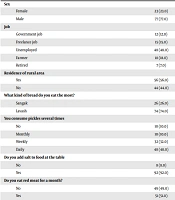
Naghipour A, Moghimbeigi A, Poorolajal J, Sadighi-Pashaki A. Investigating the Factors Related to Gastric Cancer with Conditional Logistic Regression Model: A Cross-Sectional-Retrospective Study. J Kermanshah Univ Med Sci. 2023;27(1):e133834. doi: https://doi.org/10.5812/jkums-133834
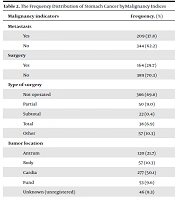
Rahimi M, Roshanaei G, Faradmal J, Ghaderi B, Moradi L. Stomach Cancer in Patients Referred to Tohid Hospital in Sanandaj, 2012 - 2018: An Epidemiological Study. J Arch Mil Med. 2021;9(1):e111506. doi: https://doi.org/10.5812/jamm.111506
Safaee A, Moghimi-Dehkordi B, Fatemi S, Ghiasi S, Pourhoseingholi M, et al. Clinicopathological Features of Gastric Cancer: A Study Based on Cancer Registry Data. Int J Cancer Manag. 2009;2(2):e80529. doi:
Shamsifar S, Sepahvand S, Rezapour S, Adeli M. Study of Risk Factors for Esophageal Cancer in Khorramabad City From 2012 - 2014. Jundishapur J Chronic Dis Care. 2016;5(2):e33229. doi: https://doi.org/10.17795/jjcdc-33229
Karimi Rouzbahani A, Mahmoudvand G, Shahmoradi MK, Amraei M, Beiranvand M. Refining Risk Factors for Colorectal Cancer in Patients Presenting with Gastrointestinal Complaints: A Cross-Sectional Study. Zahedan J Res Med Sci. 2024;26(1):e133328. doi: https://doi.org/10.5812/zjrms-133328
Last Update: 1 month ago
Last Update: 1 month ago
Last Update: 1 month ago
Last Update: 6 days ago
Last Update: 2 days ago
Last Update: 4 days ago
