
Fulltext
Full-text is available in PDF format.
Journal of Nursing and Midwifery Sciences
The Official Journal of Mazandaran University of Medical Sciences
Authors
Background and Purpose: Self-medication is a global medical issue, the rate of which has been reported to be on the rise in recent
years. This study aimed to evaluate the prevalence rate of self-medication and the associated factors among the university students of
Ahvaz city, Iran.
Materials and Methods: This cross-sectional study was conducted at Jundishapur and Shahid Chamran universities of Ahvaz, Iran
in 2015. In total, 680 university students were selected from 16 different medical and non-medical schools to participate in this study.
Using the easy sampling method, 45 students were selected from each school. Data collection tools included the socio-demographic
questionnaire and a researcher-made questionnaires consisting of 12 items to evaluate self-medication. Data analysis was performed in
SPSS V.20 using descriptive statistics (mean and standard deviation), independent T-test, and Chi-square test.
Results: In this study, prevalence rate of self-medication among the selected university students was 81.6%. The most frequent
medicines used by the students were adult cold (69.05%), analgesics (48.23%), and antibiotics (31.02%). Moreover, preventive factors
of self-medication among the subjects included family and friends (96.32%), lack of belief in the effectiveness of self-medication
(93.82%), and fear of the complications associated with self-medication (88.97%).
Conclusion: According to the results of this study, university students had a positive attitude toward self-medication. Therefore, it
is recommended that the knowledge and attitude of these individuals be promoted through the implementation of related training
programs in order to reduce public tendency toward self-medication.
2022 Journal of Nursing and Midwifery Sciences. This work is licensed under a Creative Commons Attribution-NonCommercial 3.0 Unported License which allows users to read, copy, distribute and make derivative works for non-commercial purposes from the material, as long as the author of the original work is cited properly. https://jnms.mazums.ac.ir/ https://wiki.creativecommons.org/wiki/License_Versions
Asefzadeh S, Anbarloei M, Habibi S, Rezaei M. Self-medication among the in-patients of Qazvin teaching hospitals. J Inflamm Dis. 2024;5(4):e154849. doi:
Baghianimoghadam M, Ehrampoush M. Evaluation of attitude and practice of students of Yazd University of Medical Sciences to self-medication.. Zahedan J Res Med Sci. 2006;8(2):e94904. doi:
Mohammadi N, Dehghani M, Emad S, Dehghani Z, Abedi S, et al. Prevalence of Self-Medication with Analgesics Among People Referring to Outpatient Dental Clinics in an Iranian Population. Int J High Risk Behav Addict. 2019;8(3):e89423. doi: https://doi.org/10.5812/ijhrba.89423
Vahedi S, Jalali FS, Bayati M, Delavari S. Predictors of Self-medication in Iran: A Notional Survey Study. Iran J Pharm Res. 2021;20(1):e124479. doi: https://doi.org/10.22037/ijpr.2020.113601.14394
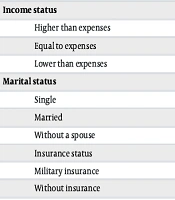
Farhad-Mollashahi N, Payandeh A, Kazemi F. Patients' Attitude and Behavior Toward Antibiotic Self-medication for Toothache. Int J High Risk Behav Addict. 2026;15(2):e170404. doi: https://doi.org/10.5812/ijhrba-170404
More by these authors
Last Update: 4 days ago
Last Update: 4 days ago
Last Update: 4 days ago
Last Update: 6 days ago
Last Update: 2 days ago
Last Update: 4 days ago