
1. Background
Self-medication is a growing public health problem defined as the “Use of a product without prescription or medical consultation to prevent or treat a disease, reduce symptoms, and promote health” (1). Information sources for self-medication vary widely from pharmacists, relatives, friends, and media to traditional practitioners and people’s own knowledge and experience (2).
The prevalence of self-medication varies from place to place depending on the study population and the age group under consideration (3-6). Numerous studies have reported that self-medication is a common behavior in both developed and developing countries (7, 8). For instance, in European countries, the frequency of self-medication for general health issues was observed to be 68% - 78% (9), while it was 80% - 94.5% in Asian countries, such as Saudi Arabia, Kuwait, Pakistan, and Bahrain (10-13), and 80% - 100% in African countries such as Cameroon, Nigeria, and Egypt (14, 15). Furthermore, the prevalence of self-medication in Iran is estimated to be three times the world average, with an estimate of 83.3% (16, 17).
Shifting toward self-diagnosis and medication instead of seeking proper professional healthcare advise is directly linked to the lack of time, money, or accessibility of healthcare services, as well as religious or cultural beliefs and prior treatment for a similar condition (15, 18). Such behavior results in harmful events, such as drug interaction, toxicity, and bacterial resistance, which are caused primarily by poor diagnosis, inappropriate indication, and overdose (19).
A headache, cough, fever, and pain are the most common consequences of practicing self-medication (10, 20). In dentistry, the chief complaint is a toothache, which is the most common reason for self-medication (18, 21). Analgesics are among medications most frequently used in self-medication (22). Despite the frequently unsupervised use of over-the-counter (OTC) analgesics, side effects are less often reported (23). Nevertheless, these analgesics are not completely risk-free. They are only safe when used according to current guidelines (24) and a patient with a painful toothache might not properly follow the guidelines.
Several cases have been documented on analgesic overdose in patients frequenting a dental emergency service (25-27). In a study, the main cause of the visit (66%) to a dental emergency service was a pain, whereby an overwhelming majority (89%) had been experiencing pain for over a week prior to seeking treatment (28).
2. Objectives
Among developing countries, Iran is the host of highly prevalent self-medication (83.3%) (16). To the best of our knowledge, no research has evaluated this issue with analgesics for dental purposes. Hence, the objective of the present study was to determine the prevalence of self-medication with analgesics for dental problems over a two-year period among a population in Shiraz, Iran.
3. Patients and Methods
This cross-sectional study was conducted between January 2016 and February 2018. The study protocol was approved by the local Ethics Committee of Shiraz University of Medical Sciences (IR.SUMS.REC. 1397.S49). The sample size was calculated to be 984 individuals, based on the expected prevalence of self-medication (80%) with an accuracy of d = 2.5% and an error of 0.05. However, so as to augment the accuracy and validity of the study, the number of participants was increased by 20% - 25%. Finally, 1,203 individuals were entered into the study.
For sampling, in the first step, 10 crowded districts of the city were considered on a map. Then, for two months, one day of each week (for eight weeks) was randomly selected. Finally, individuals in these districts that were satisfied were chosen by convenience sampling to fill out the questionnaires.
The study population was randomly selected among men and women older than 12 attending out-patient health clinics in 10 districts of Shiraz. Their education level and demographic information were recorded. The exclusion criteria included subjects who were illiterate, subjects who were mentally disabled to give valid responses to questions, subjects not willing to participate, and subjects who were physicians, dentists, or pharmacists.
This survey was carried out with a single-page questionnaire validated by four specialists including a dentist, a psychiatrist, a pharmacist, and a questionnaire advisor. Before beginning the data collection, the reliability of the questionnaire was assessed through pretesting a small group of 38 patients. Cronbach’s Alpha of 0.851 was obtained that showed an acceptable level of reliability. Subjects were informed that they were part of an investigation and their personal information would remain confidential. Privacy and confidentiality were completely protected; that is, no identifier or information associated with names or IDs was collected. Incompletely questionnaires were excluded from the study.
The questionnaire comprised four major parts, with the first part dealing with such demographic information as age, gender, education, marital status, and salary. The second part dealt with issues revolving around health status, including questions about smoking, frequency of physical exercise, and routine medical checkups. In the third part, patients were asked about analgesics taken in the case of a toothache (whether it was prescribed or self-prescribed), maximum dosage of analgesics, and its duration. The final section was about the side effects of analgesics.
Data were analyzed using SPSS version 22 software (SPSS Inc., Chicago, IL, USA). Data were reported as means ± standard deviation (SD) for quantitative variables and frequency (and percentage) for qualitative variables. The chi-square test was used to assess the data. In all statistical analyses, the values of P < 0.05 were considered significant.
4. Results
A total number of 1,203 participants completed the questionnaires, consisting of 491 (40.8%) men and 712 (59.2%) women. The average age of the participants was 36.2 years; 71.5% were married while 28.5% were single. The education level of the majority of the participants (53.5%) was high school or less, while 46.5% had academic degrees. The average monthly income of 73.1% of the participants was less than 550$, while 26.9% earned more than 550$. Descriptive statistics for the demographic and health-related variables are displayed in Table 1.
Table 1.
Description of Demographic and Health-Related Characteristics of Participants
| Variable | No. (%) |
|---|---|
| Gender | |
| Male | 491 (40.8) |
| Female | 712 (59.2) |
| Marital status | |
| Married | 835 (71.5) |
| Single | 333 (28.5) |
| Education | |
| Under diploma | 238 (19.8) |
| Diploma | 405 (33.7) |
| Academic degrees | 560 (46.5) |
| Salary, $ | |
| ≤ 550 | 818 (73.1) |
| > 550 | 301 (26.9) |
| Smoking | |
| Yes | 107 (9.1) |
| No | 1074 (90.9) |
| Routine exercise | |
| Yes | 565 (47.7) |
| No | 620 (52.3) |
| Routine medical checkups | |
| Yes | 616 (51.8) |
| No | 574 (48.2) |
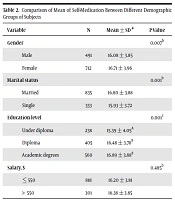
Due to dental complaints, 56.1% of the participants had taken self-prescribed analgesics. Women (57.7%) were found to practice self-medication more than men (53.8%). A statistically significant association was observed between self-medication and age (r = 0.1, P = 0.001). Table 2 shows the participants’ socio-demographic information considering prevalence of self-medication.
Table 2.
Comparison of Mean of Self-Medication Prevalence Between Different Demographic Groups of Subjects
| Variable | N | Self-Medication (%) | P Valuea |
|---|---|---|---|
| Gender | 0.174 | ||
| Male | 491 | 264 (53.8) | |
| Female | 712 | 411 (57.7) | |
| Marital status | 0.186 | ||
| Married | 835 | 479 (57.4) | |
| Single | 333 | 196 (53.3) | |
| Education level | 0.652 | ||
| Under diploma | 238 | 128 (53.8) | |
| Diploma | 405 | 233 (57.5) | |
| Academic degrees | 560 | 314 (56.1) | |
| Salary, Rls | 0.016 | ||
| ≤ 20.000.000 | 818 | 477 (58.3) | |
| > 20.000.000 | 301 | 161 (53.5) |
aChi-square test
The relationship between health information and self-medication is shown in Table 3, where this behavior was significantly lower in non-smokers (P < 0.05) and those who routinely exercised (P < 0.05).
Table 3.
Comparison of the Mean of Self-Medication Prevalence Between Groups of Health-Related Variables
| Variable | N | Self-Medication (%) | P Valuea |
|---|---|---|---|
| Smoking | 0.016 | ||
| Yes | 107 | 72 (67.3) | |
| No | 1074 | 593 (55.2) | |
| Routine exercise | 0.010 | ||
| Yes | 565 | 295 (52.2) | |
| No | 620 | 380 (59.6) | |
| Routine medical checkups | 0.673 | ||
| Yes | 616 | 342 (55.5) | |
| No | 574 | 333 (56.7) |
aChi square test
Table 4 shows the association between gender and behavior regarding analgesics consumption. Based on the statistical analysis, 58% of the participants were aware of the time interval of analgesics and men were significantly more aware than women (P = 0.020). In this study, 54% of the subjects were unaware of the correct maximum daily dosage of analgesics and males were significantly more aware than females (P = 0.005). It was observed that 61% of the participants were unaware of the side effects of the excessive consumption of analgesics and men were significantly more aware of this issue than women (P = 0.029). It was also found that 45% of the participants recommended their prescribed analgesics to others and 94% were of the opinion that arbitrary use of analgesics is not harmful.
Table 4.
Association Between Gender and Awareness Regarding Analgesics Consumption
| Behavior | Positive Answer | P Valuea | ||
|---|---|---|---|---|
| Male (N = 491) | Female (N = 712) | Total | ||
| Awareness of the maximum daily dose of analgesics | 26.2% | 20.3% | 0.01 | |
| Awareness of the time interval between the consumption of two servings of analgesics | 23.6% | 18.4% | 0.03 | |
| Awareness of the risk of analgesics overuse | 21.4% | 17.6% | 0.02 | |
| Drug advice to friends and acquaintances | 18.6% | 26.4% | 0.07 | |
aChi-square test
Table 5 shows different reasons for practicing such behavior, with the main reasons being severe pain (35.3%), followed by having prior experience (15.9%). The main sources of analgesics recommendation were pharmacists (83.5%), followed by pharmacies without prescription (8.9%), home left medication (6.9%), and family or friend (0.8%).
Table 5.
Reasons for Taking Self-Medication
| Reasons | Percentage |
|---|---|
| Having severe pain | 35.3 |
| Having prior experience | 15.9 |
| High costs of dental visits | 13.5 |
| accessible non-prescribed medications | 10.6 |
| Satisfying previous self-medication | 10.6 |
| Not having access to dentists | 8.9 |
| Time taking dental visits | 8.4 |
| Not willing to pay for dental visits | 6.7 |
| Friends consultation | 6.6 |
| Ignoring the disease | 6.2 |
| Not trusting in non-medication treatments | 4.7 |
| Not to trust dentists | 4.7 |
| Believing that medications have no side-effects | 1.9 |
Table 6 shows the data on the use of Ibuprofen (Gelofen), Acetaminophen (Paracetamol), Corticosteroids, Mefenamic acid (Ponstel), and Novafen (Acetaminophen + Caffeine + Ibuprofen) where 51.1% used its alternative, and Acetaminophen. Other painkillers such as Mefenamic acid or Novafen were taken by 25.43% of the subjects, while 8% claimed that they would only practice self-medication under the supervision of a doctor.
Table 6.
Percentage of Medications Used for Self-Medication
| Drug | Percent |
|---|---|
| Ibuprofen | 29.42 |
| Acetaminophen | 21.61 |
| Corticosteroid | 14.96 |
| Others analgesics (Mefenamic acid, Novafen) | 25.43 |
| Not using any drug | 8 |
5. Discussion
Self-medication is an important part of daily self-care behavior and one of the vital issues under debate in healthcare systems (29). It includes the use of herbal or chemical medications, previously prescribed medicines for similar cases, extra medicine at home, or not taking medicine at all (16).
The present study was an attempt to study the prevalence and pattern of self-medication practices in dentistry. As far as we know, this was the first study to examine self-medication practices among dental patients referring to oral health outreach programs in Iran. The prevalence of self-medication in the case of dental problems was found to be as high as 56.1% in the city of Shiraz, which validates the global prevalence reported in the literature, including 80.6% in Nigeria (14), 80% in Saudi Arabia (21), and 67.8% in Cameroon (18). The reported difference concerning self-medication in different countries might be associated with the variation in socioeconomic profiles and demographic characteristics of the samples.
The drugs most frequently consumed by participants were analgesics (77%), followed by antibiotics (22%); this finding is in line with the results of studies conducted in India (48%) (15) and Cameroon (40.9%) (18). The high consumption of the above-mentioned medications might be related to the fact that these medications are considered as OTC drugs and are easily accessible. Moreover, a prior experience might entail the increased request for self-medication.
In the present study, self-medication was more frequent among women than among men, which is consistent with other studies (12, 17, 30). This might be due to the lower threshold for pain in females and higher fear of dental treatments among them (17). It is also worth noting that the majority of females belonged to lower-income groups and were more likely to be unemployed.
This study further revealed that dental pain (35.3%) was the main incentive for self-medication, followed by having prior experience and taking previously prescribed medication, which is in agreement with the findings of studies from Indian (52%) (15) and Cameroonian (54%) (18).
According to Table 5, pharmacies were found to be the main source for medication (83.5%), which is similar to previous studies from Saudi Arabia (93.6%) (21), India (86%) (15), Cameroon (55.6%) (18), and Brazil (45.7%) (31).
It was further observed that self-medication was more frequent among married respondents, which accounted for more than half of the respondents (71.5%). The prevalence of self-medication in Shiraz, Iran, was higher than that in Spain (18.1%) (32), the United States (23.6%) (33), and Jordan (42.5%) (34). The results of the present survey indicate that oral self-medication is a common experience in the general population. Compared to similar studies, the prevalence of self-medication in our study was lower than that in studies from Palestine (87%) (35) and Chile (75%) (36).
Analgesics (particularly OTC drugs and non-opioids) are among the most frequently used medications globally (22, 23). Despite the relatively low risk associated with most OTC over-the-counter analgesics, potential deleterious side effects can still be observed (26, 37, 38).
With 50% of the study population taking these types of medications, 400 mg Ibuprofen (Gelofen 400) and 325 mg Acetaminophen were the most commonly used medications in the present study, which is in line with a study in Saudi Arabia (21) where 55.4% of the subjects took analgesics. The difference between the present study and the foregoing study is that the latter study investigated the prevalence of self-medication in medical students while our study focused on a general population.
In dealing with their dental pain, 15% of the subjects used Corticosteroid while around 26% made the use of other painkillers such as Mefenamic acid.
It was observed that self-medication was significantly lower in those with a monthly income of higher than $550 per month. Also present study shows that non-smokers and those with routine physical exercise had significantly lower self-medication. It can, therefore, be assumed that people with lower self-medication are in better health condition.
In our study population, more than 94% of the participants held the idea that analgesics have no side-effects. Hence, it can be concluded that informing people about the side-effects of analgesics can preclude self-medication.
One of the limitations of the present study was the self-report questionnaire, which might question its overall reliability. Furthermore, despite the fact that this survey covered all the 10 districts of Shiraz, it was hospital-based and might not have included all social strata.
5.1. Conclusions
According to the results of this study, the prevalence of arbitrary use of analgesics in Shiraz is high. These results show the need for the public to be more aware of the risks of self-medication.