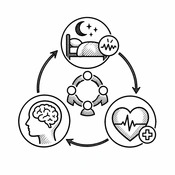

Cover image of the article: The Vital Connection Between Sleep Quality, Mental Health, and Clinical Outcomes (AI-generated illustration)

Image Credit:AI-generated illustration

The Vital Connection Between Sleep Quality, Mental Health, and Clinical Outcomes

Authors

Mehran ZarghamiMehran Zarghami ORCID1, 2, Javad SetarehJavad Setareh ORCID1,*
How to Cite:Zarghami M, Setareh J. The Vital Connection Between Sleep Quality, Mental Health, and Clinical Outcomes. J Nurs Midwifery Sci. 2026;13(4):e175813. doi: https://doi.org/10.5812/jnms-175813

Dear Editor,
We read with great interest the recent articles published in the Journal of Nursing and Midwifery Sciences. Of the 15 articles published in this journal with the word "sleep" in the title, four were published in 2026, highlighting growing interest in sleep health among various vulnerable populations (1-5). From a psychiatric perspective, we commend the journal for prioritizing sleep quality, a multidimensional construct that serves as both a physiological vital sign and a fundamental pillar of psychological resilience and overall clinical prognosis.
Sleep disorders are transdiagnostic phenomena closely linked to psychiatric and other medical conditions. Emerging evidence demonstrates that targeted nonpharmacological and nursing interventions can significantly alter the course of recovery. For instance, mindfulness-based counseling has been shown to reduce psychological distress and improve sleep quality among pregnant women recovering from COVID-19 (1). Similarly, complementary interventions such as foot reflexology have shown benefits for female students in demanding academic and clinical environments (2).
Furthermore, sleep health has direct implications for high-acuity and chronic care settings. The association between sleep health, perceived stress, and mental vigilance among coronary care unit nurses highlights an occupational vulnerability that directly compromises patient safety and staff well-being (3). In chronic conditions such as chronic obstructive pulmonary disease and end-stage renal disease, nurse-led combined pulmonary rehabilitation and the management of uremia-induced sleep disorders are vital. Integrating sleep optimization into hemodialysis and pulmonary care significantly enhances patients' health-related quality of life (4, 5, 6).
Understanding the cognitive and behavioral factors that influence sleep problems is essential for accurately assessing sleep disorders and designing targeted interventions in clinical and research settings. Validated psychometric instruments can complement clinical assessments by identifying these potentially modifiable factors. In research conducted in Iran, validated instruments such as the Persian version of the Sleep Hygiene Index (7) and the Dysfunctional Beliefs and Attitudes about Sleep-10 scale for clinical populations (8) have provided researchers and clinicians with reliable measures for examining maladaptive sleep-related behaviors and cognitions associated with insomnia.
These instruments should complement, rather than replace, clinical assessment and the diagnosis of sleep disorders. Future studies should look beyond sleep quality alone by identifying the factors underlying these disorders and, where appropriate, using objective sleep measures. Closer collaboration among nursing researchers, psychiatrists, and sleep specialists, together with integrated multidisciplinary approaches to sleep health, may lead to more targeted interventions and outcomes of greater clinical significance.

Footnotes

  • AI Use Disclosure:The authors utilized GPT-6 and GPT 6-1 (OpenAI) to improve the readability and clarity of the manuscript. After the use of these tools, the authors reviewed and edited the content as needed and take full responsibility for the content of the publication.

  • Authors' Contribution:Study Concept and Design: M. Z. and J. S.; Manuscript Drafting: M. Z.; Critical Revision for Important Intellectual Content: J. S.; Both authors read and approved the final manuscript.

  • Conflict of Interests Statement:The authors declare no conflicts of interest for this study.

  • Funding/Support:No funding was received for this study.

References

  • 1.
    Shahriary N, Mohsenzadeh Ledari F, Omidvar S, Azizi A, Gholinia Ahangar H. The effect of mindfulness-based counseling on sleep quality women with a history of COVID-19 in pregnancy. J Nurs Midwifery Sci. 2024;11(3):e150427. https://doi.org/10.5812/jnms-150427.
  • 2.
    Salus M, Nolvak K, Hansschmidt G. The effect of foot reflexology on sleep quality among female health sciences university students: An experimental study. J Nurs Midwifery Sci. 2026;13(2):e169882. https://doi.org/10.5812/jnms-169882.
  • 3.
    Bigdeli K, Valiee S, Zandkarimi E, Vatandost S. The association of sleep health and perceived stress with subjective vigilance among adult critical care unit nurses. J Nurs Midwifery Sci. 2026;13(2):e169350. https://doi.org/10.5812/jnms-169350.
  • 4.
    Ramezani F, Hosseinabadi Farahani MJ, Arsalani N, Vahedi M. The effect of a nurse-led hybrid pulmonary rehabilitation program on sleep quality in patients with chronic obstructive pulmonary disease: A randomized controlled trial. J Nurs Midwifery Sci. 2026;13(3):e169262. https://doi.org/10.5812/jnms-169262.
  • 5.
    Bouya S, Damani M, Moulaei N, Dahmardeh H. The relationship between sleep quality and quality of life in hemodialysis patients: A cross-sectional correlational study. J Nurs Midwifery Sci. 2026;13(3):e168640. https://doi.org/10.5812/jnms-168640.
  • 6.
    Hydarinia Naieni Z, Nobahar M, Ghorbani R. The relationship between sleep quality in patients' undergoing hemodialysis at different therapeutic' shifts. Koomesh. 2016;18(1):42-50.
  • 7.
    Chehri A, Kiamanesh A, Ahadi H, Khazaie H. Psychometric properties of the Persian version of Sleep Hygiene Index in the general population. Iran J Psychiatry Behav Sci. 2016;10(3). [PubMed ID: 27822283]. [PubMed Central ID: PMC5097828]. https://doi.org/10.17795/ijpbs-5268.
  • 8.
    Doos Ali Vand H, Ahmadian Vargahan F, Birashk B, Habibi M, Sadeghniiat Haghighi K, Fereidooni F. Validity and reliability of the Dysfunctional Beliefs and Attitudes about Sleep Scale-10 in Iranian clinical population. Iran J Psychiatry Behav Sci. 2018;12(2):e12288. https://doi.org/10.5812/ijpbs.12288.

Copyright

Copyright © 2026, Zarghami and Setareh. This open-access article is available under the Creative Commons Attribution 4.0 (CC BY 4.0) International License (https://creativecommons.org/licenses/by/4.0/), which allows for unrestricted use, distribution, and reproduction in any medium, provided that the original work is properly cited.

Similar Articles

1
Jan
2010
Sleep Disruption and its Correlation to Psychological Distress Among Medical Students

Sleep Disruption and its Correlation to Psychological Distress Among Medical Students

A Sahraian,
A Javadpour

Sahraian A, Javadpour A. Sleep Disruption and its Correlation to Psychological Distress Among Medical Students. Shiraz E-Med J. 2010;11(1):20378. doi:

5
Feb
2019
Sleep Quality as a Target for Improving Medication Adherence in Patients with Psychiatric Disorders

Sleep Quality as a Target for Improving Medication Adherence in Patients with Psychiatric Disorders

Leeba Rezaie

Rezaie L. Sleep Quality as a Target for Improving Medication Adherence in Patients with Psychiatric Disorders. J Kermanshah Univ Med Sci. 2019;23(1):e88889. doi: https://doi.org/10.5812/jkums.88889

3
Mar
2020
The Relationship between Sleep Quality and Happiness in Men with Coronary Artery Disease

The Relationship between Sleep Quality and Happiness in Men with Coronary Artery Disease

Davoud Ezzati,
Naimeh Mashinchi Abbasi,
Hosein Namdar,
Naser Khezerloo,
Touraj Hashemi Nosrat Abad,
Ali Shiri
,et al.

Ezzati D, Mashinchi Abbasi N, Namdar H, Khezerloo N, Hashemi Nosrat Abad T, et al. The Relationship between Sleep Quality and Happiness in Men with Coronary Artery Disease. Int J Cardiovasc Pract. 2019;4(4):e130563. doi: https://doi.org/10.29252/ijcp-28143

4
May
2020
Sleep Debt Is Not Associated with Mental Health Among School-Age Adolescents: The Gravity of Short Sleep

Sleep Debt Is Not Associated with Mental Health Among School-Age Adolescents: The Gravity of Short Sleep

Seongmin Ro,
Jungmin Lee,
In Cheol Hwang

Ro S, Lee J, Hwang IC. Sleep Debt Is Not Associated with Mental Health Among School-Age Adolescents: The Gravity of Short Sleep. Inn J Pediatr. 2020;30(3):e101947. doi: https://doi.org/10.5812/ijp.101947

1
Apr
2012
Impact of Shift Work on General Health Status of Medical Residents

Impact of Shift Work on General Health Status of Medical Residents

A Javadpour

Javadpour A. Impact of Shift Work on General Health Status of Medical Residents. Shiraz E-Med J. 2012;13(2):20526. doi:

More by these authors

Mehran ZarghamiPubMedScholar
Javad SetarehPubMedScholar
Share
Cited by
Metrics