
1. Background
Telemedicine uses electronic communication, including real-time audio and video, to improve patient care by connecting health care providers and patients remotely (1). Pharmacist involvement in telemedicine began in the early 2000s (2) and has expanded to include the management of conditions such as hypertension (3), diabetes (4), and anticoagulation therapy (5). Virtual transplant pharmacotherapy clinics, referred to here as virtual clinics, are telemedicine-based services that allow pharmacists to provide care without requiring in-person visits. In transplant care, pharmacists conduct virtual consultations to review medications, identify and manage drug-related problems (DRPs), monitor treatment adherence, provide education, and manage adverse effects (6).
2. Objectives
This study evaluated the clinical and economic impact of transplant pharmacists’ interventions for solid organ transplant (SOT) candidates and recipients delivered through virtual and in-person pharmacotherapy clinics.
3. Methods
3.1. Study Design and Participants
This cross-sectional study was conducted at the virtual and in-person pharmacotherapy clinics of Imam Khomeini Hospital Complex, affiliated with Tehran University of Medical Sciences (TUMS). It assessed the real-world outcomes of pharmacist interventions during virtual consultations with SOT candidates and recipients using the TUMS video and audio system. Virtual clinic data were collected over three months (October–December 2024), whereas in-person data were collected over eight months (September 2024 - May 2025); both clinics were held one day per week. The clinic, led by a clinical pharmacist with 20 years of transplant experience, performed the following tasks: medical record review and remote interviews for medication reconciliation, adherence assessment, DRP identification and management (7), vaccination verification, therapeutic optimization recommendations, and individualized education on medications and vaccines (Appendix 1 in the Supplementary File). Adult SOT candidates or recipients (≥18 years of age) who attended either clinic during the study period, had at least one identified DRP, and provided written informed consent were eligible for inclusion.
3.2. Clinical Outcome Analysis
Transplant pharmacists systematically identified and resolved DRPs during consultations. All identified DRPs were categorized as either clinical medication-related problems or educational/informational medication-related issues. Only clinical DRPs with a plausible pharmacological or clinical mechanism that could directly result in an adverse drug event (ADE) were eligible for ADE-risk assessment. Educational or informational DRPs, including requests for drug information, disease-management advice, and general medication education, were excluded from the risk-matrix analysis because they did not represent independent ADE risk events. ADE risk was assessed using a validated risk matrix (8):
Probability was scored on a scale of 1 - 5, with scores informed by a literature review and consensus from a three-stage Delphi process involving four experts: a transplant physician with 15 years of experience, two clinical pharmacists, and one pharmacoeconomic observer. Panel members independently scored the probability and severity of ADEs associated with the identified DRPs, and disagreements were resolved through discussion and consensus (Table 1).
Table 1.
Probability and Severity Scores for Adverse Drug Events and the Risk Matrix for Drug-Related Problems a
| Adverse Drug Event Severity | Severity Score | Rare, 0% (Probability Score 1) | Unlikely, 1% (Probability Score 2) | Possible, 10% (Probability Score 3) | Likely, 40% (Probability Score 4) | Almost certain, 60% (Probability Score 5) |
|---|---|---|---|---|---|---|
| Catastrophic: death, multiple permanent injuries, or irreversible health effects | 5 | 5 | 10 | 15 | 20 | 25 |
| Major: severe injury resulting in long-term disability; increase in hospital stay of > 15 days | 4 | 4 | 8 | 12 | 16 | 20 |
| Moderate: injury requiring professional intervention; increase in hospital stay of 4 - 15 days | 3 | 3 | 6 | 9 | 12 | 15 |
| Minor: injury or illness requiring minor intervention; increase in hospital stay of 1 - 3 days | 2 | 2 | 4 | 6 | 8 | 10 |
| Negligible: minimal injury requiring no or minimal intervention or treatment | 1 | 1 | 2 | 3 | 4 | 5 |
a Probability definitions: Rare: probably never happens or recurs; Unlikely: not expected to happen or recur, but possible; Possible: may happen or recur occasionally; Likely: will probably happen or recur, but is not persistent; Almost certain: will undoubtedly happen or recur, possibly frequently. Risk bands, low risk, score 1 - 3; moderate risk, score 4 - 6; high risk, score 8 - 12; extreme risk, score 15 - 25. Abbreviations: ADE, adverse drug event; DRP, drug-related problem.
Severity was scored on a scale of 1 - 5 and focused on graft rejection, organ damage, and immunosuppressant toxicity or failure (Table 1).
The risk score was calculated as probability × severity and categorized as follows (Table 1):
Low, score 1 - 3: minor laboratory abnormalities.
Moderate, score 4 - 6: dose adjustment required.
High, score 8 - 12: hospitalization risk due to ADEs.
Extreme, score 15 - 25: graft loss, organ damage, or death.
This approach was used to prioritize clinically important DRPs, particularly those linked to infections, cardiovascular events, and hospitalization risk.
3.3. Economic Analysis
A partial cost-benefit analysis was conducted from a limited societal perspective. The analysis included direct medical costs borne by the health system and patients, as well as selected direct nonmedical costs borne by patients. Direct medical costs included pharmacist and clinic personnel time, vaccines and medication-related interventions, miscellaneous clinic costs as recorded in clinic costing records, and hospitalization costs for expected preventable ADEs. Direct nonmedical costs included avoided transportation, meal, and accommodation costs for virtual visits. Productivity losses, informal caregiver time, patient time valuation, long-term graft outcomes, mortality costs, and broader institutional overhead were not monetized because reliable local data were unavailable and were therefore reported as exclusions. Benefits consisted primarily of cost savings and cost avoidance.
Cost savings from medication optimization were calculated as follows:
(daily cost of discontinued/reduced medications) × (remaining days of the original prescription period).
Cost avoidance was estimated as follows:
a) Preventable ADEs = Σ (Number of DRPs × ADE probability tier [1%, 10%, 40%, 60%])
b) The calculation was applied only to DRPs with ≥ 10% ADE probability and ≥moderate severity, excluding rare/negligible cases in Table 1.
All costs were valued in 2024 Iranian rials and converted to United States dollars (USD) using the 2024 Central Bank exchange rate of 285,000 Iranian rials (IRR) per USD.
Hospital reference data were used to quantify clinical costs associated with transplant rejection. The mean hospitalization duration for rejection episodes was 4.6 days, with an average daily cost of $167.83. These values formed the basis for evaluating direct medical cost outcomes in the study population. Because ADE-specific hospitalization costs were unavailable in Iran, the average hospitalization cost per transplant-related admission was used as a proxy for the cost of a preventable ADE requiring hospitalization. This proxy was derived from institutional data on transplant-rejection admissions by multiplying the unrounded mean length of stay of approximately 4.625 days by an average daily hospitalization cost of USD 167.83, yielding USD 776.21 per admission. Transplant rejection was selected as the reference admission type because it is a clinically important and costly transplant-related complication that may be associated with medication-related problems, including immunosuppressant nonadherence, drug interactions, or inadequate therapeutic monitoring. This value was applied to the estimated number of preventable ADEs to calculate modeled ADE-related cost avoidance. The cost per encounter was $6.9 for virtual clinic visits and $3.7 for in-person visits. The benefit-to-cost ratio (BCR) was calculated as total benefits divided by intervention costs. Because the virtual-clinic setup cost was a one-time cost, the base-case analysis used the recurrent-cost BCR, excluding setup costs from the denominator. A conservative scenario allocated the entire one-time setup cost to the three-month observation period. The base-case virtual-clinic BCR was 11.12, and the conservative setup-inclusive BCR was 9.92.
3.4. Data Collection and Analysis
Clinical and economic data were prospectively collected using standardized forms and verified by two researchers. The data were analyzed in Excel 2013 using descriptive statistics and cost-benefit calculations. Vaccination rates before and after the pharmacist visit were compared using a paired-sample t-test separately within each clinic group. Because the study was not designed for direct comparative inference between clinic models, no between-group statistical comparisons were performed.
BCR robustness was evaluated using one-way sensitivity analysis (± 20%; tornado diagram), Monte Carlo simulation (10,000 iterations; normal cost and lognormal cost-avoidance distributions), and two-way deterministic analysis. Analyses were performed in Python, version 3.9, using NumPy, Pandas, and Matplotlib.
3.5. Ethical Approval
The study was approved by the TUMS Ethics Committee (IR.TUMS.TIPS.REC.1403.024) and conducted in accordance with the Declaration of Helsinki. All participants provided written informed consent, and their data were deidentified using unique codes.
4. Results
4.1. Demographic and Clinical Characteristics
A total of 232 patients (147 males and 85 females) received consultations. Their mean age was 50.28 ± 12.4 years, with dispersion expressed as the SD. Most participants were liver transplant candidates or recipients referred from the liver transplant clinic to the pharmacotherapy clinic.
4.2. Clinical Outcomes
A total of 22 virtual and 32 in-person sessions were conducted, each lasting approximately 45 minutes. Table 2 presents patient counts; the frequency and categories of DRPs and corresponding recommendations; cost analyses; and vaccination data for both settings. In both clinic models, postintervention follow-up showed marked improvements in vaccination coverage, with increased uptake of influenza, pneumococcal, tetanus, and hepatitis B vaccines compared with baseline (Table 2). However, 11 patients remained unvaccinated before transplantation because of nonadherence; 35 lacked pneumococcal vaccination; 41 lacked influenza vaccination because of shortages; 11 had hepatitis B infection; and 5 were nonadherent only to hepatitis B vaccination.
Table 2.
Normalized Economic and Clinical Estimates Accounting for Unequal Observation Periods a
| Characteristic | Virtual Clinic | In-person Clinic |
|---|---|---|
| Observation period (mo) | 3 | 8 |
| Total No. of patients | 82 | 150 |
| No. of post-transplant patients | 11 | 65 |
| No. of pre-transplant patients | 71 | 85 |
| Patients (mo) | 27.33 | 18.75 |
| Target organ | ||
| Liver | 82 | 140 |
| Others | 0 | 10 |
| No. of DRPs | 504 | 1103 |
| No. of recommendations | 674 | 1594 |
| DRPs/patient encounter | 6.15 | 7.35 |
| Recommendations/patient | 8.22 | 10.63 |
| DRPs/month | 168.00 | 137.88 |
| Cost savings/patient | $22.96 | $5.12 |
| Cost avoidance/patient | $372.59 | $504.45 |
| Total benefit/patient | $395.55 | $509.57 |
| Intervention cost/patient, setup included | $39.89 | $41.28 |
| BCR, setup included | 9.92 | 12.34 |
| BCR, setup excluded/recurrent-cost base | 11.12 | 12.31 |
| Types of DRPs, No. (%) | ||
| Preventive therapy required | 258 (51.1) | 291 (26.4) |
| Request for drug information | 86 (17.1) | 156 (14.2) |
| Request for disease management advice | 85 (16.8) | 156 (14.2) |
| High daily dose | 5 (1.0) | 70 (6.4) |
| Others | 70 (14) | 430 (39.0) |
| Types of recommendations, No. (%) | ||
| Initiate medication | 262 (39) | 415 (26) |
| Drug regimen education | 79 (11.7) | 165 (10.4) |
| Medication-adherence-promoting education | 79 (11.7) | 155 (9.7) |
| Adherence education | 75 (11.1) | 102 (6.4) |
| Others | 179 (26.5) | 757 (47.5) |
| Associated medications, No. (%) | ||
| Vaccines | 126 (72) | 319 (55) |
| Dietary supplements | 15 (8.5) | 85 (14.8) |
| Hypoglycemic agents | 8 (4.5) | 86 (15) |
| Antiplatelets and anticoagulants | 6 (3.5) | 13 (2.2) |
| Others | 20 (11.5) | 71 (13) |
| Physicians’ acceptance rate, (%) | 82 | 84 |
| Patients’ acceptance rate, (%) | 74 | 77 |
| Vaccination before vs after the pharmacist intervention | ||
| Influenza | 2 vs 23 (P < 0.001) | 3 vs 17 (P < 0.001) |
| Pneumococcal | 1 vs 26 (P < 0.001) | 0 vs 23 (P < 0.001) |
| Tetanus | 1 vs 26 (P < 0.001) | 5 vs 48 (P < 0.001) |
| Hepatitis B | 0 vs 18 (P < 0.001) | 6 vs 46 (P < 0.001) |
a The DRP-category denominators are 504 for the virtual clinic and 1,103 for the in-person clinic. The associated-medication categories contain 175 virtual-clinic entries and 574 in-person entries in total. Abbreviations: BCR, benefit-to-cost ratio; DRP, drug-related problem.
Of the 504 DRPs identified in the virtual clinic, 364 were educational or informational medication-related issues and were excluded from ADE-risk assessment. The remaining 140 were clinical DRPs with a plausible mechanism for an ADE and were included in the risk-matrix analysis. Among these 140 DRPs, 106 (75.7%) had an estimated progression probability of at least 10%. Using all 140 assessed DRPs as the denominator, 40 (28.6%) were classified as extreme risk; the proportions classified as high, moderate, and low risk were 63%, 5.4%, and 3%, respectively (Table 3).
Table 3.
Risk Matrix for Drug-Related Problems (DRPs) in the Virtual Clinic a
| ADE Severity | Severity Score | Rare, 0% (Score 1) b | Unlikely, 1% (Score 2) | Possible, 10% (Score 3) | Likely, 40% (Score 4) | Almost Certain, 60% (Score 5) | Total |
|---|---|---|---|---|---|---|---|
| Catastrophic | 5 | 26 | 26 (18.6) | ||||
| Major | 4 | 10 | 2 | 13 | 25 (17.9) | ||
| Moderate | 3 | 21 | 30 | 25 | 76 (54.2) | ||
| Minor | 2 | 4 | 4 | 1 | 9 (6.4) | ||
| Negligible b | 1 | 3 | 1 | 4 (2.9) | |||
| Total | 3 (2.1) | 31 (22.2) | 35 (25) | 33 (23.6) | 38 (27.1) | 140 (100) |
a Data are presented as the number of DRPs (%). Abbreviations: ADE, adverse drug event; DRP, drug-related problem.
b DRPs classified as low risk (scores 1 - 3) or moderate risk (scores 4 - 6) were excluded from the calculation of preventable ADEs.
Of the 1,103 DRPs identified in the in-person clinic, 695 were educational or informational medication-related issues and were excluded from ADE-risk assessment. The remaining 408 were clinical DRPs with a plausible mechanism for an ADE and were included in the risk-matrix analysis. Among these 408 DRPs, 281 (68.9%) had an estimated progression probability of at least 10%. Using all 408 assessed DRPs as the denominator, 128 (31.4%) were classified as extreme risk; the proportions classified as high, moderate, and low risk were 42.1%, 11.5%, and 15%, respectively (Table 4).
Table 4.
Risk Matrix for Drug-Related Problems (DRPs) in the In-Person Clinic a
| ADE Severity | Severity Score | Rare, 0% (Score 1) b | Unlikely, 1% (Score 2) | Possible, 10% (Score 3) | Likely, 40% (Score 4) | Almost Certain, 60% (Score 5) | Total |
|---|---|---|---|---|---|---|---|
| Catastrophic | 5 | 48 | 7 | 13 | 133 (32.6) | ||
| Major | 4 | 26 | 4 | 14 | 44 (10.8) | ||
| Moderate | 3 | 3 | 32 | 47 | 25 | 107 (26.2) | |
| Minor | 2 | 14 | 20 | 10 | 3 | 16 | 63 (15.4) |
| Negligible b | 1 | 16 | 26 | 5 | 4 | 10 | 61 (15) |
| Total | 30 (7.4) | 97 (23.8) | 73 (18) | 130 (31.8) | 78 (19) | 408 (100) |
a Data are presented as the number of DRPs (%). Abbreviations: ADE, adverse drug event; DRP, drug-related problem.
b DRPs classified as low risk (scores 1 - 3) or moderate risk (scores 4 - 6) were excluded from the calculation of preventable ADEs.
4.3. Cost Outcomes
In the virtual clinic, 17 medication adjustments generated savings of $142.84; in-person care involved 125 interventions and generated savings of $768.07. To address the unequal observation periods, activity and economic outcomes were normalized per month and per patient for descriptive reporting. The virtual clinic generated 168.0 DRPs/month and 224.7 recommendations/month, whereas the in-person clinic generated 137.9 DRPs/month and 199.3 recommendations/month. These values describe each clinic model separately and should not be interpreted as a direct between-group comparison. DRPs per patient were 6.15 in the virtual clinic and 7.35 in the in-person clinic. Cost avoidance per patient was $372.59 for the virtual clinic and $504.45 for the in-person clinic. The risk-matrix calculation yielded 39.36 expected preventable ADEs for the virtual clinic and 97.48 for the in-person clinic. Applying the average hospitalization cost per transplant-related admission of USD 776.21 as a proxy for the cost of a preventable ADE requiring hospitalization resulted in modeled cost avoidance of USD 30,552.43 in the virtual clinic and USD 75,666.94 in the in-person clinic. The virtual clinic's base-case recurrent-cost BCR was 11.12; when the one-time setup cost was fully allocated to the three-month observation period, the BCR was 9.92. The in-person clinic's base-case BCR was 12.31. Because the cohorts differed in several baseline and operational characteristics, these BCRs should be interpreted as separate descriptive estimates of economic value within each clinic model, rather than as evidence that one model was superior to the other (Table 1 in the Supplementary File). A detailed cost-input table reports unit costs, resource quantities, valuation sources, and inclusion/exclusion status for all direct medical costs, selected direct nonmedical costs, cost savings, and cost-avoidance inputs (Table 2 in the Supplementary File).
Nonmedical savings were also substantial in the virtual clinic. Among 82 patients, 52 Tehran residents saved $8.40 each in transportation costs; 17 patients living nearby saved $29.52 each in travel and meal costs; and 13 patients living farther away saved $61.65 each, including lodging costs. The virtual model also eliminated approximately 196 miles of travel and saved approximately 6 hours per visit.
4.4. Sensitivity Analysis
In the virtual clinic, one-way sensitivity analysis showed that cost avoidance had the greatest influence on the BCR: a 20% reduction led to a marked decrease in the BCR, whereas pharmacist and miscellaneous costs had minimal effects. The tornado diagram identified cost avoidance, medication/vaccine costs, and savings as key drivers of the BCR, highlighting the importance of ADE prevention.
In the virtual clinic, Monte Carlo simulation with 10,000 iterations, based on the recurrent-cost BCR of 11.12, yielded a BCR range of 8.32 - 14.91 (mean, 11.19; median, 11.13; 95% CI, 9.34 - 13.41), supporting the robustness of the base-case economic result (Figure 1C–D).
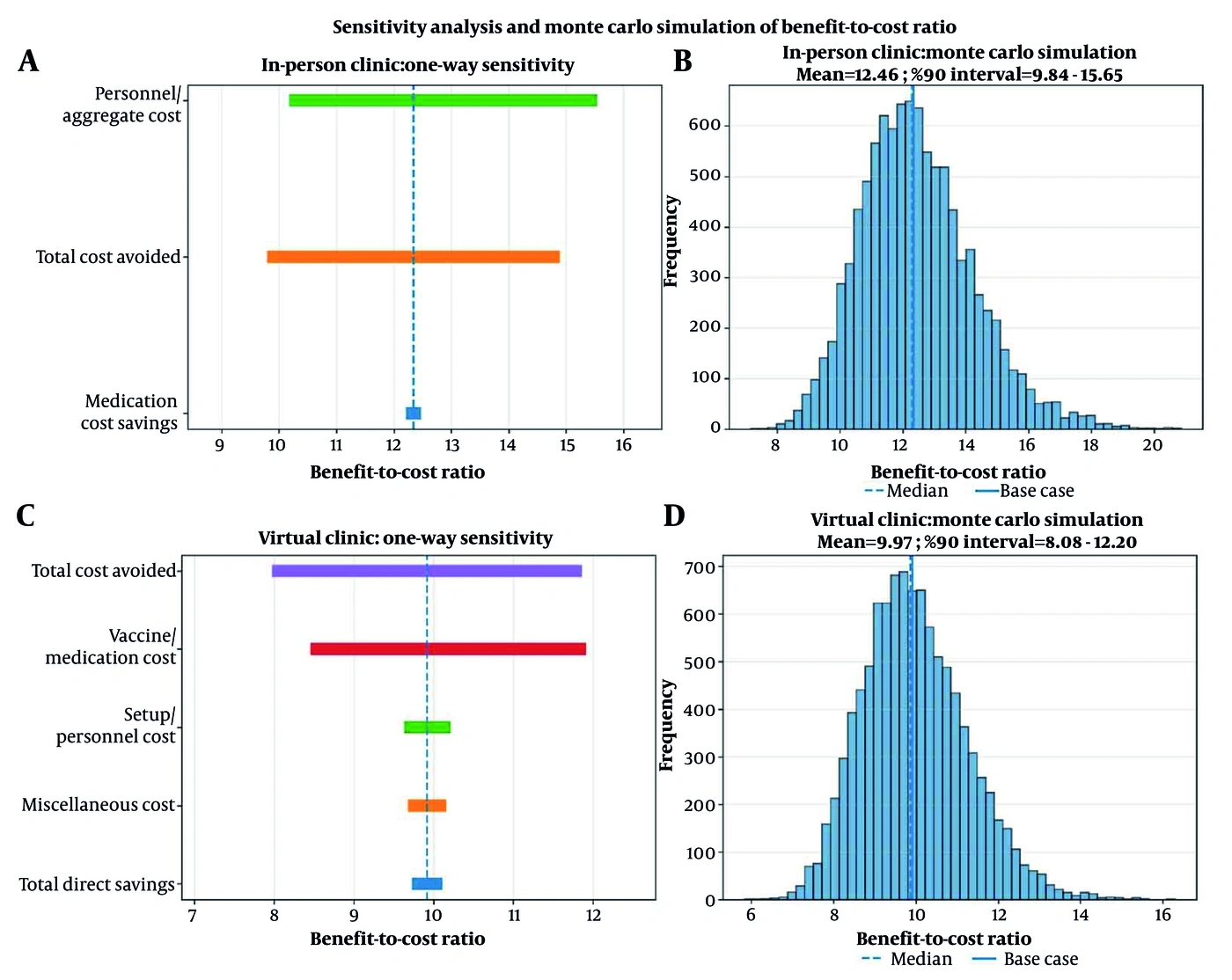
Figure 1.
Sensitivity analysis and Monte Carlo simulation of the benefit-to-cost ratio (BCR) for in-person and virtual pharmacotherapy clinics. A and B show analyses for the in-person clinic. A shows a tornado diagram of the effect of ± 20% variation in key cost parameters on the base-case BCR of 12.31 (dashed line). B shows the Monte Carlo simulation (10,000 iterations), with a mean BCR of 12.42, a 90% probability interval of 9.21 - 16.12, and all simulated BCRs exceeding 1. C and D show analyses for the virtual clinic. C shows a tornado diagram of the effect of ± 20% variation in key cost parameters on the base-case recurrent-cost BCR of 11.12 (dashed line), which excludes the one-time virtual-clinic setup cost. D shows the Monte Carlo simulation (10,000 iterations) based on this base case, with a mean BCR of 11.19, a median of 11.13, and a 95% CI of 9.34 - 13.41. For the virtual clinic, a conservative scenario allocating the one-time setup cost to the three-month observation period yielded a BCR of 9.92. The BCR is total monetized benefits divided by total intervention costs; a value greater than 1 indicates that estimated benefits exceeded intervention costs.
For the in-person clinic (BCR, 12.31), the results were most sensitive to total cost avoidance and personnel costs. A 20% increase in personnel costs reduced the BCR to 10.59, whereas a decrease in personnel costs increased it to 14.75. Monte Carlo simulation further supported the robustness of the result, yielding a mean BCR of 12.42, with all values > 1.0 and a 90% probability interval of 9.21 - 16.12 (Figure 1A–B).
5. Discussion
This study presents Iran’s first comprehensive evaluation of the clinical and economic outcomes of pharmacist-led virtual and in-person transplant pharmacotherapy clinics in SOT patients. Both models identified a high burden of clinically significant DRPs, many of which were associated with moderate-to-extreme ADE risk. Targeted interventions, including medication optimization, vaccination updates, supplement review, and glycemic control, addressed clinically important DRPs and were associated with improved vaccination coverage. The clinical and economic benefits related to ADEs were modeled estimates rather than directly observed outcomes. In this descriptive evaluation, the virtual model was associated with operational advantages, including reduced travel and time burdens and improved access for remote patients. Estimated avoidance of ADE-related hospitalization or graft compromise was based on modeled cost avoidance and should not be interpreted as a directly observed clinical advantage over in-person care. Sensitivity analyses indicated that the BCRs were robust to parameter variation and were largely driven by modeled cost avoidance associated with potentially preventable ADEs. These findings support the potential efficiency and sustainability of both clinic models in resource-limited settings, although the economic results should be interpreted as estimates rather than as observed savings from prevented events.
SOT recipients are highly vulnerable to infections because of chronic immunosuppression and require careful vaccination planning. They face elevated risks of influenza, pneumococcal disease, hepatitis B, and tetanus, while appropriate vaccination reduces the incidence and severity of these infections. Influenza is the most prevalent viral infection in transplant patients. Yeo et al. found that influenza vaccination among SOT recipients was associated with lower odds of influenza infection (OR 0.19, 95% CI 0.04 - 0.99) (9). Harboe et al. found that influenza vaccination was associated with reduced pneumonia admissions (P = 0.035) and mortality (P = 0.001) over 11,000 person-years among SOT recipients (10). The American Society of Transplantation recommends annual influenza vaccination for all SOT recipients, administered at least one month after transplantation (11).
Transplant recipients have an increased risk of invasive pneumococcal disease compared with the general population (12). Despite this risk, vaccination is underutilized. Canadian data show that programs involving the 23-valent pneumococcal polysaccharide vaccine (PPV23) and 7-valent pneumococcal conjugate vaccine (PCV7) reduced disease incidence by 43 - 90% in immunocompromised adults (13). These findings support guidelines recommending pneumococcal vaccination to prevent invasive and respiratory infections in transplant recipients (14).
Similarly, hepatitis B virus infection poses a major threat to graft and patient survival because of cirrhosis, hepatocellular carcinoma, and posttransplant complications (15). Pretransplant vaccination reduces infection risk, hepatitis B virus reactivation, and graft failure while improving outcomes (15). Guidelines recommend routine hepatitis B vaccination for all transplant candidates with chronic liver disease (16).
Tetanus vaccination is essential in immunocompromised patients because of the risk of severe outcomes. Patients with chronic liver disease or those undergoing transplantation are at increased risk because of immune dysregulation and perioperative exposure. The American Society of Transplantation recommends updating tetanus vaccination before major procedures (11).
Pharmacotherapy clinics also addressed the increasing use of supplements among transplant recipients. Although supplements are often used for health benefits, they may cause drug-herb interactions (17), immunomodulation (17), and toxicity from unregulated ingredients (18). These effects can alter immunosuppressant metabolism and increase the risk of rejection or immunosuppressive drug toxicity (17). We reviewed supplements, identified high-risk products, and discontinued those linked to rejection or uncertain benefit.
Blood glucose management was a major focus of these pharmacotherapy clinics. Hyperglycemia resulting from stress, corticosteroids, and immunosuppressants increases the risk of infection, graft dysfunction, and mortality (19). Our multidisciplinary approach, involving telemonitoring, education, and individualized pharmacotherapy, maintained patients’ glycemic control. Pharmacists adjusted metformin or discontinued it in patients with renal or hepatic impairment and initiated sodium-glucose cotransporter 2 inhibitors when appropriate (20). These interventions demonstrate the role of virtual clinics in metabolic management.
Vaccination management significantly reduced DRPs in SOT recipients at high risk of infection in both models. Pharmacist identification of vaccination gaps improved coverage and may reduce morbidity, hospitalization, and graft complications (14). Supplement review and glycemic control also addressed overlooked risks in transplant care.
Virtual clinics offer advantages over in-person care, including improved access and remote follow-up (21). Telemedicine reduces transportation, lodging, and productivity losses (22) and improves outcomes (23). Virtual care improves adherence, continuity, and satisfaction (24). Access to pharmacists enables timely dose adjustments and management of adverse effects (24). Reduced exposure to crowded environments lowers infection risk (25). The BCRs in this study are broadly consistent with previously reported ratios of 2.4 - 4.2 for pharmacist services in solid organ transplantation, which were also largely driven by modeled avoidance of hospitalization and graft-related complications (26).
The economic findings should be interpreted as descriptive real-world evidence rather than as evidence of the direct superiority of one model over the other. The virtual and in-person cohorts differed in observation period, patient volume, transplant status, and organ type, and the analysis was not designed to fully adjust for these differences. Nevertheless, the normalized results and sensitivity analyses indicated that each service model was associated with favorable economic value within its own cohort, primarily driven by modeled cost avoidance related to potentially preventable ADEs. These findings do not establish equivalence or superiority of either model.
The dominant contribution of cost avoidance is clinically plausible because high-risk DRPs in transplant patients may lead to hospitalization, graft injury, or rejection. However, these events were not prospectively tracked in this study; therefore, the reported cost avoidance represents an estimate of the potential economic burden averted through pharmacists’ identification and management of high-risk DRPs. Because ADE-specific and severity-specific hospitalization costs were unavailable locally, the average hospitalization cost per transplant-related admission was used as a proxy for the cost of a preventable ADE requiring hospitalization. This approach was necessary because no local study or administrative dataset identified the proportion of transplant-related admissions attributable to ADEs or provided ADE-specific cost estimates. Nevertheless, this proxy may not accurately reflect the cost of all ADEs: it may overestimate the cost of less severe ADEs that do not require hospitalization and underestimate the cost of major or catastrophic events requiring prolonged admission, intensive care, or additional procedures. Future studies should directly identify ADE-attributable hospitalizations and apply severity-specific cost estimates.
The virtual and in-person cohorts differed in transplant status, target organ type, observation period, calendar period, and patient volume. In addition, the study used a cross-sectional, nonrandomized design and did not perform between-group statistical comparisons or adjust for these differences. Therefore, the reported outcomes provide descriptive real-world evidence for each clinic model and do not support direct conclusions about comparative effectiveness, superiority, noninferiority, or equivalence between virtual and in-person care.
5.1. Limitations
Several limitations should be acknowledged. The cross-sectional design limits causal inference. Differences in observation periods between groups affect comparability. Service fees reflect local rates and may underestimate costs elsewhere. The single-center design limits generalizability and does not fully capture infrastructure costs. Future multicenter studies should assess hospitalization, graft outcomes, and mortality. Studies should also use patient-level longitudinal follow-up, severity-specific ADE costs, and broader societal-cost inputs, including productivity losses and caregiver time.
5.2. Conclusions
Pharmacist-led virtual and in-person transplant pharmacotherapy clinics each played an important role in identifying and resolving DRPs among SOT candidates and recipients and were associated with significant improvements in vaccination rates within their respective cohorts. By identifying and addressing high-risk DRPs and optimizing preventive care, these services provided preliminary evidence of potential clinical and economic benefits, including modeled cost avoidance associated with potentially preventable ADEs. Within the limitations of this single-center, cross-sectional study, integrating virtual clinics into transplant care pathways may represent a feasible and economically favorable complement to in-person pharmacotherapy services, particularly in resource-constrained settings. Longer-term, multicenter studies with larger samples, appropriate comparator groups, direct measurement of ADEs and hospitalizations, and patient-level longitudinal follow-up are needed to determine whether these benefits are sustained and to evaluate the clinical and economic impact of virtual transplant pharmacotherapy clinics more robustly.