
Dear editor,
On March 11, 2020, the World Health Organization announced COVID-19 as a global pandemic. Although the responsible virus, SARS-CoV-2, mainly involves the respiratory system, it affects other systems as well. Since the rapid diagnosis of patients is of imperative importance, researchers all around the world have dedicated precise attention to clinical, laboratory, and even pathological manifestations of this disease. The diagnosis of SARS-CoV-2 infection is generally confirmed by signs and symptoms, like fever, cough, dyspnea, fatigue, headache, gastrointestinal discomfort, and radiological and laboratory findings. Cutaneous manifestations are not among the most common findings, but there are a considerable amount of studies reporting skin manifestations in patients with COVID-19. For instance, in a study conducted in Italy, 20.4% of the patients (18 out of 88) showed cutaneous involvement, ten of whom developed the features after hospitalization (1).
- Acral cutaneous lesions: Mostly observed in patients with severe COVID-19, these lesions can result from the state of hypercoagulation and disseminated intravascular coagulation (DIC). This can be supported by concurrent laboratory findings of elevated levels of D-dimer and increased prothrombin time.
- Livedo and necrosis: A net-like discoloration in the skin in the form of bruise, visceral cyanosis, and dry gangrene, which suggest thrombotic vascular involvement when observed along with areas of truncal or acral ischemia. Possible accumulation of micro thromboses formed in the other organs can lead to transient livedo reticularis-like manifestations.
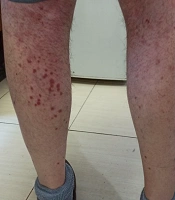
- Rash: A rash is an area of irritated or swollen skin, which can be seen with or without petechiae and purpura. Morbilliform rash, erythematous rash, chickenpox-like vesicles, localized pruritic lesions, urticarial rash, and petechial skin rash are the most common cutaneous manifestations. Skin rash can be a delayed presentation in COVID-19. Physicians should consider similar clinical representations, such as dengue fever, to prevent any misdiagnosis. Several other viral infections like measles and rubella can also develop common cutaneous lesions alongside fever and other general symptoms.
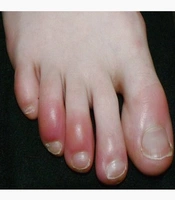
- Chilblain-like edematous and erythematous eruptions: With an asymmetric pattern, these eruptions are seen in children and younger adults with mild COVID-19. They vanish after general treatment without leaving any scars or permanent skin damages.
- Urticaria: Truncal, palmar, and dispersed patterns are reported, sometimes along with itching. Urticarial rash with fever is indicative of the early phase of COVID-19. There are reports of pruritic urticaria occurring after administration of Hydroxychloroquine and Azithromycin. These lesions are mostly related to complement activation and serum sickness induced by interactions of the immune system.
- Vesicular eruptions: A case-series from Italy reported 22 cases of COVID-19 with papulovesicular lesions. Independent from medication and underlying comorbidities, the authors claim the papulovesicular lesions are related to COVID-19, which may indicate the host response or direct viral damage to the skin's structure. Viral antigens are mostly detectable in various skin-related structures such as vesicles via different methods. Herpetiform lesions have also been discussed as a potential cutaneous indicator, mostly containing vesicles with an erythematous halo around them, observed in the trunk and back. Crust formation has also been reported in such cases.
- Erythema multiforme: As a less common manifestation, they are mostly seen in children with mild infection.
Many underlying mechanisms could contribute to developing cutaneous manifestations. For example, cutaneous manifestations can be a result of the administration of COVID-19 treatment protocols, leading to a variety of adverse effects. For example, usage of Hydroxychloroquine has been associated with the exacerbation in psoriasis patients as a result of an increase in the proliferation of keratinocytes. Urticarial and morbilliform eruptions are also noted in Azithromycin administration. Also, it is notable that there are reports of androgenic alopecia in patients with COVID-19, indicating a possible genetic involvement in the disease course (8). Therefore, taking a detailed past medical history and family history is crucial to prevent misdiagnosing and setting false relation between the skin manifestations and actual disease course. Skin manifestation could also appear as a result of accompanying syndromes of the infection. For example, the COVID-19-induced thrombocytopenia could lead to developing purpura and petechiae, and the disseminated intravascular coagulation (DIC) in patients admitted to the intensive care unit could result in ischemia and dry gangrene. On the other hand, this co-occurrence can be clinically beneficial; for instance, if COVID-19 patients with systemic occlusive vascular diseases are confirmed to develop livedoid eruptions, detecting these eruptions can play a prognostic role among with aid in the diagnosis of the disease (4).
Cutaneous findings do not play the chief role in the diagnosis of COVID-19, and for some cases, it is unknown whether they appear as a result of the primary skin infection, reactivation of viruses from other sites, or secondary to immune-related activities (9). However, the possible clinical applications of common skin manifestations could be of great assist in early diagnosis or evaluating the prognosis of patients. Measuring viral load before and after the cutaneous presentation and knowing the chronological order of these could provide diagnostic assistance in clinical practice. The active presence of dermatologists in COVID-19-related wards may accelerate the determination of the mentioned values. As the rapid diagnosis of COVID-19 impressively affects the prognosis of the patients, physicians should pay careful attention to clinical manifestations. More data on cutaneous findings of COVID-19 and their prevalence is required to determine whether they could be used as definitive and reliable diagnostic tools or not.