Journal of Semnan University of Medical Sciences
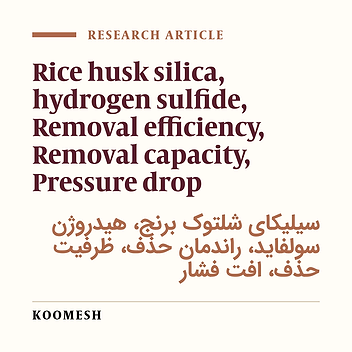
Investigation of the capability of regenerated rice husk silica to remove hydrogen sulfide pollution
Authors
Abstract
Introduction: The main goal of this study was to investigate the capability of regenerated rice husk silica after saturation to remove Hydrogen sulfide (H2S). For this purpose, rice husk silica and regenerated rice husk silica were used as adsorbents bed in filter. Material and Methods: A poly vinyl chloride filter with one liter of prepared bed was tested. Rice husk silica was prepared in a furnace at temperature of 800 ºC for Four hours, after acid leaching. Saturated rice husk silica was regenerated in a furnace at temperature of 800 ºC for Four hours too. Removal efficiency, elimination capacity, and pressure drop were the three parameters to evaluate the filters bed. System were operated with empty bed residence time of 60 s and different inlet concentration of H2S from 10 to 300 part per million (ppm). Results: More than 98% of removal efficiency was observed for both packed filters at inlet concentrations of H2S. The maximum elimination capacity was 7.02 gm-3h-1 with H2S mass loading rate of 9.0 gm-3h-1 in the both beds. This study showed that at a 1.0 lmin-1 flow rate and different concentration of inlet H2S. There is no significant difference between the rice husk silica and the regenerated rice husk silica beds in the amount of removal efficiency (p< 0.01). Also, there is no significant difference between these two beds in the amount of elimination capacity at the same condition (p< 0.01). Moreover, this study showed that the amount of pressure drop was undetectable (zero) in both filter’s bed. Conclusion: The results of this study showed the regenerated rice husk silica has the same performance of the primary rice husk silica, Therefore it can be considered as a suitable and inexpensive bed to remove H2S at low concentration.
Highlights
Copyright
© 2012, Author(s). This open-access article is available under the Creative Commons Attribution 4.0 (CC BY 4.0) International License (https://creativecommons.org/licenses/by/4.0/), which allows for unrestricted use, distribution, and reproduction in any medium, provided that the original work is properly cited.
Similar Articles
Replacement of lemon juice wastes instead of strong inorganic acids in production of silica from rice husk and efficiency of produced adsorbents in removal of cadmium from aqueous solutions
Rastgou T, Hassani AH, Moeinian K, Mehdinia SM. Replacement of lemon juice wastes instead of strong inorganic acids in production of silica from rice husk and efficiency of produced adsorbents in removal of cadmium from aqueous solutions. koomesh. 2016;18(3):e151127. doi:
Changes in pH and Bacterial Populations in Sewage Sludge and Mixture of Sewage Sludge With Rice Husk Silica to Remove H2S Pollution
Mehdinia SM, Abdul Latif PB. Changes in pH and Bacterial Populations in Sewage Sludge and Mixture of Sewage Sludge With Rice Husk Silica to Remove H2S Pollution. Middle East J Rehabil Health Stud. 2015;2(1):e25892. doi: https://doi.org/10.17795/mejrh-25892

Cadmium removability from aqueous solutions using TiO2 nano photocatalytic compound and rice husk silica
Nassehinia H, Mahmoodi A, Mehdinia SM. Cadmium removability from aqueous solutions using TiO2 nano photocatalytic compound and rice husk silica. koomesh. 2016;18(3):e151122. doi:
Determinants of natural zeolite clinoptilolite adsorption capacity for removing NO2
Mansouri N, Massoudinejad MR, Asilian H, Mafreshi A. Determinants of natural zeolite clinoptilolite adsorption capacity for removing NO2. J Kermanshah Univ Med Sci. 2010;14(3):e79472. doi:
Sodium Dodecyl Sulfate Modified-Zeolite as a Promising Adsorbent for the Removal of Natural Organic Matter From Aqueous Environments
Mahvi AH, Vosoughi M, Mohammadi MJ, Asadi A, Hashemzadeh B, et al. Sodium Dodecyl Sulfate Modified-Zeolite as a Promising Adsorbent for the Removal of Natural Organic Matter From Aqueous Environments. Health Scope. 2016;5(1):e29966. doi: https://doi.org/10.17795/jhealthscope-29966
More by these authors
- Scopus by DOI: 0
Last Update: 2 weeks ago
- Scopus by Title: 4
Last Update: 2 weeks ago
- Scopus by Title (Ref): 4
Last Update: 2 weeks ago
- CrossRef: 0
Last Update: 5 hours ago
- OpenAlex: 0
Last Update: 1 day ago
- OpenCitations: 0
Last Update: 5 days ago