Journal of Semnan University of Medical Sciences
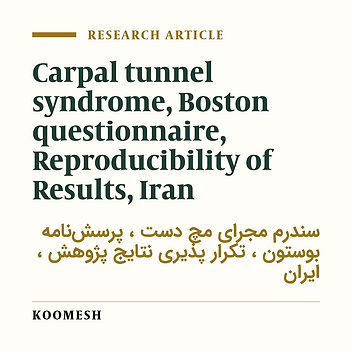
Validity and reliability of the Persian Boston questionnaire in Iranian patients with carpal tunnel syndrome
Authors
Abstract
Introduction: Using Boston questionnaire (BQ) is common to evaluate the severity and functional ability in patients with carpal tunnel syndrome (CTS). This study aimed to translate and adapt the Persian version of BQ for the assessment of the severity and investigation of its validity and reliability. Materials and Methods: BQ has two parts: first part with 11 questions evaluates the severity of symptoms (BQ-SS) and the other part with 8 questions evaluates the functional status (BQ-FS) of patients. After translation and preparing the Persian version of BQ by two translators, it has been re-translated to English and matched to the original. For content and construct validity evaluation, the opinions of 15 patients with CTS and 20 specialist medical doctors were used. They were asked to complete the final Persian version of BQ. To investigate the reliability, 45 CTS patients (age ranged 20-60 years old, 86 affected wrists) in two groups low-literate and literate, completed Persian BQ in two different sessions with at least 2 weeks interval for each affected hand. Results: Using Cronbach's alpha, showed excellent internal consistency for both literate (BQ-SS= 0.88, BQ-FS= 0.90) and low-literate (BQ-SS= 0.90, BQ-FS= 0.90) subjects. The intraclass correlation oefficients were also excellent in both literate (BQ-SS= 0.834, P
Highlights
Copyright
© 2014, Author(s). This open-access article is available under the Creative Commons Attribution 4.0 (CC BY 4.0) International License (https://creativecommons.org/licenses/by/4.0/), which allows for unrestricted use, distribution, and reproduction in any medium, provided that the original work is properly cited.
Similar Articles
Validity and Reliability of the Persian Translation of the Diagnostic Criteria for Temporomandibular Disorders Questionnaire
Soltani F, Mafi S, Jamshidy L, Rad M. Validity and Reliability of the Persian Translation of the Diagnostic Criteria for Temporomandibular Disorders Questionnaire. J Kermanshah Univ Med Sci. 2023;27(4):e140581. doi: https://doi.org/10.5812/jkums-140581
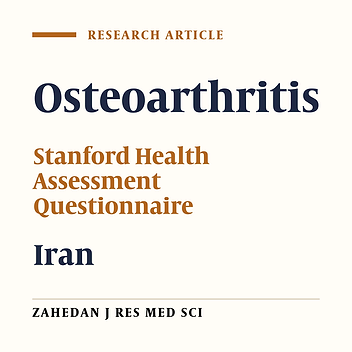
Measuring the Validity and Reliability of the Persian Version of Stanford Health Assessment Questionnaire in Iranian Patients with Osteoarthritis
Anvari F, Khalilian A, Ali Mohammadpour R, Mobini M. Measuring the Validity and Reliability of the Persian Version of Stanford Health Assessment Questionnaire in Iranian Patients with Osteoarthritis. Zahedan J Res Med Sci. 2014;16(9):. doi:
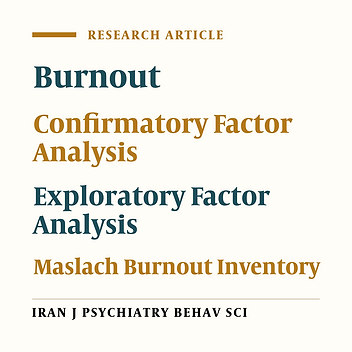
Validity and Reliability of the Persian Version of the Maslach Burnout Inventory (General Survey Version) in Iranian Population
Sepehri Shamloo Z, Hashemian SS, Khoshsima H, Shahverdi A, Khodadost M, et al. Validity and Reliability of the Persian Version of the Maslach Burnout Inventory (General Survey Version) in Iranian Population. Iran J Psychiatry Behav Sci. 2017;11(2):e8168. doi: https://doi.org/10.5812/ijpbs.8168
Factor Structure of Persian Translation of the Patient Health Questionnaire in Iranian Earthquake Survivors
Rafiey H, Alipour F, LeBeau R, Salimi Y, Ahmadi S. Factor Structure of Persian Translation of the Patient Health Questionnaire in Iranian Earthquake Survivors. Iran J Psychiatry Behav Sci. 2018;12(4):e59416. doi: https://doi.org/10.5812/ijpbs.59416
Psychometric Properties of Persian Version of the Amphetamine Withdrawal Questionnaire Version 2 (AWQV2) in Patients with Methamphetamine-Type Substance Use Disorder
Farnia V, Moradinazar M, Abdoli N, Alikhani M, Rezaei M, et al. Psychometric Properties of Persian Version of the Amphetamine Withdrawal Questionnaire Version 2 (AWQV2) in Patients with Methamphetamine-Type Substance Use Disorder. Iran J Psychiatry Behav Sci. 2020;14(4):e98260. doi: https://doi.org/10.5812/ijpbs.98260
- Scopus by DOI: 0
Last Update: 1 week ago
- Scopus by Title: 29
Last Update: 1 week ago
- Scopus by Title (Ref): 29
Last Update: 1 week ago
- CrossRef: 0
Last Update: 9 hours ago
- OpenAlex: 0
Last Update: 10 hours ago
- OpenCitations: 0
Last Update: 5 days ago