
1. Background
Temporomandibular joints, rodent muscles, and other tissues are involved in a complex clinical problem called temporomandibular joint disorders (TMD). The temporomandibular joint disorder is a painful oral and facial disease that causes clicking joints, muscle spasms, and discomfort around the temporomandibular joint, in addition to psychological stress, occlusal interference, oral parafunction, dysfunction of the masticatory muscles and surrounding tissues, degenerative joint disorders, or a combination of these for various reasons (1-3). There are no accurate statistics on the prevalence of these disorders in Iran, and rates reported vary from 18.7 to 51.5% of the country's population (4-6). In the absence of proper diagnosis and treatment, disorders of this joint can cause chronic pain, reduced working days, health care costs, and social and psychological effects (7). Recent research has also shown that TMD symptoms, especially pain, can exacerbate physical and mental damage and have a devastating impact on quality of life (8, 9). In addition, studies have indicated that TMD severity is associated with decreased oral health-related quality of life (OHRQL), making early detection of TMD cases significant (10).
Several evaluation methods have been developed, including questionnaires, clinical indicators, patient history indicators, and diagnostic criteria (11-16), such as the Helkimo Index (17), the American Academy of Oral and Facial Pain Questionnaire (AAOP) (12), and the Research Diagnostic Criteria for Temporomandibular Disorders (RDC/TMD) (14).
The RDC/TMD questionnaire developed in 1992 is one of the few measurement methods that provide an accurate and usable index for diagnosing TMD (18, 19). The most comprehensive version of the benchmark was published under the name DC/TMD in 2014 (20). Diagnostic Criteria for Temporomandibular Disorders is a guideline for assessing patients with temporomandibular joint disorders consisting of two axes, with axis I associated with clinical examinations of TMJ disorders. In contrast, axis II refers to social and psychological factors associated with TMD (20-22). Diagnostic Criteria for Temporomandibular Disorders passed rigorous tests in several languages for temporal disorders (TMDs) and intra-articular disorders, which are typical and associated with pain (6). An assessment from DC/TMD Axis I showed high levels of reliability and reliability for most diagnoses (23, 24). While reliability is concerned with the stability of the questionnaire over time, validity refers to how effectively the questionnaire evaluates what it is designed to measure (25). A standard technique called the DC/TMD Symptom Questionnaire is used to assess the symptoms of temporomandibular disorders (TMD) (20). Several studies have reported successful DC/TMD translation and validation in Spanish, Portuguese, French, German, Italian, Dutch, Turkish, Japanese, Korean, and others (22, 26-33). However, Farsi-speaking researchers cannot access the questionnaire since it has not yet been translated into Persian.
2. Objectives
This study was conducted by Kermanshah University of Medical Sciences' dentistry students to determine the accuracy and validity of the Persian translation of the DC/TMD Symptom Questionnaire.
3. Methods
A cross-sectional study was conducted at the Faculty of Dentistry in Kermanshah In April 2022 (Code of ethics: IR.KUMS.REC.1401.366).
The study population comprised all dental students who had completed the basic science course at the Faculty of Dentistry in Kermanshah. A sample of 150 students was selected using stratified random sampling with proportional allocation to each semester.
The DC/TMD Symptom Questionnaire consists of 12 items that assess the presence and severity of TMD symptoms, such as pain or discomfort in the jaw, face, or temple region, difficulty opening or closing the mouth, clicking, or popping sounds in the jaw joint and headaches (20).
A fluent English speaker performed the translation into Farsi, which was then adjusted by a group of specialists in orofacial pain, oral diseases, orthodontics, prosthodontics, biostatistics, and Persian language editing. The English translation of the Farsi translation was then contrasted with the original questionnaire using native English speakers' translating skills. A committee of experts evaluated each question's suitability using a four-point rating system. The content validity index (CVI) was 0.95, indicating acceptable content validity.
First, 30 students completed the questionnaire two weeks later. The same sample of 30 dentistry students answered the survey again to determine test-retest reliability. The agreement between the two sets of scores was assessed using the intraclass correlation coefficient (ICC). Cronbach's alpha coefficient was used to evaluate internal dependability.
Exploratory factor analysis, Bartlett’s tests, and the Kaiser-Meyer-Olkin (KMO) index were used to evaluate the construct validity (34). Correlations between variables were examined using Pearson correlation analysis, group comparisons were conducted using t-tests, and comparisons across multiple groups were assessed using ANOVA (35).
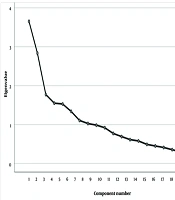
Scree Plot: This plot shows the eigenvalues for each extracted component. The largest eigenvalue starts at the top, thus indicating a descending plot.
4. Results
This study's content validity index (CVI) was 0.95, indicating good validity. A total of 30 students completed the questionnaire and then re-completed by the same students after three weeks. The reliability was relatively high since the intraclass correlation coefficient (ICC) was 0.98. About 150 students ultimately completed the questionnaire to determine construct validity.
The Kaiser-Meyer-Olkin (KMO) index was 0.62 for the entire questionnaire, indicating that the questions were acceptable. The KMO index is a number between 0 and 1 calculated for each question and the questionnaire. A value above 0.5 is acceptable for individual questions, and a value above 0.6 is acceptable for the entire questionnaire. Therefore, the questionnaire questions were acceptable and significant at a desirable level.
Additionally, Bartlett's test was significant (P = 0.0001), indicating the presence of a relationship between the questions in the questionnaire. Therefore, the data can be considered effective with a 95% confidence level, and the questionnaire has acceptable validity (Table 1).
Table 1.
Cronbach's Alpha by Question Groups
| 1 | Factor | Cronbach's Alpha |
|---|---|---|
| 2 | Questions 2, 3, 4 | 0.800 |
| 3 | Questions 1, 5, 6, 7 | 0.819 |
| 4 | Questions 8, 9, 10 | 0.525 |
| 5 | Questions 11 - 14 | 0.903 |
| 6 | All questions | 0.900 |
Based on this plot, the third point is the elbow point, but the fifth can also be considered the elbow point. Therefore, the questions are placed between factors 2 to 4.
Cronbach's alpha was calculated to determine the variables' internal consistency.
Based on the coefficients of all factors, they had a high level of internal consistency, except for questions 8, 9, and 10, which had a coefficient of 0.525, which was undesirable. Considering these questions and questions 11 to 14, the coefficient increased to 0.903. As the internal consistency of all questions (Cronbach's alpha = 0.90) was equal to or greater than the consistency of the factors, it can be concluded that the questionnaire is a unidimensional tool with high reliability. Therefore, all 18 questions are factorable and can be summed up in the analysis.
About 150 students aged 21 and 41, with a mean age of 26.54, participated in this study. The majority of the participants in the research (84, or 56%) were male, single (138, or 92%), and in their tenth semester (43, or 28.7%). There were an estimated 34% of pupils with TMD.
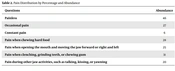
The results indicated that most patients were pain-free, with the highest pain level reported during tooth grinding. In contrast, the lowest pain level was reported during kissing, talking, and bending activities (Table 2).
Table 2.
Pain Distribution by Percentage and Abundance
| Questions | Abundance | Percent |
|---|---|---|
| Painless | 46 | 30.7 |
| Occasional pain | 27 | 18 |
| Constant pain | 6 | 4 |
| Pain when chewing hard food | 28 | 18.7 |
| Pain when opening the mouth and moving the jaw forward or right and left | 25 | 16.7 |
| Pain when clenching, grinding teeth, or chewing gum | 31 | 20.7 |
| Pain during other jaw activities, such as talking, kissing, or yawning | 20 | 13.3 |
5. Discussion
Temporomandibular joint disorders is a common jaw and face disease caused by various factors common in middle-aged and young people, which are characterized by discomfort, soreness, and TMJ dysfunction, making it difficult to chew, speak, and swallow (18). According to the current study, 34% of participants had TMD. A few more studies have shown prevalence rates much higher than 25 and 33%, but most earlier investigations estimated the prevalence of TMD to be between 5 and 12% in the general population (6).
This study aimed to translate and check the validity and reliability of the Persian translation of the standard DC/TMD questionnaire as a practical and valuable global tool in temporomandibular disorders.
The results of this study can help Persian language researchers of the temporomandibular area in extensive research and screening of large communities to investigate temporomandibular disorders so that these researchers can use this questionnaire as a practical tool for quick and effective screening of patients in large communities.
The DC/TMD is a comprehensive diagnostic tool, including Axis I and II components. DC/TMD Axis I is used to diagnose TMD based on clinical and imaging examinations. Axis I includes a standardized clinical examination protocol and a set of diagnostic criteria based on physical signs and symptoms. The clinical examination protocol includes the assessment of joint sounds, range of motion, and palpation of the masticatory muscles and TMJ. The diagnostic criteria include both specific and non-specific TMD diagnoses, such as disc displacement, osteoarthritis, myofascial pain, and headache attributed to TMD (20).
Temporomandibular joint disorders's psychological and behavioral aspects are evaluated using the DC/TMD Axis II. Axis II consists of several validated questionnaires that measure psychological distress, behavioral variables, and pain-related impairments probably associated with TMD symptoms. The Patient Health Questionnaire (PHQ), the Graded Chronic Pain Scale (GCPS), and the Oral Behaviors Checklist (OBC) are the questionnaires utilized in Axis II. The psychological and behavioral aspects that may influence TMD symptoms can be evaluated using the DC/TMD Axis II questionnaires. Anxiety, sadness, stress, and dental habits like grinding or clenching teeth can be contributing causes. The validated questionnaires used in Axis II provide valuable information that can aid in developing effective treatment strategies (20). Additionally, all Axis II instruments have been separated into separate documents, and demographic questions are placed in a separate document. This modular organization enhances flexibility in adapting the DC/TMD protocol to specific settings. For instance, one setting may use only the Axis II screening instruments, while another may utilize the complete Axis II instruments. Similarly, one setting might gather demographic information through an existing mandatory clinic registration form, while another may require a separate form for research purposes (20, 22).
The DC/TMD Symptom Questionnaire is part of Axis I of the DC/TMD to diagnose TMD based on clinical and imaging examinations. The DC/TMD Symptom Questionnaire is a tool developed to assess the presence and severity of TMD symptoms. The questionnaire consists of 12 items that assess the frequency and severity of pain, restricted jaw movement, and other TMD-related symptoms (20). According to the developer of the DC/TMD, the Patient History Questionnaire (PHQ) of the RDC/TMD has undergone a complete revision for the DC/TMD, resulting in its renaming as the Symptom Questionnaire (SQ) to differentiate it from the pre-existing PHQ-9 and PHQ-15 developed independently of the DC/TMD. There are several notable differences between the RDC/TMD PHQ and the DC/TMD SQ. Firstly, the DC/TMD SQ primarily focuses on Axis I diagnostic requirements (excluding the pain chronicity question). The TMD pain screener was initially designed as a stand-alone screening instrument suitable for various settings. The DC/TMD SQ now includes most of the TMD pain screener's scope, but there is a difference in the pain-related filter item between the two instruments. The TMD pain screener focuses on pain in the jaw or temple area to maximize specificity about other conditions that can cause TMD-like pain. In contrast, the DC/TMD SQ aims to be more inclusive and asks about pain in the jaw, temple, ear, or front of the ear, with confirmation through clinical examination. The potential impact of this difference in wording on the outcomes is yet to be determined empirically or logically. The DC/TMD SQ alone will suffice as the pain history collection instrument in many settings, rendering the TMD pain screener unnecessary. However, there may be settings where only the TMD pain screener is required. Translating both instruments is essential to provide a complete set of language instruments for all users in a particular language setting (20, 22).
The validity and reliability of the DC/TMD Symptom Questionnaire's Persian translation were evaluated in the current study using a dentistry sample. The Persian translation exhibited outstanding reliability (ICC coefficient of 0.98) and strong internal consistency (Cronbach's alpha value of 0.90 or higher). The content validity index (CVI) was 0.95, indicating satisfactory content validity.
The ability to translate the DC/TMD Symptom Questionnaire into different languages is important because it allows for standardized assessment of TMD symptoms across diverse populations and languages. This facilitates cross-cultural research and improves diagnostic accuracy, which can lead to better patient outcomes and quality of life. Furthermore, the availability of valid and reliable translated versions of the questionnaire allows for comparing TMD prevalence and severity across different and large populations, which can develop effective TMD treatment strategies.
5.1. Strengths and Limitations
As validated in the present study, the Persian translation of the DC/TMD Symptom Questionnaire is a valuable tool for assessing TMD symptoms in the Persian-speaking population. This questionnaire has been translated into Farsi for the first time, and researchers can utilize it as a screening tool in their studies. Additionally, clinicians can use it to assess patients' progress during treatment. It is crucial to remember that the DC/TMD SQ's validity and reliability should be evaluated among multiple groups and a broader population, and the questionnaire alone is insufficient for diagnosing TMD. A thorough clinical examination and diagnostic imaging are also necessary to ensure accurate diagnosis and treatment planning.
5.2. Conclusions
The Kaiser-Meyer-Olkin (KMO) index was 0.62 for the entire questionnaire, indicating that the questions were acceptable. The KMO index is a number between 0 and 1 calculated for each question and the questionnaire. A value above 0.5 is acceptable for individual questions, and a value above 0.6 is acceptable for the entire questionnaire. Therefore, the questionnaire questions were acceptable and significant at a desirable level.
Additionally, Bartlett's test was significant (P = 0.0001), indicating the presence of a relationship between the questions in the questionnaire. Therefore, the data has a 95% chance of being effective, and the questionnaire has acceptable validity (Table 1).
In addition, the Persian translation exhibited outstanding reliability (ICC coefficient of 0.98) and strong internal consistency (Cronbach's alpha value of 0.90 or higher). The content validity index (CVI) of 0.95 indicates satisfactory content validity.
Based on the results, the DC/TMD Symptom Questionnaire is a validated tool that can aid in assessing TMD symptoms. The availability of translated versions of the questionnaire allows for the standardized evaluation of TMD symptoms across different populations and languages, facilitating cross-cultural research and improving diagnostic accuracy. The Persian version of the questionnaire can be used in clinical settings for TMD diagnosis and evaluation in Persian-speaking populations. The study has important implications for clinical practice. Conducting further studies to assess the reliability and validity of the DC/TMD Symptom Questionnaire in different populations and larger groups would be beneficial.