Journal of Semnan University of Medical Sciences
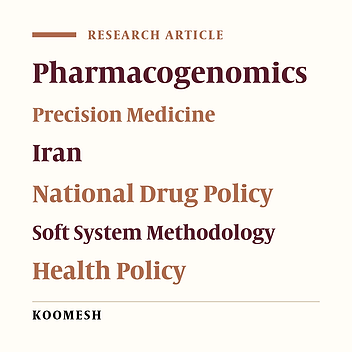
Image Credit:Koomesh
Outline
A Conceptual model on the pharmacogenomics implementation complications: An applied qualitative research based on national drug policy components
Authors
 , Abbas Kebriaeezadeh, Ali Rajabzadeh, Shekoufeh Nikfar,*
Abstract
Introduction: Pharmacogenomics may well have substantial effects on the clinical, economic and regulatory aspects of health sector which can lead to complications in access. Therefore, there is a need for evidence-based frameworks based on national drug policy components. The objective of the current study is to identify pharmacogenomics-based complications and develop a conceptual model. Materials and Methods: The current, is an applied-quantitative study using soft system methodology. The first step adopted scoping review with systematic-search to identify early-adopters experiences. The second used cognitive mapping technique with strategic options development and analysis method using expert panels to assess the relativeness of the challenges and evaluated influence with interpretive structural modeling. In addition, stakeholder mapping was conducted using semi-structured questioners. The third step is used to develop the conceptual model. Results: Systematic search acknowledged 82 studies for qualitative analysis on the challenges. The identified challenges, which were confirmed by the experts subsequently, were clinical trial protocols, clinical utility of tests and identifying biomarkers in the efficacy/safety component, pricing, coverage and economic assessment in the affordability component, regulations, availability and stakeholders management in the access component and education, guidelines, patient compliance, information technology, bench-to-bedside strategies and ethical/legal/social hazards in the rational use of medicine component. The most influential issue was biomarker validity. The main stakeholder, as the owner and customer, was identified to be the ministry of health. All the results were included in the complicated conceptual model. Conclusion: The current, was the first study identifying dynamic complications ahead of pharmacogenomics adoption, using soft system methodology. The results may be the basis of the first evidence-based policy on pharmacogenomics, in Iran and other developing countries.
Highlights
References
- 1.Ginsburg GS, McCarthy JJ. Personalized medicine: revolutionizing drug discovery and patient care. Trends Biotechnol 2001; 19: 491-496.
- 2.Johnson JA, Weitzel KW. Advancing pharmacogenomics as a component of precision medicine: how, where, and who? Clin Pharmacol Ther 2016; 99: 154-156.
- 3.Charlab R, Zhang L. Pharmacogenomics: historical perspective and current status. Methods Mol Biol 2013; 1015: 3-22.
- 4.Kasztura M, Richard A, Bempong NE, Loncar D, Flahault A. Cost-effectiveness of precision medicine: a scoping review. Int J Public Health 2019; 64: 1261-1271.
- 5.Plthner M, Ribbentrop D, Hartman J-P, Frank M. Cost-effectiveness of pharmacogenomic and pharmacogenetic test-guided personalized therapies: a systematic review of the approved active substances for personalized Mmedicine in Germany. Adv Ther 2016; 33: 1461-1480.
- 6.Tekola-Ayele F, Rotimi CN. Translational genomics in low- and middle-income countries: opportunities and challenges. Public Health Genom 2015; 18: 242-247.
- 7.Ghaddar F, Saba K, K Zgheib N. Teaching pharmacogenetics in low and middle income countries (LMICS): an empirical study of the lessons learned. Curr Pharmacogenomics Per Med 2012; 10: 217-225.
- 8.Pang T. Pharmacogenomics and personalized medicine for the developing world - Too soon or just-in-time? A personal view from the World Health Organization. Curr Pharmacogenomics Per Med 2009; 7: 149-157.
- 9.Patrinos GP, Pasparakis E, Koiliari E, Pereira AC, Hnemeier T, Pereira LV, et al. Roadmap for establishing large-scale genomic medicine initiatives in low- and middle-income countries. Am J Hum Genet 2020; 107: 589-595.
- 10.Mitropoulos K, Al Jaibeji H, Forero DA, Laissue P, Wonkam A, Lopez-Correa C, et al. Success stories in genomic medicine from resource-limited countries. Hum Genom 2015; 9: 11.
- 11.Chong HY, Allotey PA, Chaiyakunapruk N. Current landscape of personalized medicine adoption and implementation in Southeast Asia. BMC Genom 2018; 11.
- 12.Warnich L, I Drogemoller B, S Pepper M, Dandara C, EB Wright G. Pharmacogenomic research in South Africa: lessons learned and future opportunities in the rainbow nation. Curr Pharmacogenomics Per Med 2011; 9: 191-207.
- 13.Chong HY, Allotey PA, Chaiyakunapruk N. Current landscape of personalized medicine adoption and implementation in Southeast Asia. BMC Medical Genom 2018; 11.
- 14.Rafi I, Crinson I, Dawes M, Rafi D, Pirmohamed M, Walter F. The implementation of pharmacogenomics into UK general practice: a qualitative study exploring barriers, challenges and opportunities. J Community Genet 2020; 11: 269-277.
- 15.Bashir NS, Ungar WJ. The 3-I framework: a framework for developing public policies regarding pharmacogenomics (PGx) testing in Canada. Genome 2015; 58: 527-540.
- 16.Henderson LK, Craig JC, Willis NS, Tovey D, Webster AC. How to write a Cochrane systematic review. Nephrology 2010; 15: 617-624.
- 17.Eden C, Ackermann FJ. Cognitive mapping expert views for policy analysis in the public sector. Eur J Oper Res 2004; 152: 615-630.
- 18.Bergvall-Kreborn B, Mirijamdotter A, Basden A. Basic principles of SSM modeling: an examination of CATWOE from a soft perspective. Syst Pract Action Res 2004; 17: 55-73.
- 19.Wilson B. Soft systems methodology: Conceptual model building and its contribution. 2001.
- 20.Tuckson RV, Au SM, Berry CE, McGrath BB, Chen C, Evans JP, et al. Realizing the promise of pharmacogenomics: opportunities and challenges. Biotechnol Law Rep 2007; 26: 261-291.
- 21.Teutsch S, Tukson R. Realizing the potential of pharmacogenomics: opportunities and challenges. Report of secretary's advisory committee on genetics, health and society 2008; Available from: https://www.personalizedmedicinecoalition.org/Userfiles/PMC-Corporate/file/sacghs_pharmacogenomics_report1.pdf.
- 22.Lin JJ, Riely GJ, Shaw AT. Targeting ALK: Precision Medicine Takes on Drug Resistance. Cancer Discov 2017; 7: 137-155.
- 23.European U. European Commission Working Document2013 [cited 2019 July 28]. Available from: http://ec.europa.eu/health/files/latest_news/2013-10_personalised_medicine_en.pdf.
- 24.Knowles L, Luth W, Bubela T. Paving the road to personalized medicine: recommendations on regulatory, intellectual property and reimbursement challenges. J Law Biosci 2017; 4: 453-506.
- 25.Weda M. Personalized Medicine Products: Evaluation of Regulatory Framework. 2014.##.
Copyright
© 2022, Author(s). This open-access article is available under the Creative Commons Attribution 4.0 (CC BY 4.0) International License (https://creativecommons.org/licenses/by/4.0/), which allows for unrestricted use, distribution, and reproduction in any medium, provided that the original work is properly cited.
Similar Articles
Pharmacogenomics Implementation and Hurdles to Overcome; In the Context of a Developing Country
Ayati N, Afzali M, Hasanzad M, Kebriaeezadeh A, Rajabzadeh A, et al. Pharmacogenomics Implementation and Hurdles to Overcome; In the Context of a Developing Country. Iran J Pharm Res. 2021;20(4):e124542. doi: https://doi.org/10.22037/ijpr.2021.114899.15091
Modeling a semantic recommender system for medical prescriptions and drug interaction detection
Saghaei A, Safaei SS. Modeling a semantic recommender system for medical prescriptions and drug interaction detection. koomesh. 2020;22(1):e153161. doi:
Choosing Appropriate Theories for Understanding Hospital Reporting of Adverse Drug Events, a Theoretical Domains Framework Approach
Shalviri G, Yazdizadeh B, Mirbaha F, Gholami K, Majdzadeh R. Choosing Appropriate Theories for Understanding Hospital Reporting of Adverse Drug Events, a Theoretical Domains Framework Approach. Iran J Pharm Res. 2018;17(2):e124806. doi: https://doi.org/10.22037/ijpr.2018.2240

Technical Factors Associated with Polypharmacy Management Through Leavitt’s Sociotechnical Model
Yousefzadeh N, Abolghasem Gorji H, Hamidi H, Aryankhesal A. Technical Factors Associated with Polypharmacy Management Through Leavitt’s Sociotechnical Model. Jundishapur J Nat Pharm Prod. 2023;18(3):e136748. doi: https://doi.org/10.5812/jjnpp-136748
Developing a Conceptual Framework of Medication Adherence Among Patients with Diabetes from a Pharmaceutical Branding Perspective: A Qualitative Study
Shahraki S, Alimohammadzadeh K, Ghasem Beigloo A, Mirzaei A. Developing a Conceptual Framework of Medication Adherence Among Patients with Diabetes from a Pharmaceutical Branding Perspective: A Qualitative Study. J Arch Mil Med. 2026;14(2):e174223. doi: https://doi.org/10.69107/jamm-174223
- Scopus by DOI: 0
Last Update: 0 months ago
- Scopus by Title: 0
Last Update: 0 months ago
- Scopus by Title (Ref): 0
Last Update: 0 months ago
- CrossRef: 0
Last Update: 5 hours ago
- OpenAlex: 0
Last Update: 7 hours ago
- OpenCitations: 0
Last Update: 4 days ago
