Journal of Semnan University of Medical Sciences
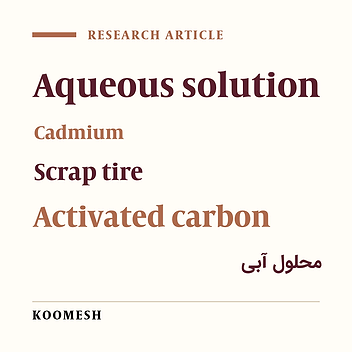
Evaluation of Cadmium removal Efficiency from aqueous solution by Activated Carbon Derived from Scrap Tire
Authors
Abstract
Introduction: Cadmium (Cd) is one of the main types of heavy metals having wide use in today industrial age. This Heavy metal is very toxic even in very low amount that can cause kidney damage, high blood pressure, bone fraction and destruction of red blood cells. This study was performed with the purpose of producing activated carbon from scrap tires and it’s application to removal of Cd(II) ions from synthetic solution. Materials and Methods: In this experimental study, powder activated carbon derived from scrap tires (TDAC) was prepared under laboratory conditions. Structural properties of TDAC were analyzed using Scanning Electron Microscopy (SEM) coupled with energy dispersive spectrometry (EDS). The special surface area was calculated using Brunauer-Emmett-Teller (BET) and Barret-Joyner-Halenda (BJH) isotherms. In adsorption studies, the effects of Cd(II) ions concentration, pH, contact time and the adsorbent dosage on adsorption process were investigated in batch system. The experimental data were analyzed with Langmuir and Freundlich isotherm models. Results: The results showed that the efficiency of activated carbon production is at 32-36% range. Main component of TDAC is Carbon (76.78%). It’s special surface area using BET and BJH methods are approximately 185.046 and 146.443 m2/g, respectively. In adsorption studies, increasing of TDAC dosage resulted in a decrease in qmax and also adsorption was increased with increasing the pH, Cd+2 ions. The adsorption experimental data complies with Freundlich equation model (R2 = 0.9987) and the maximum amount of adsorption (qmax) was 83.33 mg/g. Conclusion: Results of this study show producing activated carbon from scrap tire can have some economic and environmental advantages and it can be introduced as a suitable method in order to recovery of scrap tires. The produced activated carbon from scrap tires has high efficiency for Cd removal from aqueous solutions.
Highlights
Copyright
© 2014, Author(s). This open-access article is available under the Creative Commons Attribution 4.0 (CC BY 4.0) International License (https://creativecommons.org/licenses/by/4.0/), which allows for unrestricted use, distribution, and reproduction in any medium, provided that the original work is properly cited.
Similar Articles
Replacement of lemon juice wastes instead of strong inorganic acids in production of silica from rice husk and efficiency of produced adsorbents in removal of cadmium from aqueous solutions
Rastgou T, Hassani AH, Moeinian K, Mehdinia SM. Replacement of lemon juice wastes instead of strong inorganic acids in production of silica from rice husk and efficiency of produced adsorbents in removal of cadmium from aqueous solutions. koomesh. 2016;18(3):e151127. doi:
Cadmium removability from aqueous solutions using TiO2 nano photocatalytic compound and rice husk silica
Nassehinia H, Mahmoodi A, Mehdinia SM. Cadmium removability from aqueous solutions using TiO2 nano photocatalytic compound and rice husk silica. koomesh. 2016;18(3):e151122. doi:
Analysis of Carbonated Biosorbents Application in Heavy Metal Removal from Synthetic Wastewater
Taghavi L, Nasseh I, Barikbin B, Nasseh N. Analysis of Carbonated Biosorbents Application in Heavy Metal Removal from Synthetic Wastewater. Ann Mil Health Sci Res. 2016;14(2):e11360. doi:
The study of Effective Factors in Mercury Removed from Aqueous Solutions Using Granular Activated Carbon
Derayat J, Rezaee A, Mortazavi S, Yamini Y, Khavanin A, et al. The study of Effective Factors in Mercury Removed from Aqueous Solutions Using Granular Activated Carbon. J Kermanshah Univ Med Sci. 2005;9(1):e81520. doi:
Removal of Cadmium from Aqueous Environments by Electrocoagulation process using Aluminum Electrodes
Bazrafshan E, mahvi AH. Removal of Cadmium from Aqueous Environments by Electrocoagulation process using Aluminum Electrodes. Zahedan J Res Med Sci. 2007;9(1):e94819. doi:
- Scopus by DOI: 0
Last Update: 1 week ago
- Scopus by Title: 3
Last Update: 1 week ago
- Scopus by Title (Ref): 3
Last Update: 1 week ago
- CrossRef: 0
Last Update: 7 hours ago
- OpenAlex: 0
Last Update: 9 hours ago
- OpenCitations: 0
Last Update: 5 days ago