Journal of Semnan University of Medical Sciences
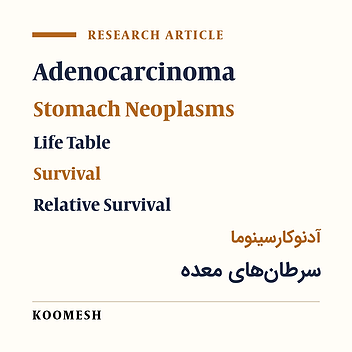
Image Credit:Koomesh
Outline
Postoperative net survival of gastric adenocarcinoma at Imam Khomeini hospital in Tehran: Estimating in a relative-survival framework
Authors
 ,*, Kazem Mohammad, Hojjat Zeraati, Mohammad Ali Mansournia, Mahdi Yaseri, Amir Molaei
Abstract
Introduction: Adenocarcinoma is the most common form of gastric cancer with relatively high mortality and morbidity in Iran. In this way, the aim of this study was to estimating postoperative net survival for patients with gastric Adenocarcinoma in Iran in the context of relative survival regarding its value and accuracy as a useful indicator. Materials and Methods: Data analysis was performed on gastric adenocarcinoma patients undergoing curative surgical treatment followed by subsequent supplementary therapies in Imam Hospital in Tehran during the years 1995 to 1999 (follow up to 2004). While describing the data with frequency and life table, the net survival of 1- to 5-year was estimated via the multiple models based on the underlying factors using stata software. Results: Data of 281 patients with a mean age of 66.0 ± 10.8 (200 males and 81 females) with gastric Adenocarcinoma followed up for a maximum of 10 years was used. Among all 214 patients (76.2%) were diagnosed at stages 3 and 4 of the disease.Noticeably, the survival of 1- and 5- year for patients was 68.27 (95% CI: 62.17 -73.69) and 22.17 (95% CI: 16.39-28.63), respectively. The minimum amount for the specific survival rate was 77.76% for the time interval of 1 to 1.5 years. Conclusion: The risk of death from this illness is more likely to occur within 1 to 2 years after surgery. While statistical healing can be considered to be from the seventh year onwards. Patients diagnosed at higher stages and who use less complementary therapies have less survival
Highlights
References
- 1.Jemal A, Bray F, Center MM, Ferlay J, Ward E, Forman D. Global cancer statistics. CA Cancer J Clin 2011; 61: 69-90.
- 2.Siegel R, DeSantis C, Jemal A. Colorectal cancer statistics, 2014. CA Cancer J Clin 2014; 64: 104-117.
- 3.Parkin DM. Epidemiology of cancer: global patterns and trends. Toxicol Lett 1998; 102-103: 227.
- 4.Pisani P, Parkin DM, Ferlay J. Estimates of the worldwide mortality from eighteen major cancers in 1985. Implications for prevention and projections of future burden. Int J Cancer 1993; 55: 891.
- 5.Alberts SR1, Cervantes A, van de Velde CJ. Gastric cancer: epidemiology, pathology and treatment. Ann Oncol 2003; 14: ii31-36.
- 6.Cancer Incidence and Mortality Worldwide: IARC CancerBase [Internet]. International Journal of Cancer. 2012 [cited 10 February 2017]. Available from: http://globocan.iarc.fr.
- 7.Malekzadeh R, Derakhshan MH, Malekzadeh Z. Gastric cancer in Iran: epidemiology and risk factors. Arch Iran Med 2009; 12: 576-583.
- 8.Reim D, Loos M, Vogl F, Novotny A, Schuster T, Langer R, et al. Prognostic implications of the seventh edition of the international ::union:: against cancer classification for patients with gastric cancer: the Western experience of patients treated in a single-center European institution. J Clin Oncol 2012; 31: 263-271.
- 9.Cancer Research UK. Available from: http://www.cancerresearchuk.org/health-professional/cancer-statistics/statistics-by-cancer-type/stomach-cancer/survival.
- 10.Veisani Y, Delpisheh A. Survival rate of gastric cancer in Iran; a systematic review and meta-analysis. Gastroenterol Hepatol Bed Bench 2016; 9: 78-86.
- 11.Zeraati H, Amiri Z. Estimating postoperative survival of gastric cancer patients and factors affecting it in Iran: Based on a TNM-7 Staging System. Acta Med Iran 2016; 54: 114-118.
- 12.Zare A, Mahmoodi M, Mohammad K, Zeraati H, Hosseini M, Holakouie Naieni K. Factors affecting the survival of patients with gastric cancer undergone surgery at Iran cancer institute: univariate and multivariate analyses. Iran J Public Health 2014; 43: 800-808.
- 13.Zare A, Mahmoodi M, Mohammad K, Zeraati H, Hosseini M, Naieni KH. Survival analysis of patients with gastric cancer undergoing surgery at the iran cancer institute: a method based on multi-state models. Asian Pac J Cancer Prev 2013; 14: 6369-6373.
- 14.Zeraati H, Mahmoudi M, Kazemnejhad A, Mohammad K. Postoperative surgical in gastric cancer patients and its associated factors: a time dependent covariates model. Iran J Publ Health 2006; 35: 40-46. (Persian).
- 15.Dickman PW, Coviello E, Hills M. Estimating and modeling relative survival. Stata J 2015; 15: 186-215.
- 16.Hakulinen T, Sepp K, Lambert PC. Choosing the relative survival method for cancer survival estimation. Eur J Cancer 2011; 47: 2202-2210.
- 17.Berkson J. The calculation of survival rates. In: Walters W, Gray H, Priestly J, eds., Carcinoma and other malignant lesions of the stomach. Philadelphia: Sanders, 1942; 467-484.
- 18.Ederer F, Heise H. HH: Instructions to IBM 650 programmers in processing survival computations: Methodological note No 10 Bethesda. MD National Cancer Institute. 1959.
- 19.Howlader N, Ries LA, Mariotto AB, Reichman ME, Ruhl J, Cronin KA. Improved estimates of cancer-specific survival rates from population-based data. J Natl Cancer Inst 2010; 102: 1584-1598.
- 20.Hinchliffe S, Rutherford M, Crowther M, Nelson C, Lambert P. Should relative survival be used with lung cancer data? Br J Cancer 2012; 106: 1854-1859.
- 21.Schwarz R, Zagala-Nevarez K. Ethnic survival differences after gastrectomy for gastric cancer are better explained by factors specific for disease location and individual patient comorbidity. Eur J Surg Oncol 2002; 28: 214-219.
- 22.Wang L, Wei D, Huang S, Peng Z, Le X, Wu TT, et al. Transcription factor Sp1 expression is a significant predictor of survival in human gastric cancer. Clin Cancer Res 2003; 9: 6371-6380.
- 23.Sigon R, Canzonieri V, Rossi C. Early gastric cancer: a single-institution experience on 60 cases. Suppl Tumori 2002; 2: S23-26.
- 24.Koizumi W, Kim YH, Fujii M, Kim HK, Imamura H, Lee KH, et al. Addition of docetaxel to S-1 without platinum prolongs survival of patients with advanced gastric cancer: a randomized study (START). J Cancer Res Clin Oncol 2014; 140: 319-328.
- 25.Maroufizadeh S, Hajizadeh E, Baghestani A, Fatemi R. Prognostic factor for patients with gastric cancer using the Aalens additive hazards model. Koomesh 2011; 13: 120-127. (Persian).
- 26.Roshanaei G, Sadighi S, Safari M, Faradmal J. Estimated survival time in gastric cancer patients and its associated factors. Koomesh 2012; 14: 47-54. (Persian).
Copyright
© 2018, Author(s). This open-access article is available under the Creative Commons Attribution 4.0 (CC BY 4.0) International License (https://creativecommons.org/licenses/by/4.0/), which allows for unrestricted use, distribution, and reproduction in any medium, provided that the original work is properly cited.
Similar Articles
Estimated survival time in gastric cancer patients and its associated factors
Roshnaei G, Sedighi S, Safari M, Faradmal J. Estimated survival time in gastric cancer patients and its associated factors. koomesh. 2012;14(1):e152548. doi:
Prognostic factor for patients with gastric cancer using the Aalen’s additive hazards model
Maroufizadeh S, HajiZadeh E, Baghestani AR, Fatemi SR. Prognostic factor for patients with gastric cancer using the Aalen’s additive hazards model. koomesh. 2011;13(1):e152498. doi:
Survival estimating following recurrence in gastric cancer patients and its relative factors
Roshnaei G, Kazemnejad A, Sedighi S. Survival estimating following recurrence in gastric cancer patients and its relative factors. koomesh. 2011;12(3):e152450. doi:
Application of Bayes method in determining of the risk factors on the survival rate of gastric cancer patients
Baghestani AR, HajiZadeh E, Fatemi SR. Application of Bayes method in determining of the risk factors on the survival rate of gastric cancer patients. koomesh. 2010;11(2):e153798. doi:
Prognostic Significance of Metastatic Lymph Node Ratio in Patients with Gastric Cancer: an Evaluation in North-East of Iran
Taghizadeh-Kermani A, Yahouiyan SZ, Aliakbarian M, Seilanian Toussi M. Prognostic Significance of Metastatic Lymph Node Ratio in Patients with Gastric Cancer: an Evaluation in North-East of Iran. Int J Cancer Manag. 2014;7(2):e80520. doi:
- Scopus by DOI: 0
Last Update: 1 day ago
- Scopus by Title: 2
Last Update: 1 day ago
- Scopus by Title (Ref): 2
Last Update: 1 day ago
- CrossRef: 0
Last Update: 7 hours ago
- OpenAlex: 0
Last Update: 9 hours ago
- OpenCitations: 0
Last Update: 4 days ago