Cover image of the article: A Young Woman with Atypical Chest Pain: Introducing a Rare Case of ARCAPA

Image Credit:Multidisciplinary Cardiovascular Annals

A Young Woman with Atypical Chest Pain: Introducing a Rare Case of ARCAPA

Authors

Zahra Khajali Zahra  Khajali ORCID1,*, Mohammad Esmaeel Zangenehfar1, Mohsen Maadani1, Mojgan Parsaee1
1Rajaie Cardiovascular, Medical, and Research Center, Iran University of Medical Sciences, Tehran, Iran
*Corresponding Author: Rajaie Cardiovascular, Medical, and Research Center, Iran University of Medical Sciences, Tehran, Iran. Email: khajaliz@yahoo.com

Multidisciplinary Cardiovascular Annals:Vol. 11, issue 2; e106461
Published online:Jul 20, 2020
Article type:Case Report
Received:Jun 14, 2020
Accepted:Jun 15, 2020
How to Cite:Khajali Z, Zangenehfar ME, Maadani M, Parsaee M. A Young Woman with Atypical Chest Pain: Introducing a Rare Case of ARCAPA. Multidiscip Cardio Annal. 2020;11(2):e106461. doi: https://doi.org/10.5812/mca.106461

Abstract

Anomalous origin of the right coronary artery originating from the pulmonary trunk (ARCAPA) is a rare congenital coronary anomaly with wide spectrum of clinical outcome. We are presenting a case of ARCAPA with a review of the previous studies about it.

1. Introduction

Incidence of congenital coronary anomalies in general population is about 0.3% - 0.9% (1). Anomalous origin of the right coronary artery from the pulmonary artery (ARCAPA) is a very rare and potentially fatal. It has a very wide spectrum of clinical courses, ranging from incidental finding in asymptomatic patients and chronic ischemia presenting with chest pain or dyspnea and sudden death. Transthoracic echocardiogram can guide us in the first step and final diagnosis is confirmed on a conventional coronary angiogram or coronary CT angiography.

2. Case Presentation

A 26-year-old woman presented to cardiology clinic complaining about dizziness and exertional and chest discomfort for several months. Electrocardiogram revealed T inversion in inferior leads, heart examination revealed a 3/6 grade systolic murmur in upper left sternal border. An echocardiogram revealed normal biventricular contractility and abnormal turbulent flow in the interventricular septum, which raised the suspicious of a coronary fistula (Figure 1). She was referred to cardiology center for further evaluation.
Parasternal short axis view with turbulent abnormal flow in the interventricular septum (white arrow).
Figure 1.
Parasternal short axis view with turbulent abnormal flow in the interventricular septum (white arrow).
In our center, selective coronary angiography and right heart catheterization revealed normal origin of left main with very tortuous dilated LAD and normal LCX. Retrograde filling of the tortuous dilated right coronary artery from collateral vessels and drained to pulmonary artery (Figure 2). In aortic root injection RCA, origin was not visualized. Right heart catheterization and pressure study revealed normal PA pressure and no significant shunt.
Selective coronary angiography left main injection revealed aneurysmal LAD, normal LCX, RCA was filled retrograde from left system and drained to pulmonary artery (white arrow).
Figure 2.
Selective coronary angiography left main injection revealed aneurysmal LAD, normal LCX, RCA was filled retrograde from left system and drained to pulmonary artery (white arrow).
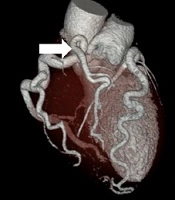
In the next step, coronary CT angiography confirmed our prior findings (Figure 3).
Coronary CT angiogram, dilated aneurysmal RCA originating from pulmonary artery (white arrow).
Figure 3.
Coronary CT angiogram, dilated aneurysmal RCA originating from pulmonary artery (white arrow).
We ruled out any associated cardiac anomaly in our studies. We decided to evaluate ischemia, myocardial perfusion imaging revealed mild stress induced ischemia in anterolateral segment (Figure 4).
Mild reversible stress induced ischemia in anterolateral segment (white curved arrows).
Figure 4.
Mild reversible stress induced ischemia in anterolateral segment (white curved arrows).
After presenting all data in the heart team, we planned for surgically repairing anomalous origin of RCA from pulmonary artery but our patient refused it. In one-year follow up she had mild symptoms without heart attack.

3. Discussion

Incidence of congenital coronary anomalies in general population is about 0.3% - 0.9% (1). Congenital anomalous origin of the coronary artery arising from the pulmonary artery was described by Soloff in four different categories:
(1) ALCAPA (anomalous left coronary artery from the pulmonary artery) that is a common type with a total incidence of 0.008%
(2) ARCAPA (right coronary artery from the pulmonary artery), with about 0.002% incidence rate in general population
(3) Both coronary arteries from the pulmonary artery
(4) An accessory coronary artery from the pulmonary artery (2)
ARCAPA is associated with structural heart anomalies in 25% - 30% of cases. Tetralogy of Fallot and aorta-pulmonary window, aortic stenosis, septal defects and aortic coarctation are associated anomalies with ARCAPA (3).
ARCAPA can cause myocardial ischemia with coronary steal phenomenon or abnormal left to right shunt, indeed pulmonary trunk steals oxygenated blood from normal coronary arteries through well-developed collateral vessels (4). Cardiac computed tomography coronary angiogram and cardiovascular magnetic resonance are excellent diagnostic methods for coronary artery anomalies. They are providing detailed anatomic information of origin, course, and relationship of the anomalous coronary artery (5).
After diagnosis, we should prevent myocardial ischemia and sudden death. The treatment of choice for ARCAPA is surgical transfer of anomalous RCA to aorta; this correction can eliminate the left to right shunt and provide normal bicoronary circulation (6). Surgical correction of ARCAPA has low operative mortality ranging from 2% to 3% (5). Alternative surgical technics are ligation of the abnormal pulmonary origin of the coronary artery, and arterial bypass grafting (7). We have limited data about post-surgery follow up in ARCAPA.

3.1. Conclusion

An anomalous origin of the right coronary artery is a rare congenital anomaly with a wide range of clinical importance mostly detected incidentally in asymptomatic patients and sometimes can cause myocardial ischemia or sudden cardiac death, coronary CT angiography is the best modality for diagnosis, and its appropriate treatment is surgical correction of anomalous right coronary artery from pulmonary trunk.
Footnotes

  • Authors' Contribution: Dr. Maadani is patient’ physicion, Dr. Parsaei was done TTE, Dr. Khajali was done coronary angiography, and Dr. Zangenehfar helped in writing the case report.

  • Conflict of Interests: There is no conflict of interests.

  • Funding/Support: This study was supported by Rajaei Cardiovascular Center.

  • Informed Consent: Informed consent was filled by patient.

References

  • 1.
    Topaz O, DeMarchena EJ, Perin E, Sommer LS, Mallon SM, Chahine RA. Anomalous coronary arteries: angiographic findings in 80 patients. International Journal of Cardiology. 1992;34(2):129-38. https://doi.org/10.1016/0167-5273(92)90148-v.
  • 2.
    Soloff LA. Anomalous coronary arteries arising from the pulmonary artery. American Heart Journal. 1942;24(1):118-27. https://doi.org/10.1016/s0002-8703(42)91023-8.
  • 3.
    Williams IA, Gersony WM, Hellenbrand WE. Anomalous right coronary artery arising from the pulmonary artery: a report of 7 cases and a review of the literature. Am Heart J. 2006;152(5):1004 e9-17. [PubMed ID: 17070181]. https://doi.org/10.1016/j.ahj.2006.07.023.
  • 4.
    Mintz GS, Iskandrian AS, Bemis CE, Mundth ED, Owens JS. Myocardial ischemia in anomalous origin of the right coronary artery from the pulmonary trunk. The American Journal of Cardiology. 1983;51(3):610-2. https://doi.org/10.1016/s0002-9149(83)80108-8.
  • 5.
    Hekmat V, Rao SM, Chhabra M, Chiavarelli M, Anderson JE, Nudel DB. Anomalous origin of the right coronary artery from the main pulmonary artery: diagnosis and management. Clin Cardiol. 1998;21(10):773-6. [PubMed ID: 9789702]. [PubMed Central ID: PMC6655656]. https://doi.org/10.1002/clc.4960211016.
  • 6.
    Kuhn A, Kasnar-Samprec J, Schreiber C, Vogt M. Anomalous origin of the right coronary artery from the pulmonary artery (ARCAPA). Int J Cardiol. 2010;139(2):e27-8. [PubMed ID: 19100636]. https://doi.org/10.1016/j.ijcard.2008.10.036.
  • 7.
    Luisi SV, Ashraf MH, Gula G, Radley-Smith R, Yacoub M. Anomalous origin of the right coronary artery with aortopulmonary window: functional and surgical considerations. Thorax. 1980;35(6):446-8. [PubMed ID: 7434300]. [PubMed Central ID: PMC471308]. https://doi.org/10.1136/thx.35.6.446.

Copyright

Copyright © 2020, Multidisciplinary Cardiovascular Annals. This is an open-access article distributed under the terms of the Creative Commons Attribution-NonCommercial 4.0 International License (http://creativecommons.org/licenses/by-nc/4.0/) which permits copy and redistribute the material just in noncommercial usages, provided the original work is properly cited.

Similar Articles

30
Jun
2009
Presentation of Anomalous Origin of the Left Coronary Artery From the Pulmonary Artery with Left Sided Coronary Ostium in an Adult Patient

Presentation of Anomalous Origin of the Left Coronary Artery From the Pulmonary Artery with Left Sided Coronary Ostium in an Adult Patient

Zahra Ojaghi Haghighi,
H Poorzand,
HA Bassiri

Ojaghi Haghighi Z, Poorzand H, Bassiri H. Presentation of Anomalous Origin of the Left Coronary Artery From the Pulmonary Artery with Left Sided Coronary Ostium in an Adult Patient. Int Cardiovasc Res J. 2009;3(2):e68469. doi:

31
Mar
2009
Coronary Artery Origin Anomalies with Especial Emphasis on Delayed Diagnosis of Anomalous Origin of the Left Coronary Artery from Pulmonary Artery, A report from South of Iran

Coronary Artery Origin Anomalies with Especial Emphasis on Delayed Diagnosis of Anomalous Origin of the Left Coronary Artery from Pulmonary Artery, A report from South of Iran

Ahmad Amirghofran,
GH Ajami,
Mohammad Borzouee,
MA Navvabi,
Hamid Amoozgar,
S Sarikhani

Amirghofran A, Ajami G, Borzouee M, Navvabi M, Amoozgar H, et al. Coronary Artery Origin Anomalies with Especial Emphasis on Delayed Diagnosis of Anomalous Origin of the Left Coronary Artery from Pulmonary Artery, A report from South of Iran. Int Cardiovasc Res J. 2009;3(1):e68528. doi:

25
Jan
2016
Missed Diagnosis and Treatment Dilemma: Large Patent Ductus Arteriosus Combined with Anomalous Origin of the Left Coronary Artery From the Pulmonary Artery

Missed Diagnosis and Treatment Dilemma: Large Patent Ductus Arteriosus Combined with Anomalous Origin of the Left Coronary Artery From the Pulmonary Artery

Ayca Ata Korkmaz,
Hakan Erkan,
Aysegul Karadeniz,
Cihan Orem

Korkmaz AA, Erkan H, Karadeniz A, Orem C. Missed Diagnosis and Treatment Dilemma: Large Patent Ductus Arteriosus Combined with Anomalous Origin of the Left Coronary Artery From the Pulmonary Artery. I J Radiol. 2017;14(2):e30713. doi: https://doi.org/10.5812/iranjradiol.30713

15
Sep
2016
Anomalous Origin of Right Coronary Artery from Distal Left Circumflex Artery: A Very Rare Variant of Single Coronary Artery Anomaly

Anomalous Origin of Right Coronary Artery from Distal Left Circumflex Artery: A Very Rare Variant of Single Coronary Artery Anomaly

Arash Gholoobi

Gholoobi A. Anomalous Origin of Right Coronary Artery from Distal Left Circumflex Artery: A Very Rare Variant of Single Coronary Artery Anomaly. Int Cardiovasc Res J. 2016;10(3):e10180. doi:

25
Apr
2016
Anomalous Origin of the Right Coronary Artery from the Mid-Portion of the Left Anterior Descending Artery in a Patient with Single Left Coronary Artery: A Rare Coronary Artery Anomaly and Review of Literature

Anomalous Origin of the Right Coronary Artery from the Mid-Portion of the Left Anterior Descending Artery in a Patient with Single Left Coronary Artery: A Rare Coronary Artery Anomaly and Review of Literature

Mahmoud Beheshti Monfared,
Hamid Ghaderi,
Taraneh Faghihi Langroudi,
Seyedeh Adeleh Mirjafari,
Mahnoosh Foroughi,
Mohammad Forozeshfard
,et al.

Beheshti Monfared M, Ghaderi H, Faghihi Langroudi T, Mirjafari SA, Foroughi M, et al. Anomalous Origin of the Right Coronary Artery from the Mid-Portion of the Left Anterior Descending Artery in a Patient with Single Left Coronary Artery: A Rare Coronary Artery Anomaly and Review of Literature. I J Radiol. 2017;14(1):e13458. doi: https://doi.org/10.5812/iranjradiol.23484

More by these authors

Zahra KhajaliPubMedScholar
Mohammad Esmaeel ZangenehfarPubMedScholar
Mohsen MaadaniPubMedScholar
Mojgan ParsaeePubMedScholar
Share
Cited by
Metrics