
1. Context
Mitral annular calcification (MAC) is postulated to be an atherosclerotic process associated with multiple adverse outcomes (1). Approximately 8% to 15% of the population is affected by this condition (2). Despite its clinical significance and association with adverse outcomes, MAC remains incompletely understood. Once considered a benign, age-related condition, it is now recognized as a predictor of increased mortality and morbidity (3). Multiple studies have demonstrated associations between MAC and female sex, older age, atrial fibrillation (AF), chronic kidney disease (CKD), and aortic stenosis (AS) (3). Concomitant MAC is a common cardiac computed tomography (CT) finding in patients with severe AS scheduled for transcatheter aortic valve implantation (TAVI) (4). The association between MAC and AS has important clinical implications. This review aims to highlight the importance and implications of concomitant MAC in patients with AS.
2. Evidence Acquisition
This narrative mini-review evaluates the current literature on the prevalence, associated factors, and prognostic implications of MAC in patients with severe AS. A literature search of PubMed, Scopus, and Web of Science was conducted using a combination of MeSH and free-text terms, including “mitral annular calcification,” “mitral annulus calcification,” “MAC,” “aortic stenosis,” “severe aortic stenosis,” “transcatheter aortic valve implantation (TAVI),” and “aortic valve replacement.” Only original data reported in English-language, peer-reviewed articles involving human subjects were evaluated. Potentially relevant references were also identified by manually reviewing the reference lists of the included studies.
Because this was a narrative review that included a wide range of evidence types, including observational studies and case reports, no formal quality assessment, meta-analysis, or systematic synthesis of the results was performed. The review prioritized studies published within the past 10 years; however, earlier studies providing important contextual foundations were also included. Two case reports of combined transcatheter aortic and mitral valve interventions (references 14 and 15) were included for illustrative narrative context only and were not part of the formal evidence synthesis on prevalence or prognostic outcomes.
3. Results
3.1. Prevalence and Pathogenesis
MAC is usually an incidental finding, particularly during evaluation for AS (4). Movahed et al. reported that MAC was observed in 14.8% of patients with AS and was significantly associated with AS (P = 0.01). They suggested that AS was independently associated with MAC, along with left ventricular (LV) hypertrophy, left atrial (LA) enlargement, and mitral regurgitation (MR) (5). In a retrospective study of 761 patients, Abramowitz et al. found that 49.3% of patients who underwent TAVI had concomitant MAC and severe AS (4). Vanhaecke et al. also demonstrated, in a retrospective study of 613 patients with severe AS, that 309 patients (50.4%) had MAC. The prevalence of MAC in patients with severe AS has been increasingly documented (6).
Because MAC is associated with adverse cardiovascular outcomes, it was once considered a manifestation of atherosclerosis. MAC burden is positively associated with the coronary artery calcium score and commonly coexists with other calcific valvular disorders, particularly AS (7, 8). However, important distinctions should be recognized. Unlike atherosclerosis, MAC is strongly associated with female sex. It is not associated with high low-density lipoprotein levels but is related to triglyceride levels (9). Therefore, although MAC is associated with atherosclerosis, it is more appropriate to assume that the two conditions overlap rather than have a direct causal relationship.
AS cannot be considered an independent factor in MAC development; however, it may hypothetically increase mechanical stress on the mitral valve. Excessive shear stress may accelerate annular degeneration and calcification in predisposed patients, leading to MAC (10). Ultimately, sclerosis and restricted mitral valve motion may cause chordal rupture and provide a substrate for MR, subsequent atrial remodeling, AF, and other cardiac conduction disorders (9).
3.2. Associated Factors
In the study by Vanhaecke et al. (2025), 613 patients with severe AS were evaluated for MAC. Their analysis showed significant associations between MAC and female sex (OR, 2.44; 95% CI, 1.59 - 3.76; P < 0.001), older age (OR, 1.03; 95% CI, 1.02 - 1.05 per year; P < 0.001), and diabetes (OR, 1.80; 95% CI, 1.14 - 2.86; P < 0.001) (6). These findings are consistent with previous reports. Abramowitz et al. (2017) also showed significant associations between concomitant MAC and older age (P = 0.004) and female sex (P < 0.001). They also demonstrated that patients with chronic renal failure had significantly higher rates of MAC (21.9% vs. 14.2%; P = 0.01) (4). Weferling et al. (2025) also found strong associations between MAC severity and female sex (OR, 2.15; 95% CI, 1.38 - 3.37; P = 0.001), AF (OR, 1.58; 95% CI, 1.03 - 2.43; P = 0.035), and prior permanent pacemaker implantation (OR, 2.69; 95% CI, 1.50 - 4.81; P = 0.001) (2). Pergola et al. investigated potential risk factors for MAC in AS and concluded that the most prevalent cardiovascular risk factors for MAC in AS were hypertension, dyslipidemia, carotid artery disease, and AF (11).
3.3. Impact of MAC on AS Outcomes and TAVI Prognosis
MAC is generally associated with higher rates of major adverse cardiovascular events (MACE) and increased overall mortality after TAVI or aortic valve replacement (AVR). A recent study by Pergola et al. at Padua University Hospital, Italy, evaluated outcomes in 313 patients who underwent AVR and found no significant association between outcomes after TAVI in patients with and without MAC. However, after quantifying MAC severity based on cardiac CT, severe MAC was associated with worse outcomes after AVR in patients with AS. Patients with severe MAC, compared with those without MAC, had significantly higher HRs for MACE (HR, 2.32; 95% CI, 1.13 - 4.77; P = 0.02) and all-cause mortality (HR, 2.37; 95% CI, 1.36 - 4.16; P < 0.001) (11).
Vanhaecke et al. investigated the prognostic value of MAC and its severity. Patients with severe MAC had significantly lower survival rates during follow-up (adjusted HR, 1.24; 95% CI, 1.03 - 1.67; P < 0.001). The medical management group had markedly higher mortality than the surgical aortic valve replacement (SAVR) group (HR, 6.8; 95% CI, 3.3 - 14.5) and the TAVI group (HR, 5.33; 95% CI, 3.49 - 8.12) (overall P < 0.001). Although survival improved in both invasive intervention groups, the SAVR group had significantly better outcomes than the TAVI group (HR, 2.06; 95% CI, 1.06 - 4.01) (6).
The study by Abramowitz and colleagues at Cedars-Sinai Medical Center assessed the relationship between MAC and clinical outcomes after TAVI. They first assessed the impact of MAC on overall survival after TAVI. There was no significant relationship between mortality in groups with and without MAC (HR, 1.23; 95% CI, 0.94 - 1.62; P = 0.13) in a cohort of 761 patients. After accounting for MAC severity, severe MAC was strongly associated with overall and 1-year all-cause mortality after TAVI (HR, 1.95; 95% CI, 1.24 - 3.07; P = 0.004; and OR, 2.30; 95% CI, 1.14 - 4.66; P = 0.02, respectively). Severe MAC was also associated with a higher cardiovascular mortality rate after TAVI (HR, 2.35; 95% CI, 1.19 - 4.66; P = 0.01) (4).
Contradictory evidence also exists regarding the influence of MAC on TAVI outcomes. A retrospective study by Lak and colleagues in 2022 aimed to compare outcomes after TAVI in patients with concomitant AS and MAC. They found no significant association between MAC and adverse outcomes after TAVI; postprocedural all-cause mortality at 1 year and 2 years did not differ significantly between groups (P = 0.80 and P = 0.47, respectively). The comparison of MACE between groups with and without MAC was also not significant at 1 year (P = 0.53) (12).
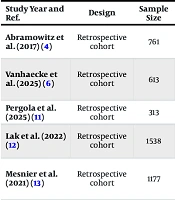
In addition, Mesnier et al. reported contrasting results when evaluating the impact of MAC on TAVI outcomes. After evaluating 1177 patients and diagnosing 504 (42.8%) with MAC, they examined the patients in greater detail. They observed similar outcomes when comparing groups with and without MAC, except for a higher need for pacemaker implantation in the MAC group after TAVI. However, they found that MAC with associated mitral stenosis (MS) was associated with all-cause mortality at 30 days (adjusted HR, 2.30; 95% CI, 1.08 - 4.86; P = 0.03) and all-cause mortality at 1 year (adjusted HR, 1.73; 95% CI, 1.04 - 2.89; P = 0.04). They concluded that MAC-MS is an independent predictor of all-cause mortality at 1 year and suggested that MAC itself may not influence outcomes; rather, MAC in combination with MS may be the relevant prognostic factor (13). These outcome studies are summarized in Table 1.
Table 1.
Summary of Key Studies Reporting Outcomes of Mitral Annular Calcification (MAC) in Patients with Severe Aortic Stenosis Undergoing Valve Intervention a
| Study Year and Ref. | Design | Sample Size | MAC Definition | Intervention | Follow-up | Key Finding | Effect Estimate (95% CI) |
|---|---|---|---|---|---|---|---|
| Abramowitz et al. (2017) (4) | Retrospective cohort | 761 | Severe MAC (CT) | TAVI | 1 year | Severe MAC was associated with higher overall, cardiovascular, and 1-year mortality | Overall: HR, 1.95 (1.24 - 3.07); CV: HR, 2.35 (1.19 - 4.66); 1-year: OR, 2.30 (1.14 - 4.66) |
| Vanhaecke et al. (2025) (6) | Retrospective cohort | 613 | Severe MAC (CT) | TAVI/SAVR/medical | 6 years | Severe MAC was associated with lower survival vs. mild MAC (HR, 2.63) and moderate MAC (HR, 1.95); any MAC vs. no MAC (HR, 1.24) | Severe vs. mild: HR, 2.63 (1.51 - 4.60); severe vs. moderate: HR, 1.95 (1.17 - 3.22); any MAC: HR, 1.24 (1.03 - 1.67) |
| Pergola et al. (2025) (11) | Retrospective cohort | 313 | Severe MAC (CT) | AVR | 5 years | Severe MAC was associated with higher MACE and all-cause mortality | MACE: HR, 2.32 (1.13 - 4.77); mortality: HR, 2.37 (1.36 - 4.16) |
| Lak et al. (2022) (12) | Retrospective cohort | 1538 | MAC (any, CT) | TAVI | 1 - 2 years | No significant association with mortality or MACE | 1-year mortality: P = 0.80; 2-year mortality: P = 0.47; MACE: P = 0.53 |
| Mesnier et al. (2021) (13) | Retrospective cohort | 1177 | MAC with MS (CT) | TAVI | 30 days, 1 year | MAC alone, even severe MAC, did not predict mortality; MAC-MS was associated with higher 30-day and 1-year mortality | 30-day: HR, 2.30 (1.08 - 4.86); 1-year: HR, 1.73 (1.04 - 2.89) |
| Movahed et al. (2007) (5) | Cross-sectional | 1000 | MAC (echocardiography) | None (prevalence study) | N/A | MAC was significantly associated with AS (prevalence, not outcome) | P = 0.01 (OR not reported) |
a Abbreviations: AS, aortic stenosis; AVR, aortic valve replacement; CI, confidence interval; CT, computed tomography; CV, cardiovascular; HR, hazard ratio; MAC, mitral annular calcification; MACE, major adverse cardiovascular events; MS, mitral stenosis; OR, odds ratio; SAVR, surgical aortic valve replacement; TAVI, transcatheter aortic valve implantation.
3.4. Therapeutic Strategies
Management of patients with severe MAC and severe AS undergoing TAVI or AVR is challenging. At present, no specific treatment has been established for MAC, and management is limited to addressing cardiovascular risk factors associated with coronary artery disease (CAD). Several case reports describe simultaneous transcatheter aortic and mitral valve interventions in patients with severe AS and symptomatic MAC-related mitral valve dysfunction. Zientara et al. documented the case of an 81-year-old woman with diabetes, obesity, severe AS, severe MAC, and concurrent mitral regurgitation who successfully underwent transcatheter aortic valve replacement (TAVR) followed by transcatheter mitral valve replacement-in-MAC (TMVR-in-MAC). The patient was discharged 9 days after TAVR without serious complications (14). In a similar case reported by Mehta et al., a 54-year-old man with hypertension and diabetes underwent successful simultaneous transcatheter double native valve replacement of the aortic and mitral valves via femoral access (15). Despite these reported cases, clinicians and readers should recognize that these successes are limited to a few instances, and no broader conclusions should be drawn from them.
4. Limitations and Strengths
Because of the numerous limitations of this narrative mini-review, it could not be registered or developed according to a published protocol. The search was limited to studies published in English, creating a potential language bias. Furthermore, as with most narrative reviews, this review did not include a formal assessment of study quality or risk of bias and did not include a meta-analysis of the included studies. In addition, the eligible studies consisted primarily of retrospective and observational studies, which are subject to inherent selection and confounding biases.
The findings of the eligible studies were ultimately heterogeneous with respect to definitions of MAC severity, outcome definitions, and follow-up duration, precluding direct comparisons across studies. The discussion of concurrent transcatheter aortic and mitral valve interventions (TAVI/TMVR or double valve replacement) was based primarily on isolated case reports and should therefore be interpreted solely as hypothesis-generating. These reports cannot support broad clinical recommendations or imply that such procedures are established, safe, or generally effective. Comparative outcome data from larger series or prospective studies are entirely lacking. Any consideration of such procedures requires careful patient selection, anatomical feasibility assessment, and multidisciplinary heart-team evaluation. Publication bias should also be considered, as studies reporting positive or significant findings may be more likely to be published than those reporting null or negative results.
In light of these limitations, the results should be viewed as exploratory and should be validated through prospective, multi-institutional studies. Despite these limitations, this is one of the first mini-reviews to synthesize evidence on MAC in severe AS, with a focus on MAC severity and concomitant mitral stenosis. A structured literature search across 3 major databases was performed, enhancing transparency within the narrative review framework.
5. Conclusions and Future Directions
The available evidence suggests that severe MAC, particularly MAC with concomitant mitral stenosis, may identify a higher-risk subset of patients with severe AS undergoing valve intervention. In patients with severe AS, there is increasing recognition of coexisting MAC, particularly among those undergoing TAVR or SAVR. Future studies should aim to better elucidate the pathophysiological mechanisms linking these 2 disorders and to determine how concomitant MAC and AS may increase the risk of adverse cardiovascular events. In addition, more definitive diagnostic tests that can accurately identify and quantify MAC, such as alternative imaging modalities or novel biomarkers, are needed to enable early diagnosis, appropriate risk stratification, and personalized treatment approaches.
The prognostic significance of MAC severity for predicting future outcomes, including the risk of MACE and all-cause mortality after either TAVR or AVR, also requires further evaluation in larger multicenter populations to resolve conflicting findings in the current literature. The role of simultaneous TAVR and TMVR strategies warrants further investigation in selected patients. However, current data do not support the routine use of this treatment approach because of low quality and limited value. Therefore, patients undergoing TAVR and TMVR who present with MAC should be carefully selected and evaluated by multidisciplinary heart teams at experienced and appropriately accredited treatment centers. Moreover, investigating potential pharmacological interventions targeting the calcification process involved in MAC may lead to new treatment options that could mitigate its negative effects on valve function and heart failure progression.
Studies focusing specifically on sex differences in MAC are warranted, particularly given the higher prevalence of MAC among females and the need to determine whether therapies designed specifically for females may improve clinical outcomes in women with severe AS and MAC. In addition, the development of effective interventions will require a collaborative multidisciplinary approach to better understand the complex interactions between AS and MAC and to improve outcomes in this vulnerable population.