
1. Context
The advent of immune checkpoint inhibitors (ICIs) has transformed the management of many cancers by improving survival in metastatic disease and becoming an integral component of therapy for early-stage cancers, including potentially curative settings. With their increasing use, understanding the cardiotoxic effects of ICIs has become essential (1, 2).
Although considerable attention has focused on ICI-associated myocarditis because of its early onset and potentially severe outcomes, thrombotic events have been underreported relative to other manifestations (3). This is clinically important because thrombosis is part of the spectrum of cardiovascular adverse effects associated with immunotherapy and may occur at a clinically relevant frequency (4, 5).
Real-world data indicate that venous thromboembolism and other vascular complications, including myocardial infarction and ischemic stroke, may occur more frequently in patients receiving ICIs (4). In a recent cohort analysis, the incidence rates of venous thrombosis, myocardial infarction, and ischemic stroke were substantially higher during ICI treatment than those in the general population (3). Previous systematic analyses have also documented pulmonary embolism and deep vein thrombosis among patients receiving ICIs (6).
From a mechanistic perspective, these events may reflect more than conventional cancer-associated thrombosis. Activated immunity, endothelial inflammation, platelet activation, cytokines, and tissue factor pathways have all been proposed as contributors to the distinctive prothrombotic state observed during ICI treatment (5, 7). Cardio-oncology specialists must therefore consider whether thrombosis following ICI monotherapy represents an immune-mediated cardiovascular complication of cancer treatment or a consequence of the malignancy itself.
2. Evidence Acquisition
This narrative mini-review provides a focused overview of the current evidence on thrombotic complications associated with ICI monotherapy. PubMed and Google Scholar were searched for studies examining thromboembolic events during ICI-based treatment.
Search terms included combinations of “immune checkpoint inhibitors,” “PD-1,” “PD-L1,” “CTLA-4,” “thrombosis,” “venous thromboembolism,” “arterial thrombosis,” “stroke,” “myocardial infarction,” “immunothrombosis,” and “cardio-oncology.” Additional relevant articles were identified by manual review of the reference lists of key publications. Although the primary focus was ICI monotherapy, selected studies involving combination checkpoint blockade were cited to provide mechanistic or contextual background.
3. Results
3.1. Rethinking Cancer-Associated Thrombosis
Cancer-associated thrombosis (CAT) is a well-established clinical phenomenon, but the immunotherapy era raises questions regarding the validity of existing risk-prediction models (8, 9). Algorithms based on tumor site, metastatic burden, chemotherapy exposure, and laboratory parameters were developed largely during the cytotoxic-therapy era and may not capture the thrombotic risk associated with ICI monotherapy (10, 11). Key studies reporting thrombotic events following ICI treatment are summarized in Table 1.
Table 1.
Key Studies Reporting Thrombotic Events Following Immune Checkpoint Inhibitor Treatment a
| Studies | Population | ICI Agent(s) | Sample Size | Follow-Up | Key Findings |
|---|---|---|---|---|---|
| Sussman et al. (2025) (28) | Mixed cancers | PD-1 (76%), PD-L1 (13%), CTLA-4 (4%), CTLA-4/PD-1 combination (7%) | 10,638 | 25.1 months | 6-month cumulative VTE: 7.6% (95% CI 7.1 - 8.1%); 12-month: 11.1% (95% CI 10.5 - 11.8%); median time to VTE: 5.4 months; dual CTLA-4/PD-1 increased VTE risk vs. PD-1 (HR 1.43); PD-L1 reduced risk vs. PD-1 (HR 0.79); anticoagulation post-ICI (non-VTE indication) reduced VTE risk by 40% (HR 0.60) |
| Gong et al. (2021) (19) | Mixed cancers | Anti-PD-1 (75%), anti-PD-L1 (10%), anti-CTLA-4 (8%), combination (7%) | 2,854 | 194 days post-ICI | VTE incidence: 7.4% at 6 months, 13.8% at 1 year; VTE risk > 4-fold higher after ICI vs. pre-ICI (HR 4.98, 95% CI 3.65 - 6.79, p < 0.001); risk factors: age < 65, hypertension (HR 1.37), Khorana score ≥ 2 (HR 1.54); melanoma associated with lower VTE risk (HR 0.59) |
| van Lent et al. (2025) (3) | Mixed cancers | Nivolumab (30%), pembrolizumab (35%), ipilimumab (7%), combination (20%) | 663 | Variable | Age- and sex-adjusted incidence rate vs. general population: venous thrombosis 22.7-fold higher (95% CI 16.6 - 31.0), MI 3.0-fold higher (95% CI 1.2 - 7.1), ischemic stroke 3.2-fold higher (95% CI 1.6 - 5.7); gynecologic malignancy associated with increased VTE risk (HR 6.7); VTE during follow-up associated with 2.3-fold increased mortality |
| Khorana et al. (2023) (33) | Advanced NSCLC (stage IV) | ICI-based (monotherapy or combination without chemo) | 2,299 | 9.1 months | VTE incidence rate per 100 person-years: 13.5 (ICI-based), 18.0 (chemo-based), 22.4 (ICI+chemo); 6-month cumulative VTE: 8.1% (ICI-based), 10.9% (chemo-based), 12.8% (ICI+chemo); ICI-based associated with 26% lower VTE risk vs. chemo (HR 0.74, p = 0.03); risk factors: prior radiation (HR 1.25) and severe obesity |
| Connors et al. (2023) (36) | Mixed cancers | Pembrolizumab (49.7%), nivolumab (31.8%), ipilimumab, atezolizumab, durvalumab | 10,638 | 25.1 months | Cumulative VTE incidence: 7.6% at 6 months, 11.1% at 1 year, 13.8% at 2 years; ipilimumab associated with highest VTE risk (HR 1.90 vs. pembrolizumab); durvalumab lowest risk (HR 0.59); anticoagulation post-ICI (non-VTE indication) associated with 41% VTE risk reduction (HR 0.59) |
| Roopkumar et al. (2021) (14) | Mixed cancers | Nivolumab (52%), pembrolizumab (27%), atezolizumab (10%), nivolumab+ipilimumab (6%) | 1,686 | 14.6 months | VTE incidence: 24% (404/1,686); 6-month cumulative VTE: 7.1%; 12-month: 10.9%; VTE associated with decreased OS (HR 1.22, 95% CI 1.06 - 1.41, p = 0.008); patients who developed VTE had higher pre-treatment levels of MDSCs (p = 0.0045), IL-8 (p = 0.016), and sVCAM-1 (p = 0.038) |
| Vladić et al. (2025) (11) | Mixed cancers | ICI monotherapy (15.4%), ICI+chemo (16.6%), ICI+targeted (1.6%) – 33.6% received ICI | 806 | 11.8 months | 6-month cumulative VTE incidence: 11.2% (95% CI 9.0 - 13.3); performance of VTE risk scores: CAT Score best (c-statistic 0.65), Khorana score poor (c-statistic 0.53), COMPASS-CAT worst (c-statistic 0.50); traditional Khorana parameters (Hb, platelets, WBC, BMI) not significantly associated with VTE |
| Icht et al. (2021) (32) | Advanced NSCLC | Single-agent ICI (nivolumab 67%, pembrolizumab 26%, ipilimumab+nivolumab 2%) | 345 | 6 months | 6-month cumulative VTE: 4.5% (ICI) vs. 7.1% (chemotherapy) (HR for chemo 1.6, 95% CI 0.66 - 3.9); Khorana score did not stratify VTE risk in ICI cohort (high-risk HR 0.17, 95% CI 0.02 - 1.36) but showed trend toward risk stratification in chemotherapy cohort (high-risk HR 3.04, 95% CI 0.82 - 11.22) |
a Unless otherwise specified, ICI exposure refers to monotherapy or combination therapy without concurrent chemotherapy. Effect sizes represent adjusted hazard ratios or odds ratios from multivariable analyses or cumulative incidence estimates with competing risk adjustment where specified.
Observational studies, chart reviews, and registries have reported substantial but variable rates of venous thromboembolism (VTE) among patients receiving ICIs. These differences reflect cohort characteristics, follow-up duration, and methods of event ascertainment. Recent syntheses suggest that population-based studies generally report 6-month VTE rates of approximately 2% to 4% and 12-month rates of 4% to 7%, whereas chart-reviewed cohorts have reported rates approaching 5% to 15% (3, 4, 10).
Arterial thrombotic events must also be considered. Myocardial infarction and stroke have been reported during ICI therapy, demonstrating that these complications are not limited to the venous circulation (3, 6). Thrombosis may also occur in patients who would not be classified as high risk by existing CAT models (3, 5, 10, 11).
In cardio-oncology, an emerging question is not only the existence of CAT in ICI-treated patients, but also whether ICI therapy may independently contribute to immune-mediated vascular changes, in addition to the inherent cancer risk (12, 13). Proposed biological mechanisms, derived from preclinical models and translational studies, include endothelial activation by inflammatory processes, neutrophil extracellular traps, and cytokine-mediated activation of coagulation (10, 14-16).
3.2. Immunothrombosis: A Plausible Mechanistic Link
ICIs act by blocking inhibitory immune checkpoints, primarily the programmed cell death protein 1/programmed death-ligand 1 (PD-1/PD-L1) and cytotoxic T-lymphocyte-associated protein 4 (CTLA-4) pathways (17, 18). The enhanced antitumor immunity responsible for their therapeutic efficacy may also contribute to a prothrombotic environment within the vessel wall (19). Thus, thrombosis may not occur merely as an incidental consequence of malignancy, but may result from dysregulated immune activity (4).
Immunothrombosis provides a biologically plausible explanation for this association. Under physiological conditions, innate immune activation promotes localized thrombosis that helps contain infection; under pathological conditions, the same process may cause harmful clot formation (20, 21). ICI therapy may activate T cells, monocytes, neutrophils, and platelets, leading to endothelial cell activation, factor X activation, and coagulation (10, 22).
Several mechanisms may contribute. ICI-induced systemic inflammation may increase cytokine release, enhance endothelial permeability, and stimulate the coagulation cascade. Endothelial dysfunction may reduce the antithrombotic capacity of the vessel wall (23, 24). Platelet activation may further promote thrombosis, while neutrophil extracellular traps can provide a structural scaffold for clot formation and amplify local inflammation (10).
This concept is clinically relevant. Chemotherapy-induced thrombosis is usually regarded as a consequence of endothelial damage, immobilization, cancer burden, or bone marrow suppression (25). However, thrombosis associated with ICIs may represent an immune-mediated vascular injury that can occur regardless of traditional thrombotic risk factors (26). If these findings are confirmed by further research, ICI-triggered thrombosis may be considered a component of immune-mediated cardiovascular toxicity (27).
3.3. Clinical Implications for Oncologists
ICI-associated thrombosis has important clinical implications. Events often occur within the first months after treatment initiation; several studies report a median time to VTE measured in months, with most events occurring within 6 months (19, 28, 29). This period overlaps with routine monitoring for immune-related toxicity.
Thrombotic events may also occur with other immune-related adverse events (irAEs), supporting the possibility of a shared inflammatory background (29). Systemic immune activation, endothelial dysfunction, and cytokine signaling may contribute to both thrombotic and nonthrombotic irAEs, suggesting that thrombosis may be part of a broader immune-toxicity syndrome rather than an isolated vascular complication (10, 30). The coexistence of thrombosis with rash, colitis, pneumonitis, hepatitis, or endocrinopathy may indicate a more inflammatory phase of treatment toxicity (15).
Conventional methods for estimating thrombotic risk may be inadequate in this setting. Traditional CAT models were developed without accounting for ICI-related immune activation, changes in inflammatory markers, or endothelial dysfunction (10, 31). Consequently, patients with a low baseline risk may still develop clinically important venous or arterial events during treatment (28).
The threshold for diagnostic evaluation should therefore remain low. New or unexplained dyspnea, pleuritic chest pain, neurologic deficits, syncope, tachycardia, unilateral limb edema, or functional decline during ICI therapy should prompt evaluation for VTE, pulmonary embolism, acute coronary syndrome, stroke, or another vascular disorder (32). These findings should not be attributed automatically to disease progression, anemia, deconditioning, or other treatment effects (10, 15). Practical implications for clinicians managing patients receiving ICI monotherapy are summarized in Table 2.
Table 2.
Clinical Implications of Thrombotic Complications Following Immune Checkpoint Inhibitor Monotherapy a
| Clinical Domain | Practical Implication | Suggested Clinical Approach |
|---|---|---|
| Recognition of Thrombotic Risk | Thrombotic complications during ICI monotherapy may represent a distinct immune-mediated cardiovascular toxicity rather than only conventional cancer-associated thrombosis | Incorporate venous and arterial thrombosis into routine cardio-oncology surveillance during ICI therapy |
| Timing of Events | Many thrombotic events occur within the first 6 months of treatment | Increase vigilance and clinical monitoring during early treatment cycles |
| Spectrum of Complications | Both venous and arterial events may occur, including VTE, pulmonary embolism, myocardial infarction, and ischemic stroke | Maintain broad differential diagnosis when new cardiopulmonary or neurologic symptoms arise |
| Association with irAEs | Thrombosis may overlap with other immune-related adverse events (e.g., pneumonitis, colitis, rash, hepatitis) | Consider thrombotic evaluation in patients entering a more inflammatory phase of treatment toxicity |
| Risk Assessment Limitations | Conventional CAT models may underestimate risk in patients receiving ICIs | Supplement standard risk tools with individualized clinical judgment and inflammatory assessment |
| Baseline Evaluation | Preexisting cardiovascular and thrombotic risk factors remain important | Assess prior thrombosis, cardiovascular disease, obesity, metastatic burden, platelet count, and cancer type before ICI initiation |
| Role of Biomarkers | Biomarkers such as CRP and neutrophil-to-lymphocyte ratio may reflect immune-driven thrombotic risk | Consider serial inflammatory marker monitoring in selected high-risk patients, while recognizing current lack of validation |
| Diagnostic Vigilance | Symptoms may be misattributed to cancer progression or general treatment effects | Promptly investigate unexplained dyspnea, chest pain, syncope, neurologic deficits, tachycardia, or unilateral swelling |
| Multidisciplinary Management | Optimal care often requires collaboration across specialties | Coordinate management between oncology, cardiology, hematology, thrombosis, and emergency medicine teams |
| Anticoagulation Strategy | Evidence for universal prophylactic anticoagulation remains insufficient | Use individualized anticoagulation decisions based on thrombotic and bleeding risks |
| Immunotherapy Continuation | Stopping ICIs after thrombosis may not always be necessary | Make treatment continuation decisions through multidisciplinary discussion balancing oncologic benefit and vascular risk |
| Research Implications | Current evidence is largely retrospective and heterogeneous | Support development of prospective registries, biomarker-guided stratification, and randomized prophylaxis trials |
| Cardio-oncology Framework | ICI-associated thrombosis may warrant inclusion within irCVT definitions | Expand institutional cardio-oncology protocols to include thrombotic surveillance and management pathways |
a Abbreviations: ICI, immune checkpoint inhibitor; VTE, venous thromboembolism; irAEs, immune-related adverse events; CAT, cancer-associated thrombosis; CRP, C-reactive protein; irCVT, immune-related cardiovascular toxicity.
From a cardio-oncology perspective, ICI-associated thromboembolism requires timely management. Early diagnosis, prompt imaging, and collaboration among oncologists, cardiologists, hematologists, and thrombosis specialists may improve outcomes, particularly when thrombosis coincides with inflammatory toxicity or occurs in patients without traditional risk factors.
3.4. Toward a Practical Risk-Adapted Strategy
In the absence of randomized trial evidence, several authorities have proposed practical, risk-adapted strategies for thrombosis during ICI therapy, although none has been validated. Available data suggest that ICI treatment may independently increase VTE risk, that anticoagulation initiated after ICI treatment for non-VTE indications may be associated with a lower VTE hazard in retrospective analyses, and that existing CAT models do not fully capture this risk (4, 15, 28, 33). A proposed risk-adapted approach is shown in Figure 1.
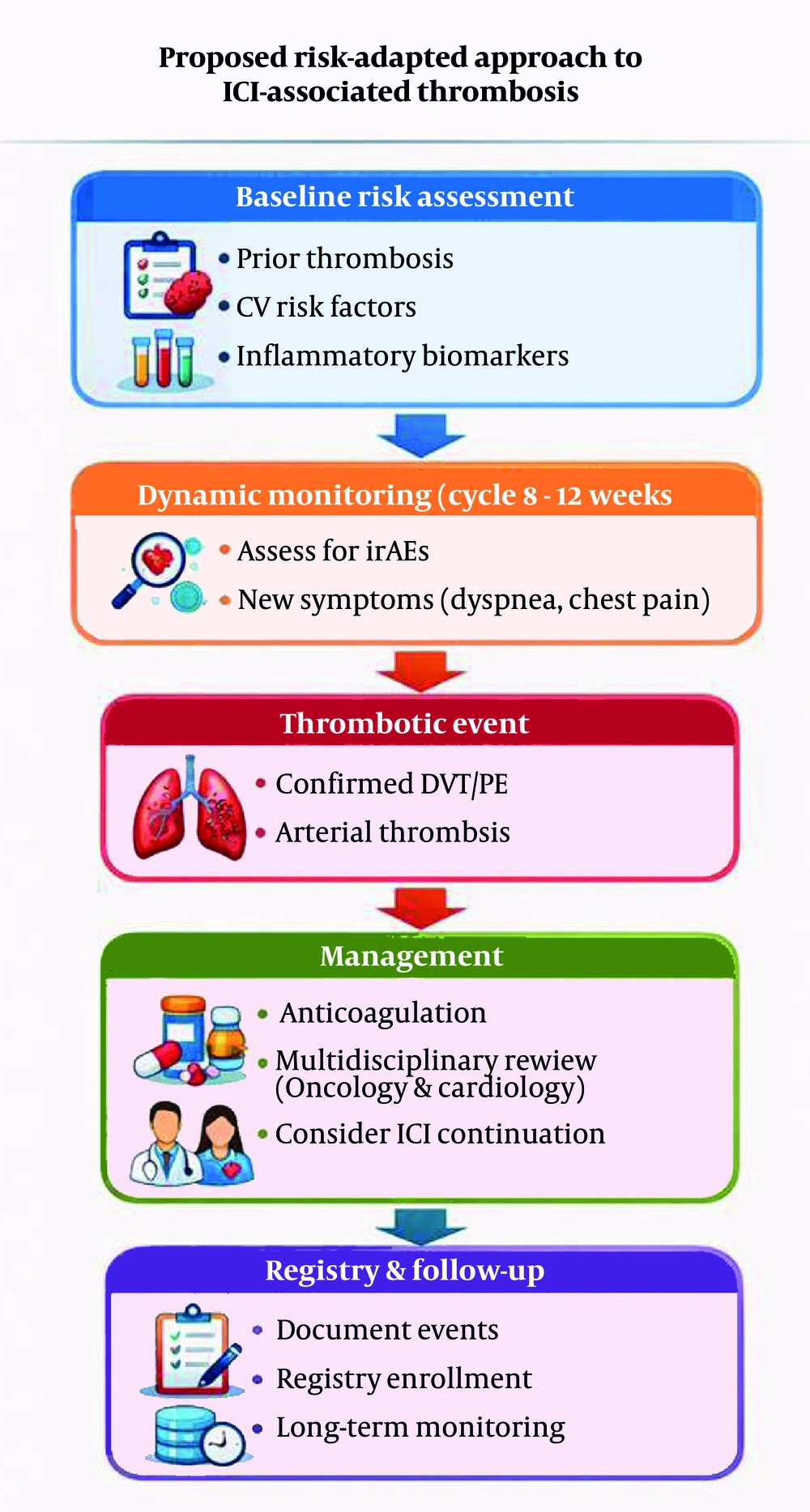
Figure 1.
Proposed risk-adapted approach to ICI-associated thrombosis. The framework integrates four components: (1) baseline risk assessment (prior thrombosis, cardiovascular risk factors, inflammatory biomarkers); (2) dynamic monitoring at 8- to 12-week intervals (assessment for new irAEs and thrombotic symptoms); (3) management of confirmed thrombotic events (anticoagulation, multidisciplinary cardio-oncology review, individualized ICI continuation); and (4) long-term follow-up with registry documentation. Abbreviations: ICI, immune checkpoint inhibitor; irAE, immune-related adverse event; DVT, deep vein thrombosis; PE, pulmonary embolism.
Baseline assessment should be performed before ICI administration and should include a history of thrombosis, cardiovascular risk factors, and cancer-related factors such as metastatic burden, tumor type, obesity, and platelet count (34). Inflammatory biomarkers, including C-reactive protein (CRP) and the neutrophil-to-lymphocyte ratio (NLR), are being investigated as predictors of thrombotic risk, although they are not validated for clinical decision-making (10). Nevertheless, they may help identify patients in whom inflammation and thrombotic risk overlap (4).
Dynamic monitoring is also important because events may occur early and may overlap with other irAEs (30). Reassessment may be particularly relevant during the early treatment period and when pneumonitis, colitis, hepatitis, or skin eruptions develop, as these findings may indicate heightened immune activation. Current evidence does not support universal primary anticoagulant prophylaxis for all patients receiving ICI therapy (15, 28).
Confirmed VTE can generally be managed according to current cancer-associated thrombosis guidelines, with individualized assessment of bleeding risk. Decisions to withhold, restart, or continue immunotherapy after a vascular event are complex because the oncologic benefits may outweigh the vascular risks (10, 35), particularly in patients with limited treatment options.
3.5. The Need for Prospective Data and Registries
A major evidence gap is the absence of adequately powered prospective trials focused on thrombosis during ICI monotherapy (38, 39). Most available data are derived from retrospective analyses and registries and are therefore vulnerable to ascertainment bias (10, 28).
Prospective registries of venous and arterial thrombotic events, biomarker-based risk stratification using CRP, NLR, or novel endothelial markers, translational studies of immunothrombosis, and trials of targeted interventions in high-risk populations are needed.
International collaboration through cardio-oncology networks is essential to generate sufficiently large data sets and support evidence-based recommendations.
3.6. Expanding the Definition of Immune-Related Cardiovascular Toxicity
As immunotherapy becomes a central component of oncology, the phenotype of immune-related cardiovascular toxicity (irCVT) may need to expand beyond myocarditis and pericarditis to include thrombosis. Current literature suggests that ICI-associated thrombotic events arise in a prothrombotic milieu characterized by endothelial inflammation, T-cell activation, and neutrophil extracellular traps (4, 40).
This expanded framework would classify VTE, myocardial infarction, and stroke as immune-mediated vascular disorders that often develop within 6 months and may coexist with irAEs such as pneumonitis or colitis. Immunothrombosis provides a mechanistic link and underscores the importance of monitoring and managing vascular risk without unnecessarily discontinuing effective treatment (40, 41).
These observations support consideration of ICI-associated thrombosis as a potential component of irCVT. Recognizing thrombosis within this framework may improve patient safety and risk assessment while preserving oncologic efficacy.
3.7. Limitations
This narrative mini-review has several limitations. First, it was not conducted as a systematic review, and relevant studies may therefore have been missed. Second, most evidence on ICI-associated thrombosis comes from observational studies and registries that are susceptible to bias. Third, studies vary substantially in their definitions of thrombosis, follow-up duration, and participant characteristics.
4. Conclusions
Increasing evidence suggests that thrombosis during ICI monotherapy may be more complex than conventional cancer-associated thrombosis. Venous and arterial events may result, at least in part, from immune-mediated vascular inflammation and immunothrombosis. Clinicians should remain particularly vigilant during the first months of ICI treatment and recognize the potential overlap with other immune-related toxicities. Existing risk-prediction models do not adequately account for these mechanisms. Prospective studies, biomarker-based risk stratification, and cardio-oncology registries are therefore needed. Until stronger evidence becomes available, prompt diagnosis and multidisciplinary decision-making may reduce the risk of serious complications without compromising oncologic outcomes.