Fulltext
Full Text Available is PDF
Image Credit:Multidiscip Cardio Annal
Authors
Pulmonary hypertension is usually
classified as primary (idiopathic) or
secondary.1 It is now clear, however, that
there are conditions within the category of
secondary pulmonary hypertension that
resemble primary pulmonary hypertension
in their histopathological features and their
response to treatment. For this reason,
the World Health Organization (WHO)
classified pulmonary hypertension into
five groups on the basis of mechanisms,
rather than associated conditions.
In 2003, the World Health Organization
revised the classification of PAH into
5 categories based in part on etiology:
pulmonary arterial hypertension, pulmonary
venous hypertension, pulmonary
hypertension associated with hypoxemia,
pulmonary hypertension resulting from
chronic thrombotic or embolic disease,
and miscellaneous. 2 Group I of the WHO
classification, designated pulmonary
arterial hypertension, is the principal focus
of this review.
Pulmonary arterial hypertension is
defined as a sustained elevation of
pulmonary arterial pressure to more
than 25 mm Hg at rest or to more than
30 mm Hg with exercise, with a mean
pulmonary-capillary wedge pressure and
left ventricular end-diastolic pressure of
less than 15 mm Hg.3Diagnosis of PPH
one must excludes all secondary cause of
PHT and demonstrate normal pulmonary
wedge pressure. 2,3
Pathophysiology:
The histopathology of pulmonary vascular
disease has been classified in two phases,
early description in the 1950s (the Heath-
Edwards classification) and an extension
of this by Rabinovitch et al. 2.3Although pulmonary vascular resistance(
PVR = mPAP _ mPCWP/Q p) may be as
high as 8-10 Wood units immediately after
birth, it normally falls rapidly through
the first week of life. By 6-8 weeks,
pulmonary vascular resistance usually
has reached a normal adult level of 1-3
Wood units. In an infant, although the
pulmonary pressure is at systemic levels,
the pulmonary vascular resistance is low
and there is pulmonary over circulation.
2.3,23,26,28
Frequency data are difficult to confirm,
as there are no international registries
tracking the incidence and prevalence
of pulmonary hypertension. Elevated
pulmonary artery pressure in congenital
heart disease is caused by pulmonary over
circulation, pulmonary vasoconstriction,
and pulmonary vascular disease, either
alone or in combination.
© 2007, Multidisciplinary Cardiovascular Annals. This open-access article is available under the Creative Commons Attribution-NonCommercial 4.0 (CC BY-NC 4.0) International License (https://creativecommons.org/licenses/by-nc/4.0/), which allows for the copying and redistribution of the material only for noncommercial purposes, provided that the original work is properly cited.
OMRANI G, Jalilifar N. Pulmonary Thromboendarterectomy. Multidiscip Cardio Annal. 2009;2(4):e8727. doi:
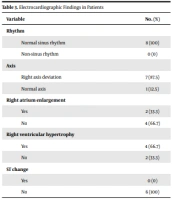
Mottaghi Moghaddam Shahri H, Ghofrani M, Alizadeh B, Seyedi J, Heidari E. Clinical and Paraclinical Findings of Primary Pulmonary Hypertension in Children. Multidiscip Cardio Annal. 2023;14(1):e114419. doi: https://doi.org/10.5812/mca-114419
Sayadpour Zanjani K. Platelets in Pulmonary Hypertension: a Causative Role or a Simple Association?. Inn J Pediatr. 2015;22(2):. doi:
Gholampour Dehaki M. Pulmonary Artery Banding in the Current Era: Is It Safe and Useful Yet?. Multidiscip Cardio Annal. 2011;3(3):e8751. doi:
Noori N, Meraji M. Comparison between echocardiography finding and cardiac catheterization data in diagnosis of pulmonary hypertension. Zahedan J Res Med Sci. 2005;7(4):e94923. doi:
Last Update: 3 weeks ago
Last Update: 3 weeks ago
Last Update: 3 weeks ago
Last Update: 8 hours ago
Last Update: 11 hours ago
Last Update: 4 days ago