Fulltext
The full text of this article is available on the PDF file.
Zahedan Journal of Research in Medical Sciences
The Official Journal of Zahedan University of Medical Sciences
Image Credit:Zahedan J Res Med Sci
Authors
Background: Pulmonary hypertension (PHT) is a common accompaniment of many congenital
cardiac lesions. Cardiac catheterization is the gold standard method for confirming the diagnosis
of PHT and for guiding management. Doppler ultrasound also can be used non-invasively to
estimate the pulmonary artery pressure.
Material and Methods: We reviewed the clinical history, examination and echocardiogram of 84
patients (male=50, female=34) [mean age = 4.2 y (3m-15y) who underwent cardiac catheterization
for their congenital heart problem in our pediatric cardiology ward (Mar 2001-Apr 2002). The
patients were divided into pulmonary hypertension (PHT) group and normal pulmonary artery
pressure (NPAP) group according to the results of catheterization.
Results: PHT was diagnosed in 40 patients (47%) by catheterization compared with 42 patients
(50%) by echocardiography. Mean age of PHT groups was 3.38 years (3 months to 4 years) by 24
male (60%); and 5.5y (8-15) by 26 male (59%) in NPAP group. The sensitivity and specificity of
echocardiography in diagnosis of PHT was 100% and 95% respectively. The positive predictive
value of echocardiography was 95% and the negative predictive value was 100%.
Conclusions: These results indicate similar diagnostic power by echocardiography and
catheterization in identifying pulmonary hypertension.
© 2005, Author(s). This open-access article is available under the Creative Commons Attribution 4.0 (CC BY 4.0) International License (https://creativecommons.org/licenses/by/4.0/), which allows for unrestricted use, distribution, and reproduction in any medium, provided that the original work is properly cited.
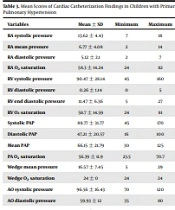
Mottaghi H, Ghofrani M, Alizadeh B, Abbasi Shaye Z, Heidari E. The Predictability of Echocardiography in Children with Primary Pulmonary Hypertension and Its Comparison with Cardiac Catheterization Parameters. Zahedan J Res Med Sci. 2022;24(4):e115130. doi: https://doi.org/10.5812/zjrms-115130
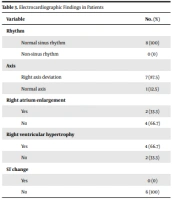
Mottaghi Moghaddam Shahri H, Ghofrani M, Alizadeh B, Seyedi J, Heidari E. Clinical and Paraclinical Findings of Primary Pulmonary Hypertension in Children. Multidiscip Cardio Annal. 2023;14(1):e114419. doi: https://doi.org/10.5812/mca-114419
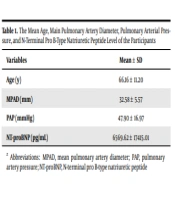
Gharibi S, Ghavami M, Khederlou H, Ghorashi SM, Dabiran S, et al. Evaluation of the Correlation of Pulmonary Arterial Hypertension (PAH) with the Pulmonary Artery Trunk Diameter and Serum Level of N-Terminal Pro B-Type Natriuretic Peptide (NT-proBNP) in Patients with PAH. I J Radiol. 2023;20(2):e133022. doi: https://doi.org/10.5812/iranjradiol-133022
Amoozgar H, Fallahi M, Ajami G, Borzouee M. The Relationship of Coronary Sinus Dilation with Pulmonary Artery Pressure in Pediatric Patients. Int Cardiovasc Res J. 2017;6(2):e12818. doi:
Gholampour Dehaki M. Pulmonary Artery Banding in the Current Era: Is It Safe and Useful Yet?. Multidiscip Cardio Annal. 2011;3(3):e8751. doi:
Last Update: 3 weeks ago
Last Update: 3 weeks ago
Last Update: 3 weeks ago
Last Update: 4 hours ago
Last Update: 1 day ago
Last Update: 4 days ago