
1. Background
Skin cancer is the most common type of cancer. Studies in most countries indicate a high prevalence of skin cancer that is increasing (1). In Iran, skin cancer is the most common type of cancer, with a male-to-female ratio of 1.6 (2). It is the first most frequent cancer for males with an age-standardized incidence rate (ASR) of 18.93 and the second most common cancer for females with an ASR of 13.09 (3).
The most important etiology of skin malignancies is ultraviolet (UV) radiation. Excessive exposure to sunlight in childhood and adolescence and its subsequent cumulative dose effect are important factors in skin cancer. Moreover, 50 - 80% of solar radiation is accumulated in childhood and adolescence (4, 5). It is estimated that 80% of sun exposure occurs before the age of 21. Children and adolescents spend numerous hours during the week at school, some of which they spend in the sun. On the other hand, adolescents are exposed to more sunlight than other age groups, especially on weekends and in the summer (6).
Primary cancer prevention emphasizes the reduction of risk factors in healthy individuals. Exposure to UV light is the most important modifiable risk factor for skin cancer (7). Studies show that sun protection programs are most effective in preventing skin cancer in childhood and adolescence, and some even consider sun protection to be effective only in childhood and adolescence. Raising cancer awareness is one of the World Health Organization strategies in cancer control because 75% of all skin cancers can be prevented by increasing the awareness of children and adolescents about sun protection measures. Such basic sun protection measures include light-colored cotton clothing that covers most of the body, hats and sunglasses, staying in the shade and avoiding exposure to sunlight at noon, and using sunscreen with an appropriate sun protection factor (8).
The high prevalence of skin cancer and its relationship to sun exposure, educating individuals on the appropriate sun protection modalities, and educating physicians and individuals about the early detection of skin cancer seems to be significant in the prevention of its incidence (9). Additionally, the first step in the development of acceptable, feasible, and effective strategies is to identify patterns of knowledge, attitude, and performance that can be used as basic tools for behavioral interventions to prevent skin cancer (8).
2. Objectives
Considering the importance of adolescence in the prevention of skin cancer in the future, the geographical location of Birjand, Iran, which is located in an area with high UV radiation, and cultural issues, this study aimed to determine the knowledge, attitude, and practice of female high school students regarding protective behaviors against UV rays.
3. Methods
This descriptive cross-sectional study was performed on female high school students in Birjand within October to January 2018. The number of samples was calculated to be approximately 380 individuals. Due to the possibility of loss or nonresponse, it was multiplied by a reliability coefficient of 1.5, resulting in a final sample size of 570 subjects.
The study population was selected using a stratified cluster random sampling method by maintaining proportionality between public schools in different regions. The stratified cluster sampling approach incorporated a combination of stratified and cluster sampling methods. Firstly, Birjand was stratified by geographic region with different socioeconomic characteristics. Therefore, the city schools were divided into four geographic regions, namely north, south, east, and west. Secondly, a cluster sampling process was performed within each stratum to ensure that each region was adequately represented. Therefore, two schools from each region were selected randomly. Within each chosen school, the total number of students were enrolled in the study. The students were justified before answering the questionnaire, and then the questionnaires were distributed in each high school among students willing to participate in the study. The exclusion criteria were incomplete or incorrect filling of the questionnaire due to a lack of proper cooperation.
The data collection tool was a researcher-made questionnaire containing various items related to knowledge, attitude, and practice. The validity of the questionnaire was confirmed by calculating the content validity index and content validity ratio. For the evaluation of reliability, a pilot study was conducted on 40 students, and Cronbach’s alpha was calculated (knowledge questionnaire: 0.949/attitude questionnaire: 0.816/practice questionnaire: 0.835). In the questionnaire, knowledge was assessed with 16 three-choice items and a score range of 0 - 16, attitude with 8 five-choice items and a score range of 8 - 40, and performance with 12 five-choice items and a score range of 12 - 60. In each field, levels above 50% and less than 50% were considered good and poor, respectively. Information was also obtained on the geographical location of the school, field of study, educational level, grade point average, and parents’ educational level.
The data were analyzed using SPSS software (version 22) based on descriptive-analytical analyses. Frequency tables, central indices, and dispersion were used to describe the data. In addition, the independent t-test and analysis of variance were used to compare the means of quantitative variables between the two groups. The chi-square test was also used for qualitative variables.
4. Results
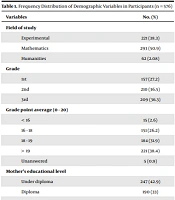
A total of 576 students answered the questionnaire correctly and were enrolled in the study. The geographical region of the school was in the north and east (poor socioeconomic status) for 47.6% of students and in the south and west (good socioeconomic status) for 52.4% of students. Table 1 shows the frequency distribution of demographic variables in the subjects, including the field of study, grade, grade point average, and parents’ educational level. The mean scores for knowledge, attitude, and practice were 6.95 ± 2.37, 29.83 ± 4.05, and 37.12 ± 7.48, respectively (Table 2). Out of all students, 26.7%, 89.1%, and 53.6% had good knowledge, attitude, and practice regarding skin protection against UV rays.
Table 1.
Frequency Distribution of Demographic Variables in Participants (n = 576)
| Variables | No. (%) |
|---|---|
| Field of study | |
| Experimental | 221 (38.3) |
| Mathematics | 293 (50.9) |
| Humanities | 62 (2.08) |
| Grade | |
| 1st | 157 (27.2) |
| 2nd | 210 (36.5) |
| 3rd | 209 (36.3) |
| Grade point average (0 - 20) | |
| < 16 | 15 (2.6) |
| 16 - 18 | 151 (26.2) |
| 18 - 19 | 184 (31.9) |
| > 19 | 221 (38.4) |
| Unanswered | 5 (0.9) |
| Mother’s educational level | |
| Under diploma | 247 (42.9) |
| Diploma | 190 (33) |
| Higher education | 139 (34.1) |
| Father’s educational level | |
| Under diploma | 191 (33.1) |
| Diploma | 194 (33.8) |
| Higher education | 191 (33.1) |
Table 2.
Central Indicators and Dispersion of Participants’ Knowledge, Attitude, and Practice Scores
| Mean ± SD | Median | The Lowest Score | The Highest Score | Score Range | |
|---|---|---|---|---|---|
| Knowledge | 6.95 ± 2.37 | 7 | 0 | 12 | 0 - 16 |
| Attitude | 29.83 ± 4.05 | 30 | 12 | 40 | 8 - 40 |
| Practice | 37.12 ± 7.48 | 37 | 17 | 55 | 12 - 60 |
Abbreviation: SD, standard deviation.
Knowledge, attitude, and practice scores were compared according to the school location, field of study, grade, last year’s grade point average, and parents’ educational level. The results showed that the practice score varied significantly according to the location of the school; the students from southern and western schools, which had a good socioeconomic status, scored higher (P < 0.001, Z = -3.74). All three scores were significantly different according to the field of study; the experimental sciences students had higher knowledge (P = 0.01, χ2 = 9.23), and the humanities students had higher attitude (P = 0.03, χ2 = 7.30) and practice (P = 0.007, χ2 = 10.02) than the other two disciplines. There was a significant difference in knowledge scores according to the grade; students in the third grade received higher scores (P < 0.001, χ2 = 19.66). Knowledge scores showed a significant difference in terms of the last year’s grade point average; the students with a grade point average above 19 scored higher (P = 0.01, χ2 = 11.21).
The students whose mothers had university education obtained a higher score in all three variables of knowledge (P = 0.004, χ2 = 11.06), attitude (P = 0.005, χ2 = 12.76), and practice (P < 0.001, χ2 = 18.78). Father’s university education was associated with higher practice scores (P < 0.001, χ2 = 20.73).
The results of the regression test showed that knowledge and attitude have a significant relationship with practice. The values of standard coefficients for knowledge and attitude were 0.10 (P = 0.008) and 0.39 (P < 0.001), respectively. Due to the higher coefficient, the attitude had a greater impact on practice.
5. Discussion
The present study showed that 26.7%, 89.1%, and 53.6% of students had good knowledge, attitude, and practice regarding skin protection against UV rays. In addition, knowledge and attitude had a significant relationship with practice. Although skin cancer is the most common cancer, it is also one of the most preventable cancers. Children and adolescents are among the most vulnerable to UV rays due to greater exposure to the sun and lower risk perception. Health education to the community, especially at-risk groups, is the main focus of disease control and prevention. The first step in the development of effective strategies is to identify patterns of behavior, knowledge, and attitude that can be used as basic tools for behavioral interventions to prevent skin cancer (7).
A study by Schuz and Eid demonstrated that time perspective, outcome expectancies, and self-efficacy are the most important factors influencing students’ attitudes toward sun protection and skin cancer prevention (10). Gibbons et al. also showed that if individuals understand the hazards and vulnerabilities of the sun, their attitudes toward sun protection will improve (11). Considering that in the present study and a study by Tabatabayian et al. (6), students did not have good knowledge about skin cancer, it seems that if the necessary information is given about the risk of skin cancer due to the lack of sun protection, their attitudes can be improved.
Maleki et al. investigated the students’ knowledge about the effects of sunlight on the skin and the necessity of skin protection behaviors against sunlight. They concluded that the knowledge of educated individuals about the need for sun protection is insufficient and highlighted the need for public education on prevention methods (12).
A study by Baghianimoghadam et al. in Yazd, Iran, has shown that beliefs play a major role in predicting sun protection behaviors (13). Cercato et al. highlighted the importance of beliefs and attitudes in behavior modification (14). Likewise, the current study showed that both knowledge and attitude have a direct effect on practice scores. In addition, due to the higher coefficient of attitude, this variable has a greater effect on performance and can increase performance by increasing the level of attitude.
Childhood seems to be a good period to intervene in sun protection behaviors, as health and lifestyle behaviors begin to take shape and stabilize in childhood and adolescence. Parents play an important role in shaping responsibility behaviors for the health of children and adolescents because they are the primary factors in shaping the beliefs, norms, and behaviors of their children; the more favorable beliefs and attitudes parents have toward protection against sunlight, the more they will engage in behaviors related to protecting their children from sunlight (13). Other studies have also shown the impact of parental attitudes and behaviors on skin protection methods in children (15-17).
The present study also showed that a mother’s university education was associated with higher knowledge, attitude, and practice scores. Father’s education only affected the practice score. Therefore, the effective role of parents, especially mothers, in shaping norms and better care for children could be understood.
Mazloomy Mahmoodabad et al. showed that knowledge has a significant relationship with age, gender, education, and occupation. They have also stated that attitudes toward skin cancer have a significant relationship with education and occupation, and behavior has a significant relationship with education (18). In the present study, the grade and grade point average of students had an effect on their level of knowledge. Moreover, the experimental sciences students had higher knowledge, and the humanities students had higher attitude and practice than other disciplines. In the current study, the students with good socioeconomic status had better practice. This issue should be considered in health policies.
The limitation of the present study was the focus on female high school students. It is recommended to perform studies that include students of both genders, all school grades, and different cities. It is also suggested to carry out further prospective and interventional studies to determine the effect of education on students’ sun protection behavior and self-care.
5.1. Conclusions
Practice can be improved by increasing the level of knowledge and attitude. The educational level of the parents, especially mothers, is very important in this regard. Therefore, by educating parents, students’ knowledge, attitude, and practice status can be improved. Moreover, the improvement of socioeconomic status will promote protective behavior.