
1. Background
The paramount importance of food hygiene in preserving human health and preventing disease is now universally recognized. The core principle of food hygiene centers on the appropriate consumption of food to maintain well-being. Food hygiene and safety are considered essential for preventing human morbidity and safeguarding the environment from contamination. Each year, millions of people contract foodborne illnesses, sometimes with fatal consequences, constituting a significant global health challenge (1). The World Health Organization (WHO) identifies food contamination and the resulting diseases as critical public health issues in the contemporary world (2). The Codex Alimentarius Commission defines food hygiene as encompassing all necessary measures during food production, processing, storage, and distribution to ensure the delivery of safe, high-quality food to consumers.
Over the past decade, the incidence of foodborne microbial illnesses has been on the rise not only in developing countries with poor sanitation but also in developed nations with high sanitary standards. Food can act as a vehicle, harboring numerous infectious and non-infectious agents. Under certain conditions, it can support the growth of infectious agents, acting as an active vector, or simply serve as a passive carrier, where the infectious agent does not proliferate but is merely transmitted to humans via the food (3). Statistical studies indicate that the majority of foodborne illnesses are caused by microorganisms. Outbreaks of these illnesses jeopardize countless lives annually, causing social and economic hardship, particularly in developing countries (4).
Unsafe food poses a global health risk, affecting everyone. Infants, young children, pregnant women, the elderly, and individuals with underlying health conditions are particularly vulnerable (5). Common symptoms of foodborne illnesses include diarrhea, fever, headache, vomiting, abdominal cramps, severe fatigue, and occasionally blood and pus in the stool (6). Data published by the centers for disease control (CDC) indicate that foodborne illnesses result in 325,000 serious illnesses requiring hospitalization and 76 million cases of gastrointestinal illness (7). Preventive measures such as public health education, avoiding traditional and unsanitary food processing methods, ensuring adequate cooking temperatures, avoiding unpasteurized dairy products, and regular monitoring by health authorities can effectively prevent dangerous food poisoning (8).
Awareness refers to knowledge, while attitude reflects expressed opinions and judgments, and performance refers to function and outcomes towards a subject (6). Studies have demonstrated that public education and increased awareness play a crucial role in improving nutritional status (9). A study examining the knowledge, attitudes, and practices of students regarding food safety revealed that students who had completed food-related coursework demonstrated significantly higher levels of knowledge and more positive attitudes compared to other students, and their practices were also notably improved (10).
Hygienic behaviors in youth and students are of considerable importance, as this demographic serves as a model for other segments of society. Furthermore, investigations into public awareness and attitudes can not only draw attention to health issues but also foster positive health behaviors (11).
2. Objectives
Therefore, assessing the level of student awareness and associated factors regarding food hygiene is of paramount importance. Given the significance of this issue and its profound impact on public health, this study investigates the knowledge, attitudes, and practices of medical students concerning food hygiene and safety.
3. Methods
This study is a cross-sectional, descriptive-analytical study. The study population consisted of 140 medical students at various academic levels at Zahedan University of Medical Sciences. Inclusion criteria included students willing to participate in the study and completion of at least one academic semester at the university. Exclusion criteria included unwillingness to participate in the study, first-semester university students, and incomplete questionnaire completion by students. The study protocol was registered and approved by the ethics committee of Zahedan University of Medical Sciences under the code IR.ZAUMS.REC.1401.185.
Considering the number of 35 medical student volunteers from each of the following academic levels — Basic Sciences, Physiopathology, Clerkship, and Internship — were selected using a stratified and convenience sampling methodology. Data were collected using a WHO-designed questionnaire, the reliability and validity of which had been assessed and confirmed using Cronbach's alpha coefficient in the study by Moghadam et al. (12). The questionnaire comprised four distinct sections. The first section elicited demographic information, followed by a second section consisting of 23 questions assessing knowledge. The third section contained 15 questions designed to evaluate attitudes, and the fourth section included 10 questions focused on performance.
Descriptive statistics, including mean, median, standard deviation, frequency percentages, statistical tables, and graphs, were utilized to describe the data. The independent samples t-test, analysis of variance (ANOVA), and chi-square tests were employed to determine the correlation between variables. All data analysis and statistical tests were conducted using SPSS version 22, with statistical significance defined as a P-value of less than 0.05.
4. Results
This study assessed the awareness, attitudes, and practices of 140 medical students at Zahedan University of Medical Sciences. The mean age of the students was 22.6 ± 2.4 years, with an age range of 18 to 29 years. Regarding gender distribution, 91 students (65%) were female, and 49 (35%) were male. In terms of marital status, 16 students (11.42%) were married, and 124 (88.6%) were single. The mean grade point average (GPA) of the students was 16.1 ± 1.06. Regarding GPA level, 33 students (23.5%) had a GPA of 17 or higher, while the remaining students had a GPA below 17.
In this study, the mean scores for awareness, attitudes, and practices of medical students at Zahedan University of Medical Sciences regarding food hygiene and safety were 25.05 (moderate awareness), 34.45 (weak attitudes), and 25.52 (moderate practices), respectively. Considering the possible score ranges, the students' level of attitude was lower than their levels of knowledge and practice. The score ranges were 0 to 57 for awareness, 15 to 75 for attitudes, and 10 to 50 for practices.
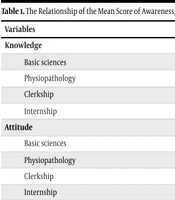
A statistically significant relationship was found between the mean awareness score of students and their academic level (P = 0.006). A significant relationship was also observed between attitude and academic level (P = 0.041). The mean awareness score was higher in the basic sciences level, and the mean attitude score was higher in the physiopathology level compared to other levels. However, no significant difference in practices was observed across the different academic levels (Table 1).
Table 1.
The Relationship of the Mean Score of Awareness, Attitude, and Performance of the Studied Students with Their Educational Level
| Variables | Mean ± SD | P-Value |
|---|---|---|
| Knowledge | 0.006 | |
| Basic sciences | 27.8 ± 10.29 | |
| Physiopathology | 26.62 ± 10.6 | |
| Clerkship | 26.16 ± 12.43 | |
| Internship | 19.44 ± 8.95 | |
| Attitude | 0.041 | |
| Basic sciences | 34.05 ± 5.7 | |
| Physiopathology | 36.42 ± 3.95 | |
| Clerkship | 33.05 ± 4.79 | |
| Internship | 34.32 ± 5.42 | |
| Practice | 0.258 | |
| Basic sciences | 26.4 ± 3.64 | |
| Physiopathology | 25.77 ± 4.38 | |
| Clerkship | 25.33 ± 3.59 | |
| Internship | 24.55 ± 3.92 |
A statistically significant negative correlation was observed between age and attitude (r = -0.205, P = 0.875), indicating that for every one-year increase in age, the attitude score decreased by 0.205 units. No significant correlation was found between age and awareness (P = 0.875) or practices (P = 0.188). Similarly, no significant correlation was found between GPA and knowledge (P = 0.749), attitude (P = 0.946), or practices (P = 0.855). No significant relationship was found between gender and the mean scores for awareness, attitudes, and practices (P = 0.461, P = 0.619, and P = 0.38, respectively). Likewise, no significant relationship was found between marital status and the mean scores for knowledge, attitudes, and practices (P = 0.686, P = 0.317, and P = 0.874, respectively).
5. Discussion
In this study, medical students demonstrated a lower level of attitude compared to their awareness and practice. This finding aligns with the results of studies by Gharibi et al., Almansour et al., and Abedi et al. (13-15). Despite a relatively acceptable level of knowledge and practice among medical students regarding food hygiene and safety, which could be attributed to the relevant coursework throughout their academic years, their attitudes in this area were found to be inadequate. For instance, approximately 35% of the students reported that, despite their awareness, they did not always store cooked food in sealed containers in the refrigerator. Furthermore, 37.1% of students admitted to occasionally purchasing food from street vendors, while about 83% considered washing fruits before consumption essential, indicating the highest level of practice among the students.
This study indicated that most students exhibited moderate levels of awareness and practice but a low level of attitude. These results corroborate the findings of studies by Roy et al., Marzban et al., and Gokceel and Akoglu (16-18). It appears that a high level of awareness among students does not necessarily translate into a change in attitude or improved practice. The study by Azanaw et al. (19) demonstrated that food safety knowledge does not directly influence attitudes towards food safety, as there was no significant correlation between knowledge and practice, suggesting that food safety behaviors were independent of attitudes among students. Such findings indicate that challenges related to foodborne illnesses may persist. Therefore, based on the findings of this study, it is recommended that efforts be made to enhance not only the awareness but also the attitudes and practices of medical students regarding food safety, in addition to formal education.
The current study revealed a significant relationship between students' knowledge level and their academic level, with basic science students demonstrating higher knowledge levels compared to those in the clerkship, physiopathology, and internship phases. This finding is consistent with the studies by Nouri Motlagh et al. and Jahdkhaniki et al. (20, 21). This difference could be attributed to chance or the fact that basic science students have recently completed or are currently taking courses in basic sciences and nutrition, and thus retain information related to food safety and hygiene more effectively.
The study illustrated no significant relationship between students' attitudes and gender. This result aligns with the studies by Azanaw et al. and Roy et al. (18, 19), but contradicts the findings of Gokceel and Akoglu (16), who reported that female students paid more attention to their diet, placed greater importance on food hygiene and health, and were more influenced by their peers in this regard. The study by Nouri Motlagh et al. revealed that 77% of students had a moderate level of attitude towards food hygiene and safety, and there was a significant correlation between students' knowledge, attitudes, and the completion of a food hygiene course (21). Therefore, it is recommended that educational programs, such as workshops or the inclusion of a food hygiene course in the curriculum for medical programs that do not offer such a course, be implemented to address the relationship between knowledge, hygiene, and food safety. Awareness about food hygiene and safety is essential for preventing foodborne illnesses and contamination. Although medical students are expected to have a high level of knowledge and practice in this area, factors such as lack of time, economic constraints, and academic pressures may hinder their ability to consistently demonstrate appropriate behaviors. Therefore, it is necessary to implement educational programs in the form of workshops.
Students in the earlier stages of their studies demonstrated higher scores in terms of awareness, attitudes, and practices regarding food safety compared to their peers in later stages. This further emphasizes the importance of education and the need for a more focused approach that emphasizes practical application.
Limitations of this study include the issue of incomplete questionnaire responses, a recognized challenge inherent in survey-based research. To mitigate this limitation, in instances of incomplete responses, a substitute participant from the same academic level was recruited. Furthermore, the limited generalizability of the findings to the entire student population constitutes another constraint of the present study. One factor that may influence knowledge and practice regarding nutrition is the socioeconomic status of students, which was not examined in this study. It is recommended that future studies investigate this factor, as well as the underlying reasons for poor food hygiene and safety practices among students. By identifying these factors, preventive measures can be implemented.
5.1. Conclusions
This study revealed that despite a relatively high level of awareness regarding food hygiene and safety among students, a change in attitude did not necessarily translate into a change in practice. Based on these findings, to achieve adequate awareness, attitudes, and improved practices among students regarding food safety and hygiene, more comprehensive and ongoing theoretical and practical training is required. Such education and support services could be provided through workshops, educational tools, or other resources throughout students' academic careers, regardless of their academic level or field of study.