
1. Background
Dentistry has been recognized as a highly stressful profession. Stress can cause a drop in the quality of services provided. Female dentists, who constitute a significant percentage, are more exposed to mental and physical diseases (1, 2). For years, theories and studies have confirmed that this profession faces more stressful situations, which are basically related to the nature of the work and the type of working conditions of the dentist (3).
Various stressful conditions in the dental profession, including economic and financial concerns, office management problems, the need to make quick and numerous decisions, working with toxic substances, unpleasant sounds and smells in the workplace, facing emergencies, physical fatigue caused by inappropriate working posture and conditions, and perception of competition with other dentists can cause a lot of stress and consequently mental and physical complications in dentists (4, 5). It has also been reported that the prevalence of stress in dentists is more than 3 times that of ordinary people. Additionally, occupational stress can cause cardiovascular, digestive, and skin diseases in others (6).
According to a report by the World Congress of Dental Education, dental education is considered complex and often stressful. Dentistry requires clinical and patient management skills. Dentists experience high levels of work-related stress that starts with dental education and continues throughout dental practice (7).
In a study of more than 3500 dentists, 38% reported always or frequently feeling worried and anxious, 34% often felt mentally and physically tired, and 26% often had headaches or backaches. Thus, some researchers have reported the highest rates of job burnout among general dentists and maxillofacial surgeons, as well as the lowest rates in orthodontic specialists due to the hard nature of dental work (8). In addition, other researchers have mentioned that various stressors in the dental profession can cause a decrease in the quality and quantity of dental services and lead to increased burnout among dentists (9).
A study that evaluated stress levels in dentists reported that some people, including educated people, may inappropriately resort to maladaptive habits and behaviors such as smoking, alcohol consumption, and drug abuse in the face of stress. The prevalence rate of suicide among dentists has been reported to be 2.5 to 5.5 times higher than the average societal prevalence rate (7).
Studies about stress and job satisfaction in the medical staff have determined that there is a significant relationship between stress and job satisfaction in these people (10, 11). Studies have also shown that the variables of age, job position, education level, work experience, overtime work, type of overtime, type of housing and workplace, and availability of in-service retraining courses are significantly associated with job satisfaction. Therefore, occupational stress, job satisfaction, and the factors affecting them are among the most important social issues that have been the focus of many researchers and psychologists in the past 2 decades (12, 13).
2. Objectives
Because of the problems that can be caused by stress in the careers of dentists and since the above-mentioned studies have recognized dentistry as a highly stressful profession, the present research was conducted in Khorramabad, Iran, to investigate the relationship between occupational stress and demographic variables, as well as to identify stressors threatening professional and social lives of dentists.
3. Methods
This research was carried out with the approval of the Ethics Committee of Lorestan University of Medical Sciences (code IR.LUMS.REC.1401.126).
The present study was a cross-sectional analytical study. The studied population included all dentists working in Khorramabad, Iran, in 2022. The census sampling method was used. After preparing the list of dentists working in Khorramabad, 92 dentists out of 120 were enrolled in the study according to the inclusion and exclusion criteria. Inclusion criteria were a working experience of more than 1 year and being a practicing dentist at the time of the study. Exclusion criteria were unwillingness to participate in the study and partial completion of the questionnaires. To collect the data, the researcher completed the questionnaires in coordination with the dentists' offices. Prior to the completion of the questionnaire, the research objectives were explained to the dentists, ensuring clarity about the purpose of the study.
The main data collection instrument in this study was Osipow’s Occupational Stress Inventory, which is a well-known test used in the field of human resources assessment. This instrument evaluates the level of stress of employees in organizational environments. Osipow and Spokane designed this test in 1987. Sharifian et al. reported the content validity of this questionnaire as very satisfactory. Its reliability was measured as satisfactory by the test-retest method, and its Cronbach's alpha coefficient was calculated and reported as 0.89 (14).
Questionnaire items are scored on a 5-point Likert scale as follows: “Never” = 1, “sometimes” = 2, “often” = 3, “frequently” = 4, and “always” = 5. The scores obtained on this questionnaire range from a minimum of 60 to a maximum of 300, with the higher scores indicating higher stress levels (1).
The scores obtained on Osipow’s Occupational Stress Questionnaire are interpreted as follows: A score of 55 to 99 indicates a low-stress level, a score between 100 and 149 shows a low to moderate stress level, a score of 150 to 199 indicates moderate to severe stress, and a score of 200 and greater indicates severe occupational stress.
Descriptive statistics were used to calculate the frequencies and percentages of variables. To examine the relationships among the desired variables and occupational stress score, first, the normality of the data was measured using the Kolmogorov-Smirnov test. If data distribution was normal, independent t-tests, analysis of variance (ANOVA), and Pearson's correlation were used. If data distribution was not normal, the non-parametric equivalents of the mentioned tests were used. Moreover, considering occupational stress as a qualitative variable, the chi-square test was used to measure the relationships between the desired variables and occupational stress. All statistical tests were performed using SPSS version 25, considering P < 0.05 as the significance level.
4. Results
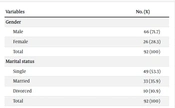
In this research, 92 dentists were interviewed, whose demographic information is listed in Table 1.
Table 1.
Demographic Information of Dentists Working in Khorramabad, Iran
| Variables | No. (%) |
|---|---|
| Gender | |
| Male | 66 (71.7) |
| Female | 26 (28.3) |
| Total | 92 (100) |
| Marital status | |
| Single | 49 (53.3) |
| Married | 33 (35.9) |
| Divorced | 10 (10.9) |
| Total | 92 (100) |
| Underlying conditions and diseases | |
| Has | 42 (45.7) |
| Does not have | 50 (54.3) |
| Total | 92 (100) |
| Sports activity | |
| Plays sports | 42 (45.7) |
| Does not play sports | 50 (54.3) |
| Total | 92 (100) |
| Hobbies and additional activities | |
| Has | 62 (67.4) |
| Does not have | 30 (32.6) |
| Total | 92 (100) |
| Workplace | |
| Personal office | 30 (32.6) |
| Private clinic | 48 (52.2) |
| Government clinic | 14 (15.2) |
| Total | 92 (100) |
Table 2 shows the state of occupational stress among dentists in Khorramabad, Iran. As can be seen, 89.1% of the dentists experienced moderate to severe stress, and 10.9% suffered from severe stress.
Table 2.
Determining the Average Occupational Stress Levels Among Dentists Working in Khorramabad, Iran
| Occupational Stress Level | No. (%) |
|---|---|
| Moderate to severe | 82 (89.1) |
| Severe | 10 (10.9) |
| Total | 92 (100) |
Table 3 presents the relationships between the average occupational stress scores and demographic variables.
Table 3.
Determining the Relationship Between Demographic Variables and Occupational Stress in Dentists Working in Khorramabad, Iran
| Variables | Number | Mean Stress Score (SD) | P Value |
|---|---|---|---|
| Age | 0.019 a | ||
| ≤ 30 | 40 | 186.75 (9.87) | |
| > 30 | 52 | 181.90 (9.44) | |
| Gender | 0.007 a | ||
| Male | 66 | 185.42 (10.68) | |
| Female | 26 | 180.42 (6.35) | |
| Workplace | < 0.001 b | ||
| Personal office | 30 | 177.77 (3.95) | |
| Private clinic | 48 | 182.79 (6.78) | |
| Government clinic | 14 | 201.57 (7.35) | |
| Marital status | 0.069 b | ||
| Single | 49 | 186 (9.63) | |
| Married | 33 | 181.85 (10.57) | |
| Divorced | 10 | 181.40 (9.88) |
a Independent t-test.
b One-way ANOVA.
The independent t-test showed that the level of occupational stress was significantly higher in dentists younger than 30 years than in those older than 30 years (P = 0.019). The independent t-test also showed that the level of occupational stress in men was significantly higher than that of women (P = 0.007).
One-way ANOVA showed that there is a significant difference between different groups in terms of place of employment. Dentists working in a government clinic had the highest level of job stress, and dentists working in a private practice had the lowest level of job stress (P < 0.001).
One-way ANOVA showed that although the stress level was higher in single dentists, no statistically significant differences were observed in the average occupational stress scores of single, married, or divorced participants (P = 0.069).
With regard to other demographic variables related to the level of occupational stress, the findings of the present research showed that there were no significant relationships between work experience, number of children, history of past illnesses, playing sports, and having hobbies or other activities with occupational stress levels in dentists working in Khorramabad, Iran.
5. Discussion
Many researches have shown that occupational stress is related to many diseases and problems in the work environment, and this relationship has been confirmed regarding cardiovascular diseases, musculoskeletal diseases, blood pressure, and some other medical conditions ((6, 15, 16). The World Health Organization (WHO) has reported that more than half of workers in industrialized countries suffer from occupational stress, and occupational stress is the second most common problem in the workplace after back pain (17-19).
In the present study, 92 dentists, 66 males (71.7%) and 26 females (28.3%), participated. The findings of the present study showed that more than 89% of dentists in Khorramabad experience moderate to severe stress, which is consistent with a study by Kouhnavard et al. (20). Additionally, Heidari (21) reported a significant difference between individual and organizational stressors affecting job performance, which is consistent with the present study. In this regard, it can be said that stress affects a major part of the life of dentists in the working environment, and if it continues for a long time or is severe, the person will gradually experience fatigue and exhaustion. Continued exposure to stressors can lead to a decrease in the physical and mental energy of employees. This can ultimately pose a risk to public health, weaken individuals' capabilities, and further exacerbate occupational stress. It creates a cycle where the detrimental effects of stressors perpetuate and intensify the overall level of occupational stress experienced by individuals.
In the present study, it was observed that the level of occupational stress in participants younger than 30 years was significantly higher than in participants over the age of 30 years (P = 0.019). In other words, younger people who are at the beginning of their professional careers experience more stress (22). A study conducted in the nursing community by Rezaee et al. (23) showed an inverse relationship between age and occupational stress, such that occupational stress levels decrease with age.
The current research showed that the level of occupational stress in men was significantly higher than that of women (P = 0.007). This can be explained by the fact that men usually have a higher daily workload due to greater financial pressures and higher societal expectations, as well as a greater desire for occupational and financial independence, resulting in greater economic and financial concerns. Physical fatigue is mostly due to working in a fixed position, and the feeling of competition with colleagues can further intensify the level of occupational stress that men experience compared to women.
The findings of the present study showed a significant relationship between the work environment and the level of occupational stress (P < 0.001). Dentists who worked in a private office experienced the least stress, and dentists who worked in government clinics (such as the Police Dental Clinic and IRGC as soldier-dentists) experienced the highest levels of occupational stress. This statistically significant difference can be attributed to differences in income levels, the psychological pressures of the work environment, and differences in the facilities and equipment available in the workplace (24).
The present study also showed that the mean stress score of single dentists was higher than that of married dentists, but it was not statistically significant. This is consistent with the results of other studies (24), showing that single working women experience more job stress than married working women. In this regard, it can be said that social support, including family relationships, has an inverse relationship with occupational stress, and married employees experience significantly fewer feelings of depression because they receive more support from their families (25).
5.1. Limitations
Among the limitations of the present study, the unwillingness of some dentists to answer some questions in the questionnaire, as well as the limited number of participants, can be mentioned. Therefore, it is recommended that similar studies with more participants be carried out in larger geographical areas.
5.2. Conclusions
This study demonstrated that most dentists suffer from moderate to severe stress. The analysis of the results indicated significant relationships between the demographic variables of age, gender, and the working environment of dentists and the occupational stress that they experienced. Further research needs to be done with analytical designs. In addition, since higher occupational stress levels increase fatigue and decrease job performance, gaining knowledge about the sources of stress and ways to deal with them can be beneficial in reducing fatigue and increasing the job performance of dentists.