Fulltext
-
Image Credit:Med Surg Nurs J
Authors
Background: Sleep disorders are one of the major challenges in intensive care units (ICUs). Psychological, physical and environmental factors are involved in the development of sleep disorders. Therefore, proper adjustment of these factors is of paramount importance. This study aimed to evaluate the effects of a quiet time protocol on the sleep quality of patients admitted in the ICU.
Methods: This clinical trial was conducted on 60 patients admitted in the surgical ICU of Ghaem Hospital of Mashhad, Iran in 2013. Patients were selected via convenience sampling and randomly divided into two groups of intervention and control. Quiet time protocol was implemented in the intervention group for three consecutive nights (7 pm-5 am). Data were collected using researcher-made questionnaires of subjective sleep quality on the first, second and third night. Data analysis was performed in SPSS version 21 using Fisher's exact test, Chi-square, independent T-test, and repeated measures ANOVA.
Results: In the intervention group, mean score of sleep quality in the domain of sleep effectiveness was higher compared to the control group during all three nights (P<0.001). Moreover, mean score of sleep disorders domain significantly reduced after the intervention in the experimental group on the first (P=0.002), second and third night (P<0.001) compared to the control group.
Conclusion: According to the results of this study, implementation of a quiet time protocol is effective in improving the sleep quality of patients admitted in surgical ICUs. Therefore, it is recommended that nurses apply this protocol to enhance the quality of sleep in critical patients.
© 2016, Author(s). This open-access article is available under the Creative Commons Attribution 4.0 (CC BY 4.0) International License (https://creativecommons.org/licenses/by/4.0/), which allows for unrestricted use, distribution, and reproduction in any medium, provided that the original work is properly cited.
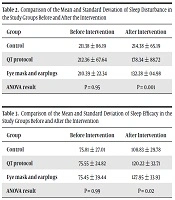
Ebrahimi Tabas E, Khodadadi F, Sarani H, Saeedinezhad F, Jahantigh M. Effect of Eye Masks, Earplugs, and Quiet Time Protocol on Sleep Quality of Patients Admitted to the Cardiac Care Unit: A Clinical Trial Study. Med Surg Nurs J. 2019;8(3):e98762. doi: https://doi.org/10.5812/msnj.98762
farokhnezhad P. The effect of moderating nursing care practices on sleep of patients admitted to coronary care unit. Med Surg Nurs J. 2014;2(3 And 4):e87651. doi:
Sabagh K, Ghaljaei F, Mahmoodi N, Kerman Saravi F, Robabi H. Interventional Effect of Quiet Time Protocol on the Physiological Parameters of Premature Neonates Admitted to the Neonatal Intensive Care Unit. Med Surg Nurs J. 2022;11(4):e135736. doi: https://doi.org/10.5812/msnj-135736
Eliyasianfar S, Khazaei H, Khatoni A, Pourmirza Kalhori R, Rezaei M. The effect of blindfolds and earplugs on sleep quality of patients admitted to the cardiac intensive care unit. J Clin Res Paramed Sci. 2016;5(1):e81442. doi:
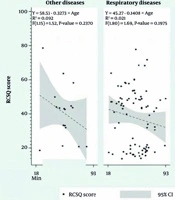
Lkoul A, Oumbarek K, Bouchriti Y, Jniene A, Dendane T. Determinants of Sleep Quality in Moroccan Intensive Care Units: A Cross-sectional Study. Jundishapur J Chronic Dis Care. 2025;14(3):e164424. doi: https://doi.org/10.5812/jjcdc-164424
More by these authors
Last Update: 4 days ago
Last Update: 4 days ago
Last Update: 4 days ago
Last Update: 5 hours ago
Last Update: 8 hours ago
Last Update: 4 days ago