Fulltext
.
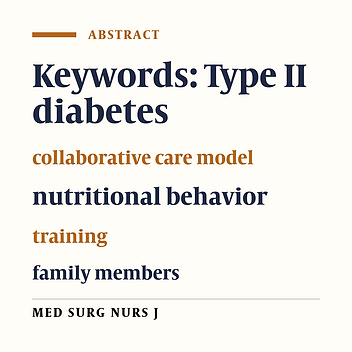
Image Credit:Med Surg Nurs J
Authors
Background and Objective: A healthy diet is one of the most important matters in caring and preventing type II diabetes in susceptible individuals. In interventional trainings performed in Iran, the family members of patients with type II diabetes are very rarely entered into training programs. Therefore, the aim of this study is to investigate the effect of education based on the collaborative care model on nutritional behavior of families of patients with type II diabetes.
Materials and Method: This study is a single-blind randomized clinical trial undertaken in the Educational Center of Diabetes of Tabriz, Iran, in 2012. The sample consisted of 40 first-degree family members of patients with type II diabetes (one member from each family) who were randomly divided into two groups of intervention (20 individuals) and control (20 individuals). In order to evaluate nutritional behavior, the modified lifestyle questionnaire was applied. First, the two groups took the pre-test and then collaborative training was held for seven one-hour sessions for the intervention group. Collaborative training consisted of the stages of motivation, preparation, engagement, and evaluation. The two groups took the post-test 3 months after the intervention. The data were analyzed by using chi-square and Student’s independent t-test in SPSS version 13.
Results: There was no statistically significant difference between the intervention and control groups in regards to age, gender, education level, job, marital status, and economic status. After the educational intervention, the intervention group reported better performance in comparison to the control group in items related to using fast foods (P = 0.001), fruits
(P = 0.005), vegetables (P = 0.004), canned food (P = 0.003), sweets (P = 0.001), solid vegetable oil (P = 0.007), sausages (P = 0.005), the usual way of cooking food (P = 0.003) and eating heavy and late-time dinners (P = 0.007).
Conclusion: The results showed that training based on the collaborative care model modifies the lifestyle of family members of patients with type II diabetes in most of the indices and nutritional behaviors. Based on the results, it is recommended to use the collaborative care model for nutritional training of family members of patients with type II diabetes.
© 2014, Author(s). This open-access article is available under the Creative Commons Attribution 4.0 (CC BY 4.0) International License (https://creativecommons.org/licenses/by/4.0/), which allows for unrestricted use, distribution, and reproduction in any medium, provided that the original work is properly cited.
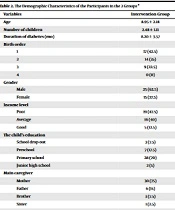
Ghaljaei F, Motamedi M, Saberi N, ArbabiSarjou A. The Effect of the Family-Centered Empowerment Model on Family Functioning in Type 1 Diabetic Children: A Quasi-experimental Study. Med Surg Nurs J. 2022;11(2):e134004. doi: https://doi.org/10.5812/msnj-134004
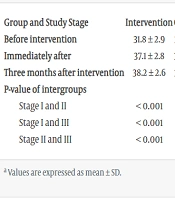
Moazeni M, Aliakbari F, Kheiri S, Salehi Tali S. The Effect of Family-Centered Empowerment Program on Husbands' Understanding of Illness, Perceived Stress and Self-care Behaviors of Type 2 Diabetes Patients. Jundishapur J Chronic Dis Care. 2024;13(4):e143656. doi: https://doi.org/10.5812/jjcdc-143656
Baraz S, Shahbazian HB, Miladinia M, Zarea K. Video Training Programs and the Quality of Life of Patients With Type II Diabetes. Jundishapur J Chronic Dis Care. 2015;4(4):e29611. doi: https://doi.org/10.17795/jjcdc-29611
Ershad Sarabi R, Mokhtari Z, Naghibzadeh Tahami A, Borhaninejad VR, Valinejadi A. Assessment of type 2 diabetes patients’ self-care status learned based on the national diabetes control and prevention program in health centers of a selected city, Iran. koomesh. 2021;23(4):e153275. doi:

Kazeminezhad B, Taghinejad H, Borji M, Tarjoman A. The Effect of Self-Care on Glycated Hemoglobin and Fasting Blood Sugar Levels on Adolescents with Diabetes. J Compr Ped. 2018;9(2):e62661. doi: https://doi.org/10.5812/compreped.62661
Last Update: 1 week ago
Last Update: 1 week ago
Last Update: 1 week ago
Last Update: 2 hours ago
Last Update: 5 hours ago
Last Update: 5 days ago