
1. Background
Diabetes refers to a group of metabolic diseases characterized by increased blood glucose due to defects in insulin secretion, insulin action, or both (1). Many physiological, genetic, environmental, dietary, psychological, and clinical factors may account for the development of diabetes (2). Diabetes requires a complex care regimen to avoid long-term complications (3).
Currently, the main goal of diabetes control is to prevent the development and progression of its chronic complications (4). Chronic hyperglycemia caused by diabetes is associated with long-term damage, dysfunction, and failure of various organs, especially eyes, kidneys, nerves, heart, and accompanying vessels (1).
Diabetes causes complications such as cardiovascular complications, nephropathy, neuropathy, retinopathy, and cataracts (5, 6). Diabetes is the fifth cause of death and the first leading cause of chronic kidney failure, non-traumatic amputation, and blindness in many societies (7). Type 1 diabetes is one of the most common childhood chronic diseases (8). It is an autoimmune disease that progresses in childhood and becomes symptomatic when 80%-85% of pancreatic beta cells are destroyed (9). According to estimates, by 2025, 75% of children with type 1 diabetes will live in developing countries (10). Globally, the highest rate of type 1 diabetes is reported in Finland and Sardinia (37000 - 45000 per 100 000 children under 15 years of age), which is 400 times higher than countries like Venezuela and parts of China, which have the lowest rate (eg, 0.5 - 0.1 thousand per 100,000 children under 15 years old) (11). In Iran, type 1 diabetes increases by 3.7 cases per 100 000 people per year (12). The data received from the diabetes clinic of Hazrat Ali Asghar (AS) Hospital in Zahedan indicated that almost 200 diabetic children were admitted to the clinic during the last year.
Controlling diabetes in children can affect the life of the child and the family and is a challenge for every family (13). The family is considered a semi-closed institution where all its members interact with each other; in this regard, an event that affects one member will also affect other members within the institution. Diagnosing a chronic disease and coping with it is considered a crisis for the family (14). Recognizing family members’ needs and concerns, teaching adaptation skills, understanding family functioning from a psychological and physical perspective, and their adaptation experiences are very important in health planning (15). A better and more effective adaptation of the family leads to an increase in the quality of life of the diabetic child and the rest of the family members (16). The family environment can play an important role in the adaptation of diabetes patients to lifestyle changes (17). Singla et al. showed that patients with diabetes who faced poor family functioning had more stress and lower blood glucose control (18). According to McMaster, family functioning determines the structural and interactive features of the family. The McMaster family assessment device (FAD) measures different aspects of family functioning: problem-solving, communication, roles, affective responsiveness, affective involvement, and behavior control (19).
The family-centered empowerment model is a health model developed in Iran based on Bandura’s theory to improve the conditions of patients with chronic diseases (20). The model focuses on empowering the individual through the acquisition of support information and life skills with a focus on motivational and psychological factors (self-esteem, self-control, and self-efficacy) and the problem (attitudes, knowledge, and perceived threats). This model empowers family members to recognize their shortcomings and gain enough power to change their situations. Empowerment brings about some benefits, such as positive self-confidence, the ability to achieve goals, hopefulness, and improving the quality of life of patients and their families (21).
Sargazi Shad et al. showed that patient empowerment training interventions carried out with the engagement of family members improved the self-efficacy and quality of life of adolescents with type 1 diabetes (22). Currently, a large number of studies have focused on patient education. Furthermore, the family-centered empowerment model seems to be effective in empowering the patient and engaging family members in identifying the patient’s care needs and cooperating with the patient to control diabetes and its complications.
2. Objectives
Since a few studies have addressed the impact of the family-centered empowerment model on family functioning in children with type 1 diabetes, the present study sought to explore the impact of these 2 variables.
3. Methods
This quasi-experimental study was conducted with a pretest-posttest design and 3 replications on 80 primary caregivers of children with type 1 diabetes admitted to the diabetes clinic of Hazrat Ali Asghar (AS) Hospital in Zahedan in 2012. According to a similar study (23) and considering a 95% CI and 95% test power, the sample size was calculated as 80 persons (40 persons per group) using the following formula:
Inclusion criteria were type 1 diabetic children aged 6 to 12 years with a confirmed diagnosis based on clinical symptoms and laboratory findings, being the only child with chronic diseases in the family, having no other underlying diseases (such as heart diseases, thalassemia, hemophilia, cancer, etc), the HbA1c range of less than 10%, and at least 2 months and at most 1 year has passed since the diagnosis of type 1 diabetes. Exclusion criteria were children who had reached the stage of diabetic ketoacidosis and the failure to attend at least 2 training sessions. The participants were selected using convenience sampling among families of children with type 1 diabetes who met the inclusion criteria. The selected participants were equally classified by the random block method and were assigned to one of two groups (intervention and control) using 4 blocks with 6 arrangement models.
The data were collected using FAD and a demographic information form. FAD was developed based on the McMaster model and contains 53 items that measure 6 subscales: problem-solving, communication, roles, affective responsiveness, affective involvement, and behavior control. This tool is suitable for assessing the family functioning of patients with multiple medical conditions such as diabetes, chronic rheumatism, gastroenteritis, asthma, obesity, and immune system disorders (24). This tool was developed by Epstein et al. to describe the organizational and structural characteristics of families. It measures the family’s ability to adapt to family functions with a self-report scale. After developing the device, it was administered to a sample of 503 people. The alpha value for its subsets ranges from 0.72 to 0.92, confirming its relatively good internal consistency (25). In the present study, its reliability was examined through internal consistency by Cronbach α. To this end, the device was randomly administered to 20 main caregivers of children with type 1 diabetes, and the intraclass correlation coefficient was estimated for the device. The reliability of the whole device was 0.88. After identifying the child’s main caregiver (at least one parent), the objectives of the study were explained to them. The caregivers also signed an informed consent form to indicate their willingness to participate in this study. First, the control group was examined. The demographic information questionnaire was completed for every child in the control group through an interview with the child’s main caregiver at the diabetes clinic. Then, the main caregiver completed the items in FAD. The patients in the control group did not attend the training intervention and only received routine training in the clinic. FAD was completed 1.5 months and 3 months after the intervention (23) by the main caregiver at the child’s home after making arrangements with the parents.
Before the intervention, the demographic information form and FAD were completed through interviews with the main caregivers of the children in the intervention group in the diabetes clinic. The family-centered empowerment program was implemented for the participants in this group through 4 steps: (1) increasing the patient’s knowledge (threat perception), (2) promoting self-efficacy, (3) educational engagement, and (4) evaluation. The intervention program was held in 4 two-hour sessions during 1 month (1 session per week) and at a specific time of the day for both the main caregiver and the child. At the beginning of each session, 2 questions from the instructions provided in the previous session were asked from the participants. Since this study was conducted during the COVID-19 pandemic, the instructions were provided individually in a classroom located in Hazrat Ali Asghar Hospital. Table 1 shows the content of the training intervention. The items in FAD were completed after 1.5 months and 3 months by the main caregiver at the child’s home after making arrangements with the parents.
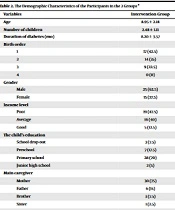
The collected data were codified and then analyzed using SPSS version 26 (SPSS Inc, Chicago, Ill, USA). The participants’ demographic data were described using measures of central tendency and dispersion, such as minimum, maximum, range, mean, SD, percentage, and frequency (Table 2). Repeated measures analysis of variance (ANOVA) was used to assess the effectiveness of the training intervention in family functioning by modifying the effect of some quantitative variables. The significance level in this study was set at 0.05 (P = 0.05).
Table 1.
The Content of the Intervention Training Program
| Session | Content |
|---|---|
| 1 | Identifying the parents’ problems, needs, and weaknesses through discussions with them, designing the content of the empowerment program, completing the questionnaires, and scheduling the training sessions |
| 2 | Threat perception: Raising the participants’ awareness, discussing parents’ problems, providing practical solutions, and offering the necessary instructions |
| 3 | Promoting self-efficacy: Demonstrating practical skills such as injecting insulin in the suitable area, checking blood sugar, interpreting blood sugar levels, pursuing the child to follow a suitable diet, and practicing the skills |
| 4 | Educational engagement: The participant is asked to share the instructions with the diabetic child and other family members and receive assistance and advice from the researcher if needed. Pamphlets were given to the participants to share with other family members. |
4. Results
This study examined the effect of the family-centered empowerment model on family functioning in children with type 1 diabetes. The mean age of the children was 8.95 ± 2.18 years in the intervention group and 9.10 ± 1.97 years in the control group. The majority of children were boys (62.5%) in the intervention group and girls (52.5%) in the control group. The average duration of diabetes was 8.20 ± 3.57 months in the intervention and 8.68 ± 3.26 months in the control group. Furthermore, none of the demographic variables showed significant differences in terms of frequency in the 2 groups (P > 0.05; Table 2). The results of repeated measures ANOVA showed significant differences in the family functioning scores between the 2 groups before the intervention and one and a half (P = 0.027) and 3 months after the intervention (P < 0.001; Tables 3 and 4).
Table 2.
The Demographic Characteristics of the Participants in the 2 Groups a
| Variables | Intervention Group | Control Group | P-Value |
|---|---|---|---|
| Age | 8.95 ± 2.18 | 9.10 ± 1.97 | 0.75 |
| Number of children | 2.48 ± 1.11 | 2.65 ± 1.17 | 0.49 |
| Duration of diabetes (mo) | 8.20 ± 3.57 | 8.68 ± 3.26 | 0.54 |
| Birth order | 0.52 | ||
| 1 | 17 (42.5) | 18 (45) | |
| 2 | 14 (35) | 12 (30) | |
| 3 | 9 (22.5) | 8 (20) | |
| 4 | 0 (0) | 2 (5) | |
| Gender | 0.18 | ||
| Male | 25 (62.5) | 19 (47.5) | |
| Female | 15 (37.5) | 21 (52.5) | |
| Income level | 0.80 | ||
| Poor | 19 (47.5) | 17 (42.5) | |
| Average | 16 (40) | 16 (40) | |
| Good | 5 (12.5) | 7 (17.5) | |
| The child’s education | 0.43 | ||
| School drop-out | 3 (7.5) | 5 (12.5) | |
| Preschool | 7 (17.5) | 3 (7.5) | |
| Primary school | 28 (70) | 28 (70) | |
| Junior high school | 2 (5) | 4 (10) | |
| Main caregiver | 0.86 | ||
| Mother | 30 (75) | 28 (70) | |
| Father | 6 (15) | 9 (22.5) | |
| Brother | 3 (7.5) | 2 (5) | |
| Sister | 1 (2.5) | 1 (2.5) | |
| The mother’s job | 0.75 | ||
| Housewife | 31 (77.5) | 29 (72.5) | |
| Employee | 4 (10) | 7 (17.5) | |
| Other | 5 (12.5) | 4 (10) | |
| The father’s job | 0.75 | ||
| Employee | 9 (22.5) | 12 (30) | |
| Self-employed | 20 (50) | 18 (45) | |
| Other | 11 (27.5) | 10 (25) | |
| The mother’s education | 0.47 | ||
| Lower education | 21 (52.5) | 19 (47.5) | |
| Diploma | 11 (27.5) | 16 (40) | |
| Higher education | 8 (20) | 5 (12.5) | |
| The father’s education | 0.43 | ||
| Lower education | 11 (27.5) | 16 (40) | |
| Diploma | 19 (47.5) | 14 (35) | |
| Higher education | 10 (25) | 10 (25) |
a Values are expressed as mean ± SD or No. (%).
Table 3.
A Comparison of the Family Functioning Scores Before and After the Intervention in the 2 Groups
| Variable, Stage | Intervention Group | Control Group | Intergroup Differences |
|---|---|---|---|
| Family functioning | |||
| Pre-intervention | 134.37 ± 18.08 | 134.65 ± 18.16 | 0.946 |
| 1.5 months after the intervention | 143.97 ± 18.86 | 134.60 ± 18.36 | 0.027 |
| 3 months after the intervention | 155.37 ± 2.95 | 134.47 ± 18.23 | < 0.001 |
Table 4.
Repeated Measures Analysis of Variance for the Family Functioning Scores Before and After the Intervention in the 2 Groups
| Source of Change | Sum of Squares | df | Mean | Statistic | P-Values |
|---|---|---|---|---|---|
| Group | 4346.725 | 1 | 4346.725 | 138.249 | < 0.001 |
| Group/time interaction | 4495.525 | 1 | 4495.525 | 142.982 | < 0.001 |
| Error | 2452.417 | 78 | 31.441 |
Table 4 indicates a significant interaction between the time and group, confirming significant changes in the family functioning before the intervention and one and a half and 3 months after the intervention in the 2 groups (P < 0.001). As the group/time interaction was significant, the pattern of changes in family functioning in the 2 groups was not the same and had a significant difference (P < 0.001).
5. Discussion
This study examined the effect of the family-centered empowerment model on the family functioning of children with type 1 diabetes. The results showed no significant differences between the 2 groups in terms of demographic characteristics, including age, sex, number of children, duration of diabetes, birth order, child’s education, main caregiver, parental education, parental employment, and monthly family income. Thus, the 2 groups were homogeneous in terms of demographic variables. The mean scores of family functioning were not significantly different between the intervention and control groups before the intervention. However, the 2 groups showed a significant difference in terms of family functioning scores one and a half and 3 months after the intervention. In fact, following the implementation of the family-centered empowerment model, the family functioning scores of the children increased significantly in the intervention group.
These results are in line with the findings of Shariat et al., who examined the effectiveness of couples’ communication model training on the performance of families with children with attention deficit hyperactivity disorder (26). Sheikholeslami et al. also confirmed that the empowerment of families caring for schizophrenic patients through education improved family functioning (27). Moreover, Suppapitiporn and Suppapitiporn reported that the family played the main role in the treatment of diabetic patients and that high family function was associated with better blood sugar control. They suggested that the family members also engaged in training programs for these patients (28). Although, unlike patient-centered interventions, very few studies have addressed the effect of training programs based on the family-centered empowerment model on the family functioning of diabetic patients, various studies have confirmed the positive effects of implementing this model in various diseases. For example, this model improved the quality of life of patients with thalassemia and multiple sclerosis (29, 30), promoted the lifestyle of patients with myocardial infarction (31), and enhanced treatment adherence in patients undergoing coronary artery bypass grafting. These findings confirm the important role of the family in improving various aspects of chronic diseases, including diabetes, confirmed in the present study.
In contrast, the results of the quasi-experimental study by Mahmoudabadi et al. on the effect of intimacy training with the Islamic approach on improving family functioning showed no significant change in most dimensions of family functioning. One of the reasons for this contradictory finding is that only women attended the training sessions (32). In their study on the relationship between empowerment and metabolic control in patients with diabetes mellitus, Shiu et al. showed no linear relationship between empowering diabetic patients and improving metabolic control (33).
Following the findings of this study and similar studies, the family functioning of patients can be used as a key element in improving disease control and management. As a result, the implementation of the family empowerment model improves patients’ problem-solving, communication, and perceptions.
5.1. Limitations
The differences in the participants’ learning rates could affect the use of the teaching materials and the results of the study. Furthermore, since this study was conducted during the COVID-19 pandemic, the researcher had difficulty holding group training sessions for the main caregivers.
5.2. Conclusions
The family-centered empowerment model can affect family functioning. Teaching family members about disease control can be very effective because there is a strong connection between the family and the health status of its members. People, especially those with chronic diseases, are dependent on their family members, and even their attitudes are affected by the family. As important members of the health care team, nurses have the most contact with children and their families. Therefore, by providing training through the family-centered empowerment model as a non-pharmacological, free-of-cost, and acceptable technique for children’s families, nurses can guide and support the patient and their family members in their efforts to achieve the desired goal. Thus, this technique can be used to provide effective training to patients in pediatric hospitals and outpatient clinics and empower their family members.