
1. Background
When the kidneys are unable to perform their normal functions, alternative therapies should be applied, the most common of which is hemodialysis (1, 2). While the hemodialysis has increased the life expectancy of patients with kidney failure, it has caused significant psychological, social, and physical problems as well as negative effects on the Quality of Life (QoL) of patients who use hemodialysis (3, 4). The dependence of these patients on hemodialysis is one of the important factors that affect their QoL and mental health (5). QoL is a multidimensional concept that contains both physical and mental health (6, 7). In recent years, many studies have evaluated and improved the QoL of patients with chronic diseases, and improving the general health and QoL of patients with chronic diseases has become an important goal (8). According to the literature, the QoL of hemodialysis patients who receive training is significantly better than that of untrained patients. Besides, it should be noted that oriented patients are less likely to report symptoms and show more confidence in managing their symptoms (9, 10). Today, education is one of the most important areas of health care (11, 12). Positive psychology training improves people’s mood and leads to positive experiences and traits. Positive people evaluate events positively; they are more hopeful about the future and experience a better QoL. Our thoughts and mindsets shape our QoL (13). Establishment of regular positive training and encouragement of patients to express their problems and shortcomings of their living environment, which determine their physical and mental health, and addressing these problems with patients’ help and increasing their level of awareness and adaptability are useful steps to enhance the health of patients (14). The results of a study entitled “the effect of positivism training on quality of life, depression, anxiety, and stress in adolescents” showed that training positive thinking reduced the average scores of depression, anxiety, and stress and improved the physical, mental, and social dimensions of the QoL (15).
2. Objectives
Since few studies have investigated the impact of positive thinking training on patients’ QoL and different results are obtained concerning the target community, the researchers aimed to investigate the effect of positive thinking training on the QoL of hemodialysis patients.
3. Methods
3.1. Design
This is a randomized controlled clinical trial conducted from April to September 2019 in Fasa, a city located in the southwest part of Fars province, I.R. Iran.
3.2. Sampling
The statistical population of the current study consisted of hemodialysis patients who were referring to the educational and medical centers affiliated to Fasa University of Medical Sciences (Iran).
The sample size was calculated based on α = 0.05, power = 90%, and the mean (mean1 = 2.82, mean2 = 5.58) and common standard deviation (S = 3.5). Besides, other similar studies were also considered (15). The minimum sample size was estimated at 68 (34 subjects in each group). By considering a 10% attrition rate, the final sample size was increased to 75, and it was raised to 78 (39 subjects in each group).
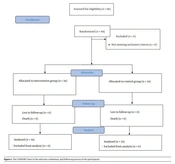
Among the patients registered in the hemodialysis centers of Fasa city, 89 were selected using the simple sampling method (based on the table of random numbers), and those who did not want to participate in the study were excluded (4 patients). Those patients who were interested in participating in the study were asked to sign a written informed consent form and then were given the SF-36 Quality of Life Questionnaire to fill in. Those who had a good QoL (a score above 75) or did not meet the inclusion criteria were excluded (7 patients). Based on the block randomization method (block size = 4), participants (n = 78) were divided into two groups (experimental and control groups, each with 39 members). During the study implementation, 3 patients of the intervention group were excluded from the study due to absence for more than two sessions. Also, one patient was excluded due to being hospitalized. In the control group, 4 subjects refused to continue the study. Finally, data of 70 participants were analyzed (Figure 1).
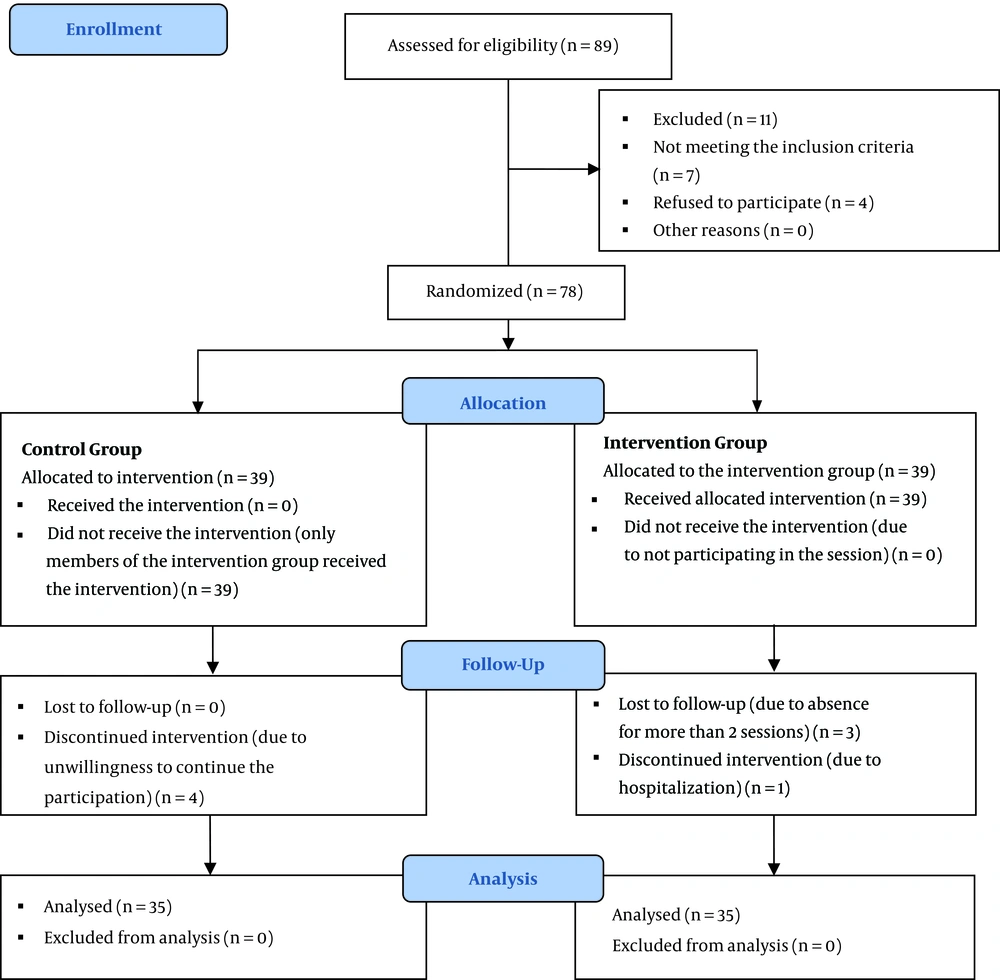
Figure 1.
The process of the study
The inclusion criteria were as follow: willingness to participate in the study, having at least 20 years of age, having the end-stage renal disease, being under hemodialysis for more than a year, not attending at other training courses as well as not having a history of participating in positive training workshops and no longer being treated with psychotropic drugs. Patients who refused to continue the study for any reason or were absent for more than two sessions were excluded
3.3. Data Collection
Data were collected using a demographic information form and the SF-36 quality of life questionnaire. This questionnaire is one of the most common and comprehensive standard tools in the field of QoL related to public health. This international tool contains two dimensions of physical and mental health (16). The validity and reliability of the Persian version of the questionnaire are confirmed in the study conducted by Montazeri and colleagues (17). The questionnaire includes 8 parts: physical performance (10 items), limited role due to physical problems (4 items), physical pain (2 items), general health (5 items), vitality and cheerfulness (4 items), social performance (2 items) ), the limitation of the function caused by emotional problems (3 items), mental health (5 items), and 1 item that individually examines changes in the person’s health status during the past year. Respondents should answer in a 0 to 5 scale (“0” indicates the worst and “5” the best status). The total score of each section ranges from 0 to 100 (the zero score indicates the lowest level, and 100 indicates the highest QoL) (18-20).
3.4. The Intervention
To develop a positive thinking training program, initially, the researchers reviewed the research and positive thinking intervention programs, as well as the studies that investigated the positive thinking training programs (both in Iran and other countries) (15, 21-24). Then, the developed program was approved by the teachers of the Fasa University of Medical Sciences, who had academic and clinical experience in this field.
The positive thinking training program was held in the form of 8 sessions, two times a week, and each lasted for 90 minutes. The main topics were familiarity with the meaning and concept of the positive thinking, positive and negative thinking, how emotions affect the relations with others, awareness of one’s abilities, familiarity with the technique of relaxing, focusing on one’s strengths, and the ability to control one’s inner and outer self in dealing with problems. The control group did not receive any training while the research was performing, but after the research was finished, they were trained positive thinking in a 2-day workshop. To hold the workshops, the researchers divided the members of the intervention group into subgroups with seven participants. The training sessions were conducted by a clinical psychologist who presented lectures, group discussions, role-playing, intellectual challenge, staging, and assigning activities as homework. Before the start of the workshop, the course provider reviewed the gist of the previous meetings, and in the end, the participants’ questions were answered. The double-blind method was used to prevent members of the control group from being informed about the way the interventions are performing for the intervention group.
Multimedia facilities, such as computers, movie players, and PowerPoint presentations, were used to provide training. To prevent participants from getting tired or bored, the workshop was accompanied by playing effective educational videos related to positivity, a rest interval, and tea/coffee break. A week after the intervention, the QoL questionnaire was filled in by participants of both control and intervention groups. The summary of the objectives and content of the meetings is listed in Table 1.
Table 1.
Brief Description of Positive Thinking Sessions
| Session | Objective | The Contents of the Training Program |
|---|---|---|
| 1 | Familiarity with the generalities and content of the course | • The participants introduced themselves and got to know the course providers; |
| • A friendly relationship was established between the participants and the course providers; | ||
| • They got acquainted with the objectives and components of the course; | ||
| • The rules and regulations of the sessions were stated. | ||
| 2 | Familiarity with the meaning and concept of positive thinking | • Discussion of the main concepts of positive thinking; |
| • Defining positive thinking and positive and negative approach to events; | ||
| • Recognition of the signs of positive thinking, beliefs; | ||
| • Expressing beliefs, analyzing one’s perspective; Assignment. | ||
| 3 | Awareness of one’s abilities | • Reviewing the main points discussed in the previous session; |
| • Awareness of one’s abilities and elimination or reduction of irrational beliefs; | ||
| • Facilitators and barriers to self-awareness; | ||
| • Forming four-person groups and group discussions; | ||
| • Expression of patients’ experiences; | ||
| • questions and answers | ||
| 4 | Positive social relationships | • Reviewing the main points discussed in the previous session; |
| • Writing down the titles for experiences and positive memories related to others and society; | ||
| • Positive communication and active feedback; | ||
| • Adaptability in dealing with unsolvable problems; | ||
| •Group discussion | ||
| 5 | Positive and negative thinking and the role of emotions in relationships with others | • Reviewing the main points discussed in the previous session; |
| • Examining the ways of learning positive thoughts and replacing them with negative thoughts | ||
| • Comparing positive and negative thinking through group discussion | ||
| • Expressing your experiences of negative and positive thoughts on various issues and comparing your feelings in both ways | ||
| 6 | Paying attention to strengths, the ability to control inner and outer one’s in dealing with issue s | • Reviewing the main points discussed in the previous session; |
| •Reviewing the assignment of the previous session and expressing the feelings of the members, acquainting people with the effects and characteristics of hope and despair, and paying attention to their strengths. | ||
| • Expressing external and internal control features | ||
| • Assignment | ||
| 7 | forgiveness | • Reviewing the main points discussed in the previous session; |
| • Explaining the concepts and strategies of forgiveness | ||
| • Forgiveness was introduced as a powerful tool that can turn the feeling of anger and resentment into a neutral feeling and even for some into positive feelings and emotions. | ||
| 8 | Enjoy and live a fruitful life | • Full awareness of pleasure and deliberate effort to prolong it as much as possible and benefit from it |
| • Acknowledgement and closing ceremony |
3.5. Ethical Considerations
After approval of the Research Committee of Shiraz University of Medical Sciences, and obtaining an ethical code of conduct for research IR.SUMS.REC.1399.132, as well as the written permission from the university and its affiliated medical centers, the study began. The objectives and the research process were explained to the subjects, and the written informed consent was taken from them. The subjects were ensured about the confidentiality of the information and there was no need to write down their names, and they could leave the study at any stage without any harm.
3.6. Statistical Analysis
The data were analyzed by using SPSS (Statistical Package for Social Science) version 20. Indices of analysis, testing, and descriptive statistics (percentage frequency distribution, mean, and standard deviation) were used to describe the demographic characteristics of the participants. Inferential statistics (student t-test) was used to compare the mean of the scores on the QoL between the two groups before and after the intervention. A paired t-test was used to compare the cases mentioned in each group before and after the intervention. Kolmogorov-Smironov two-sample test was used to evaluate the frequency distribution of variables. The significance level was considered as P < 0.05.
4. Results
A total of 70 patients participated in the study (35 in each group). The results of the demographic analysis showed that the mean age of the participants in the intervention and control groups was 58.97 ± 9.68 and 62.82 ± 8.63, respectively. The youngest and oldest participants were 36 and 70 years, respectively. Most of the participants in both groups were men. The results of the study showed no significant difference between the two groups in terms of age (P = 0.60), gender (P = 0.12), education (P = 0.22), marital status (P = 0.29), employment (P = 0.31), and place of residence (P = 0.63) (Table 2).
Table 2.
Demographic Characteristics of the Participants (N = 70)
| Demographic Variable/Participants | Intervention Group (N = 35) | Control Group (N = 35) | X2 | Pa | ||
|---|---|---|---|---|---|---|
| n | % | n | % | |||
| Age (in year) | 1.02 | 0.6 | ||||
| 20 - 39 | 3 | 8.6 | 2 | 5.7 | ||
| 40 - 59 | 11 | 31.4 | 8 | 22.9 | ||
| ≥ 60 | 21 | 60 | 25 | 71.4 | ||
| Gender | 2.38 | 0.12 | ||||
| Male | 27 | 77.1 | 21 | 60 | ||
| Female | 8 | 22.9 | 14 | 40 | ||
| Educational status | 3.06 | 0.22 | ||||
| High school | 23 | 65.7 | 17 | 48.6 | ||
| Diploma | 9 | 25.7 | 16 | 45.7 | ||
| Associate’s degree | 3 | 8.6 | 2 | 5.7 | ||
| Marital Status | 1.12 | 0.29 | ||||
| Married | 8 | 22.9 | 12 | 34.3 | ||
| Single | 27 | 77.1 | 23 | 65.7 | ||
| Occupation | 1.01 | 0.31 | ||||
| Employed | 10 | 28.6 | 14 | 40 | ||
| Unemployed | 25 | 71.4 | 21 | 60 | ||
| Place of residence | 0.23 | 0.63 | ||||
| Rural | 20 | 57.1 | 18 | 51.4 | ||
| Urban | 15 | 42.9 | 17 | 48.6 | ||
aChi-square test
Independent t-test was used to compare the mean QoL score of hemodialysis patients in the control group before and after the intervention. It did not show a significant change (P = 0.470); however, the paired t-test revealed a significant difference in the mean QoL score of hemodialysis patients in the control group (P < 0.001) so that before and after the intervention the mean score and standard deviation of the QoL in the control group was 21.19 ± 37.49 and 59.53 ± 14.88, respectively. The comparison of the mean QoL score of the intervention group before and after the intervention demonstrated that training positive thinking had a significant effect on all dimensions of the QoL, except for physical performance (P = 0.20) and bodily pain (P = 0.62). Comparing the mean QoL score in the control group before and after the intervention did not show a statistically significant effect (Table 3).
Table 3.
Comparison of Mean ± SD of Depression, Anxiety, Stress, and Quality of Life and in the Intervention and Control Groups Before and After the Intervention
| Variable/Group | Mean ± SD | P Valuea | |
|---|---|---|---|
| Pre-Test | Post-Test | ||
| Quality of life | |||
| Experimental group | 35.19 ± 10.07 | 55.98 ± 11.71 | < 0.001 |
| Control group | 34.71 ± 9.99 | 36.90 ± 13.53 | 0.119 |
| P valueb | 0.842 | < 0.001 | |
| Physical function | |||
| Experimental group | 43.15 ± 10.29 | 46.57 ± 15.98 | 0.42 |
| Control group | 41.85 ± 10.00 | 44.42 ± 20.50 | 0.610 |
| P valueb | 0.594 | 0.627 | |
| Physical role | |||
| Experimental group | 31.50 ± 42.23 | 57.85 ± 34.17 | 0.002 |
| Control group | 36.42 ± 36.55 | 44.28 ± 3380 | 0.255 |
| P valueb | 0.603 | 0.99 | |
| Emotional role | |||
| Experimental group | 20.95 ± 31.40 | 53.85 ± 30.82 | < 0.001 |
| Control group | 22.85 ± 29.17 | 19.04 ± 21.82 | 0.360 |
| P valueb | 0.851 | < 0.001 | |
| Vitality | |||
| Experimental group | 28.85 ± 22.91 | 59.14 ± 14.27 | < 0.001 |
| Control group | 27.28 ± 19.30 | 28.57 ± 17.68 | 0.270 |
| P valueb | 0.757 | < 0.001 | |
| Mental health | |||
| Experimental group | 40.22 ± 17.70 | 65.25 ± 10.21 | < 0.001 |
| Control group | 41.02 ± 17.89 | 43.42 ± 14.62 | 0.128 |
| P valueb | 0.851 | < 0.001 | |
| Social function | |||
| Experimental group | 42.14 ± 26.96 | 63.92 ± 19.11 | < 0.001 |
| Control group | 39.28 ± 19.202 | 41.78 ± 19.86 | 0.228 |
| P valueb | 0.611 | < 0.001 | |
| Bodily pain | |||
| Experimental group | 51.50 ± 26.51 | 53.28 ± 18.47 | 0.613 |
| Control group | 49.57 ± 23.45 | 48.71 ± 19.69 | 0.557 |
| P valueb | 0.748 | 0.32 | |
| General health | |||
| Experimental group | 25.71 ± 10.92 | 54.57 ± 12.74 | < 0.001 |
| Control group | 22.85 ± 12.90 | 24.14 ± 11.14 | 0.347 |
| P valueb | 0.321 | < 0.001 | |
aPaired t-test
bIndependent t-test
5. Discussion
The comparison of the mean QoL score of hemodialysis patients in the control group did not show a significant change before and after the intervention. It can be justified, as they did not receive any intervention but only the routine training of the Nursing Department. However, positive thinking training increased the mean QoL score of the intervention group. In other words, after receiving the intervention, the QoL of these patients was improved to some extent. In the positivist thinking training interventions, the researchers tried to inform the patients about the negative thinking style, as well as how to eliminate the negative thoughts and to inculcate positive thoughts about the problems and limitations of the disease in themselves. Given that the QoL is a mental concept and impacts people’s overall well-being (both physically and mentally), such interventions can greatly affect the QoL. Drawing the group’s attention to their achievements in life and highlighting their role in creating those successes and helping them to become more aware of their capabilities and belongings can all lead to a direct or indirect impact of positive thinking on the QoL.
In fact, many areas of quality of life measurement based on the tools we use are based on patients’ beliefs, mindsets, and perspectives. For example, areas such as vitality, mental health, general health, and social functioning also depend on the patient’s thinking and mentality, which affects the patient’s quality of life by creating a positive attitude and changing the patient’s beliefs. Positive people are healthier and happier and cope better with psychological tensions by using problem-solving strategies. This approach emphasizes the identification of emotions, controlling emotions, creating optimism, combating negative thoughts, and changing mental images.
The results of the current study are consistent with some of the similar studies (15, 25-28). Meanwhile, the present study differs from those in that the positive thinking training did not have a significant effect on some areas or such subscales as physical function and bodily pain; nonetheless, all aspects of QoL were evaluated more accurately. Actually, the scores on physical function and bodily pain in the intervention group were slightly increased, but it was not significant. Such a difference could be attributed to variations in the statistical population, sample size, demographic characteristics, and geographical area under study.
Based on the studies conducted in the field of positive thinking training, there is a positive and significant correlation between optimism and physical and mental health. Optimism, as an explanatory style, affects mental and physical health, and it is a learned behavior. However, to the researchers, the weakness and a decrease in the stamina of the patients’ bodies, their limitation in diet selection and the resulting malnutrition, lack of physical activity and adoption of a sedentary lifestyle, as well as aging have led to obtaining different results in the areas of physical performance and bodily pain. Therefore, they remained unchanged even through changing one’s thoughts, injecting vitality, and creating a positive mood and perspective. Of course, positive thinking intervention resulted in significant changes in other dimensions of QoL, including vitality, social-emotional function, general health, and mental health.
Therefore, regarding the obtained results of the above study, positive thinking can change people’s views and attitudes towards life and its various aspects. feeling well and softening people’s emotions and perspectives affect the quality of life. so, the use of positive thinking techniques and teaching concepts can be helpful to patients who have undergone changes and degradation in the quality of life due to chronic disorders such as chronic kidney failure.
The current study had limitations which are as follow: a) the problem of regulating teaching schedule with patients’ treatment sessions; b) during the training sessions, sometimes patients were running out of patience (the problem was dealt with by giving participants a rest and serving tea/fruit at training sessions); c) Using the self-reporting tools. Since this study is performed on hemodialysis patients, to be on the safe side, it is better to take precautions before generalizing the results to other populations.
5.1. Conclusion
Concerning that the hemodialysis reduces the QoL of patients and the need for effective interventions to improve the QoL of these patients, group training through positive thinking intervention programs can be used as a non-pharmacological, cost-effective, and uncomplicated method and as a complementary measure, along with other methods for hemodialysis patients’ care and treatment programs. It is recommended that this study be performed on other chronic patients with a larger sample size.