
1. Background
Hemodialysis is one of the most common alternative therapies for End-Stage Renal Disease (ESRD) patients (1). For successful hemodialysis, four factors are necessary: fluid restriction, adherence to medication, nutrition, and attendance at hemodialysis sessions (2). According to the evidence, due to reduced self-care ability and inability to perform daily activities and adherence to treatment regimens, hemodialysis patients are facing problems (3). Various factors, such as the information level and attitude of patients toward treatment, can influence the patient adherence to treatment regimens (4).
Nursing staff have an important role in patients’ adherence to treatment regimens (5). A comprehensive curriculum based on patients’ needs can decrease treatment costs (6, 7), improve care (7), and enhance the quality of healthcare services. Moreover, effective education helps patients to live healthier and more independently (6).
There are various methods to educate patients, among which structured education seems to be more effective than non-structured education techniques. Two main methods of structured education are individual and group training techniques. Individual education (face-to-face) involves in-person education by an instructor, which provides an opportunity to exchange ideas and emotions between the learner and instructor, both verbally and non-verbally (8).
The teach-back technique is an individual education method that contains a comprehensive strategy that can help educators understand and identify patients’ needs concerning their care through providing the necessary information (9). In this method, the provider provides the necessary information to the patient in such a way to guarantee the comprehension of patients (10).
Group discussion education is an important method to increase participants’ knowledge and skills, leading to interpersonal interaction and behavioral change. Group discussion is an active process of interaction between teacher and learner that allows them to express their ideas and experiences (11). If managed well, education by discussion in small groups leads to better learning outcomes and the reconstruction of basic concepts (12).
Therefore, education will affect health-related behaviors if it can affect people’s beliefs and attitudes. In this regard, a deep understanding of knowledge and attitude can make positive changes in people’s attitudes to strengthen health behaviors (13). Accordingly, it is crucial to evaluate these methods using Knowledge Attitude Practice (KAP) assessment to understand the effectiveness of various educational methods and unite the health behaviors of people (14). However, there is a dearth of comparative research considering the effectiveness of different educational methods on KAP among hemodialysis patients.
2. Objectives
The current study aimed to compare the effects of teach-back and group discussion techniques of self-care education on the knowledge, attitude, and practice of hemodialysis patients.
3. Methods
3.1. Study Design and Setting
This quasi-experimental study with a pretest and posttest design was conducted in two hospitals in 2019. Using the random selection method one of the hospitals was assigned to the group training and the other to the teach-back group. These hospitals were equipped with dialysis units that had similar structures.
3.2. Study Participants
Patients referred to the hemodialysis wards of the aforementioned hospitals who had the inclusion criteria were enrolled in the study using the convenient sampling technique. The inclusion criteria were lack of cognitive, learning, speech, hearing, and motor impairment, hemodialysis for at least 6 months, hemodialysis via fistula 3 times a week (3 - 4 h each session), and no background of medical sciences education. Exclusion criteria included having transplantation, patient death, lack of willingness to continue participating, transferring to other centers, and having a history of formal education related to the research.
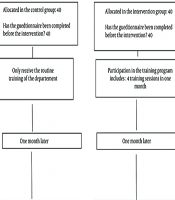
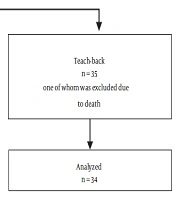
Of the 35 participants enrolled in the discussion group, two were excluded due to transplantation and death (from the teach-back group). Therefore, the intervention was completed with a total of 33 patients (Figure 1).

Figure 1.
CONSORT flow diagram
3.3. Measurements
Data were collected using a researcher-made questionnaire, which comprised questions related to demographic characteristics, knowledge (19 items), attitude (26 items), nutrition performance, activity-rest, and fistula care (25 items). Items related to the field of knowledge were designed as multiple-choice questions scored as 0 (false) or 1 (correct). Therefore, the total score of the questionnaire ranged from 0 to 19.
Attitude-related questions were scored using a five-point Likert scale (ranging from completely agree (5) to completely disagree (1)), which scored from 26 to 130. Similarly, performance-related items were scored using a five-point Likert scale (always (5) to never (1)) with a score ranging from 25 to 125.
The content validity was assessed using the content validity ratio (CVR) and content validity index (CVI). To determine the CVR, 10 experts (faculty members and nephrologists) were asked to rate each question using a three-point Likert scale (i.e., necessary, useful but unnecessary, and unhelpful scales). Based on the results, the CVR was 0.84. To calculate the CVI in terms of question clarity, the relevance and simplicity of each question were asked from the target group and experts, which yielded a value of 0.81.
The reliability of the questionnaire was evaluated using the test-retest method. To this end, the questionnaire was completed by 20 hemodialysis patients. Then, two weeks later, the same patients completed the questionnaire again, which yielded an intra class correlation coefficient (ICC) of 0.911.
3.4. Interventions
To collect data, the researcher was attending at the hospitals at different times of the day to cover both morning and evening shifts. First, the research objectives were explaining to the patients, followed by obtaining written informed consent. Then, demographic characteristics and KAP questionnaires were completed in control and intervention groups during hemodialysis without any educational intervention through interview with patients. One week after completing the questionnaire, educational materials were provided to both groups in 2 weeks (a total of three sessions with a minimum of a 2-day interval). The sessions lasted from 30 to 45 minutes. In the first session, issues related to nutrition in hemodialysis patients were highlighted. The second session was about the activity and mobility of these individuals, and the third session was focused on the necessary maintenance of arterial venous fistula. Finally, the original questionnaire was completed again in the same way one month after the training.
To initiate the intervention, for those who were planned to receive the group education, patients were first divided into six small groups each with four to six members. The researcher informed the participants about the schedule of sessions and the course plan before beginning the training sessions. In each group, education was performed in the form of group discussion after the completion of the dialysis. The class chairs were arranged in a way that the participants had maximum eye contact with the researcher. After the introduction of the topic, the participants discussed the issue and the discussion was directed by the researcher as the leader of the group.
Similarly, participants in the teach-back group were provided with the teaching schedule and content. After the dialysis session, educational content was presented to the patients in person until the information was completely comprehended. A similar process was repeated for all members of this group.
3.5. Statistical Analysis
Data were analyzed by SPSS (version 13) using descriptive statistics (to prepare tables of frequency distribution, mean, and standard deviation). In addition, independent and paired t-tests and regression analyses were used to compare the knowledge, attitude, and practice of both groups.
4. Results
Most of the participants were male and married with a mean age of 52 years. According to the results, no significant difference was observed between the two groups in terms of age, body mass index, duration of hemodialysis treatment, gender, marital status, place of residence, satisfaction with family support, level of education, occupational status, smoking, and drug use, and diseases (P > 0.05). On the other hand, there was no significant difference in terms of satisfaction with social support, economic status, duration of renal disease, and family history of hemodialysis treatment (P < 0.05) (Table 1).
Table 1.
Comparison of the Studied Variables Among Participants of the Two Groupsa
| Demographic Characteristics | Group | P Value | |
|---|---|---|---|
| Teach-Back (N = 34) | Group Discussion (N = 33) | ||
| Gender (male) | 19 (55.9) | 23 (69.7) | 0.24b |
| Marital status (married) | 26 (76.5) | 27 (81.8) | 0.54b |
| Place of residence (city) | 29 (85.3) | 28 (84.8) | 0.95b |
| Level of education (elementary) | 13 (38.2) | 14 (42.4) | 0.75b |
| Occupational status (unemployed) | 6 (17.6) | 7 (21.2) | 0.66b |
| Economic status (not enough) | 16 (47.1) | 14 (42.4) | 0.02b |
| Satisfaction of family support | 32 (94.1) | 32 (97) | 0.57b |
| Satisfaction of social support | 17 (50) | 8 (24.2) | 0.04b |
| Not smoking | 32 (94.1) | 27 (81.8) | 0.12b |
| Not drug abuse | 32 (94.1) | 30 (90.9) | 0.61b |
| Not family history of hemodialysis treatment | 30 (88.2) | 33 (100) | 0.04b |
| Family members’ jobs unrelated to medical science | 34 (100) | 33 (100) | - |
| Age (year) | 12.86 ± 52.03 | 12.55 ± 52.69 | 0.83c |
| BMI (kg/m2) | 4.26 ± 23.76 | 4.37 ± 24.19 | 0.68c |
| Duration of hemodialysis treatment (year) | 1.13 ± 2.85 | 1.16 ± 2.66 | 0.50c |
aValues are expressed as No. (%) or mean ± SD.
bChi-square test
cIndependent t-test
The confounding effect of the variables was modified using the linear regression model. Independent t-test revealed no significant difference (P = 0.15) between mean knowledge of hemodialysis patients in the teach-back (14.17 ± 1.94) and group discussion (14.78 ± 1.45) before the intervention, suggesting an identical knowledge status in both groups. Although mean knowledge in both groups increased significantly one month after the training compared to the pre-intervention (P < 0.001), there was no significant difference between the two groups, meaning that both methods had a similar effect on the knowledge of the patients (P = 0.82) (Table 2).
Table 2.
Comparison of Knowledge of Participants of the Two Groups
| Groups | Before Intervention, Mean ± SD | After Intervention, Mean ± SD | Paired t-Test | P Value |
|---|---|---|---|---|
| Group discussion | 1.45 ± 14.78 | 0.42 ± 18.06 | -12.66 | < 0.001 |
| Teach-back | 1.94 ± 14.17 | 0.75 ± 18.08 | -10.967 | < 0.001 |
| Independent t-test | 1.45 | 0.05a | ||
| P value | 0.15 | 0.82 |
aAdjusted for the effects of confounders using regression analysis
The discussion group (101.12 ± 6.00) and teach-back (102.03 ± 7.74) groups had no significant difference regarding the mean attitude of patients who were undergoing hemodialysis before the intervention (P = 0.59). Meanwhile, after providing the intervention, the attitude of patients of both groups increased (P < 0.001), but the increase was higher in the teach-back than the discussion group (P < 0.01) (Table 3).
Table 3.
Comparison of Attitude of Participants in Two Groups
| Groups | Before Intervention, Mean ± SD | After Intervention, Mean ± SD | Paired t-Test | P Value |
|---|---|---|---|---|
| Group discussion | 6.00 ± 101.12 | 5.68 ± 110.48 | -9.20 | < 0.001 |
| Teach-back | 7.74 ± 102.03 | 4.13 ± 113.88 | -9.48 | < 0.001 |
| Independent t-test | -0.53 | 6.76a | ||
| P value | 0.59 | 0.009 |
aAdjusted for the effects of confounders using regression analysis
Independent t-test showed no significant difference (P = 0.15) between the mean performance of hemodialysis patients in the teach-back (93.08 ± 5.86) and group discussion (93.45 ± 4.59) groups before the intervention, suggesting an identical performance in both groups. Although mean performance in both groups increased significantly one month after providing the training compared to pre-intervention levels (P < 0.001), but the two groups were not significantly different, which indicates that the performance of these patients was similarly influenced by both methods (P = 0.49) (Table 4).
Table 4.
Comparison of Performance of Participants in Two Groups
| Groups | Before Intervention, Mean ± SD | After Intervention, Mean ± SD | Paired t-Test | P Value |
|---|---|---|---|---|
| Group discussion | 4.59 ± 93.45 | 3.68 ± 99.30 | -8.91 | < 0.001 |
| Teach-back | 5.86 ± 93.08 | 5.45 ± 100.44 | -13.08 | < 0.001 |
| Independent t-test | 0.28 | 0.46a | ||
| P value | 0.77 | 0.49 |
aAdjusted for the effects of confounders using regression analysis
5. Discussion
According to the results, both teach-back and group discussion methods increased the patients’ knowledge in terms of nutrition, activity, rest, and maintenance of the fistula. In this line, some studies reported that training of patients could improve their knowledge such that both teach-back and image teaching methods could increase the knowledge, adherence to medications, and diet in type 2 diabetic patients (16). Similarly, lecture teaching, group discussion, and question/answer techniques used to train diabetic patients could increase the knowledge of the patients about foot care (17). For postmenopausal women, the self-care education program which was based on the teach-back method, successfully increased self-care knowledge (18). The lack of difference reported in the current study can be attributed to the fact that our hemodialysis patients were extremely eager to learn how to care themselves, particularly about physical condition and food restrictions. Therefore, the knowledge level of these patients could be increased to an acceptable level regardless of the teaching technique. Therefore, hemodialysis patients should have the necessary information about health-promoting behaviors to care themselves successfully.
According to the results, the general attitude of hemodialysis patients in the teach-back group was significantly different from that of the other group after the intervention. Teach-back education could improve the attitude of patients through individual training. In this respect, a study reported that the teach-back changed the attitudes of type 2 diabetic patients (19). However, the effect of face-to-face and video education on attitude was compared with Patients’ adherence to diet undergoing hemodialysis. It was found that education had an equal effect on the increase of attitude associated with diet and fluids compliance among members of both groups (20). As mentioned above, the current study used the lecture method; however, training was carried out individually and in a teach-back manner in the current study. Therefore, this difference can be a reason for the contradictory results. It can be claimed that the increase in patients’ awareness was due to the full understanding of the educational points in the teach-back education.
The results of the present study indicated that both teach-back and group discussion methods could increase the nutritional function, activity and rest, and fistula care among hemodialysis patients, which is consistent with the results of other studies. For instance, the education of hemodialysis patients resulted in weight loss, improved blood pressure, and modified blood biochemical parameters (21). Teach-back learning could improve the treatment in four domains of hemodialysis, drug therapy, fluid intake, and diet among hemodialysis patients (22). However, the use of pamphlet training was more effective than face-to-face training in preventing risk factors for cardiovascular diseases. This can be attributed to the better performance of the pamphlet training group than face-to-face training before the intervention (23). According to the literature, self-care education is of utmost importance in a hemodialysis patient, because it leads to an increased level of knowledge to prevent secondary complications. Although there is still no significant difference regarding the effects of various training methods, proper education can increase knowledge, attitude, and performance in hemodialysis patients. One of the major limitations of this study was self-report by patients, which might be associated with some errors that were out of the control of the researcher.
5.1. Conclusions
According to the results of the current study, both teach-back and group training methods heightened the knowledge, attitude, and performance of hemodialysis patients. Besides, considering that the teach-back method had higher effectiveness on attitude than the group training method, it is recommended to apply this training method to educate hemodialysis patients with a negative attitude toward the treatment and disease.