Nephro-Urology Monthly

Image Credit:Nephro-Urology Monthly

Bilateral Vesicoureteral Reflux in Congenital Nephrotic Syndrome

Author(s):
Mohammad Reza TohidiMohammad Reza TohidiMohammad Reza Tohidi ORCID1,*, Mohammad Saleh  SeyedzadehMohammad Saleh Seyedzadeh1, Sara HookariSara Hookari1, Rahimpour  AmiriRahimpour Amiri1, Abolhassan  SeyedzadehAbolhassan SeyedzadehAbolhassan  Seyedzadeh ORCID1
1Department of Pediatric Nephrology, Urology and Nephrology Research Center, Kermanshah University of Medical Sciences, Kermanshah, Iran

Nephro-Urology Monthly:Vol. 12, issue 4; e107531
Published online:Oct 10, 2020
Article type:Case Report
Received:Jul 29, 2020
Accepted:Aug 14, 2020
How to Cite:Tohidi MR, Seyedzadeh MS, Hookari S, Amiri R, Seyedzadeh A. Bilateral Vesicoureteral Reflux in Congenital Nephrotic Syndrome. Nephro-Urol Mon. 2020;12(4):e107531. doi: https://doi.org/10.5812/numonthly.107531

Abstract

1. Introduction

CNS is defined as a nephrotic range proteinuria (>40mg/m2/h) starting within the first trimester after birth (1-3). It is a rare kidney disorder with heavy leakage of plasma protein into urine. In most of the patients, this is due to mutations in regulatory or structural genes of the renal filtration barrier located in the glomerular capillary wall (2). CNS may also be part of a more systematic disorder or can be caused by some perinatal infections such as TORCH (Toxoplasmosis, other, Rubella, Cytomegalovirus, Herpes). Genetic defects account for most of the CNS patients, but infections are a possible cause, especially in developing countries (3). Different associations between CNS and other organ anomalies have already been reported. The evaluation of possible coexisting malformations is important. These include neurological abnormalities (Golloway-Mowat), ocular defects (mutation in LAMB2 gene), and genital disorders (mutation in WT1 gene) (2, 4). Here, we report a case of congenital nephrotic syndrome and vesicoureteral reflux presenting with urosepsis.

2. Case Presentation

A 25-day-old male newborn, who was the result of a normal vaginal delivery, was referred to our hospital with generalized edema. The pregnancy course was uneventful. However, a large placenta was reported. The primary laboratory tests showed massive proteinuria, hypoalbuminemia, and hyperlipidemia. The results of the investigations of congenital infections were negative. His parents were cousins with no significant health problems. A detailed family history revealed that the first child of this family was also diagnosed with CNS and had died because of dialysis complications when 20 months old. Conservative management with albumin infusion, ACE-inhibitor, and aspirin with anti-platelet dosage was started, but the parents refused nephrectomy.
The baby, then four months old, was admitted to the hospital with high fever and poor feeding.
Sepsis workup was performed. Urinalysis revealed significant pyuria. Urine culture was positive for E. Coli with more than 100/000 CFU. A diagnosis of the urinary tract infection was established.
Intravenous antibiotic therapy continued for a period of 14 days. A voiding cystourethrography was performed after cleaning the urine of infection, which showed moderate bilateral VUR (Figures 1 and 2). The fluoroscopical study of the urethra appeared to be normal.
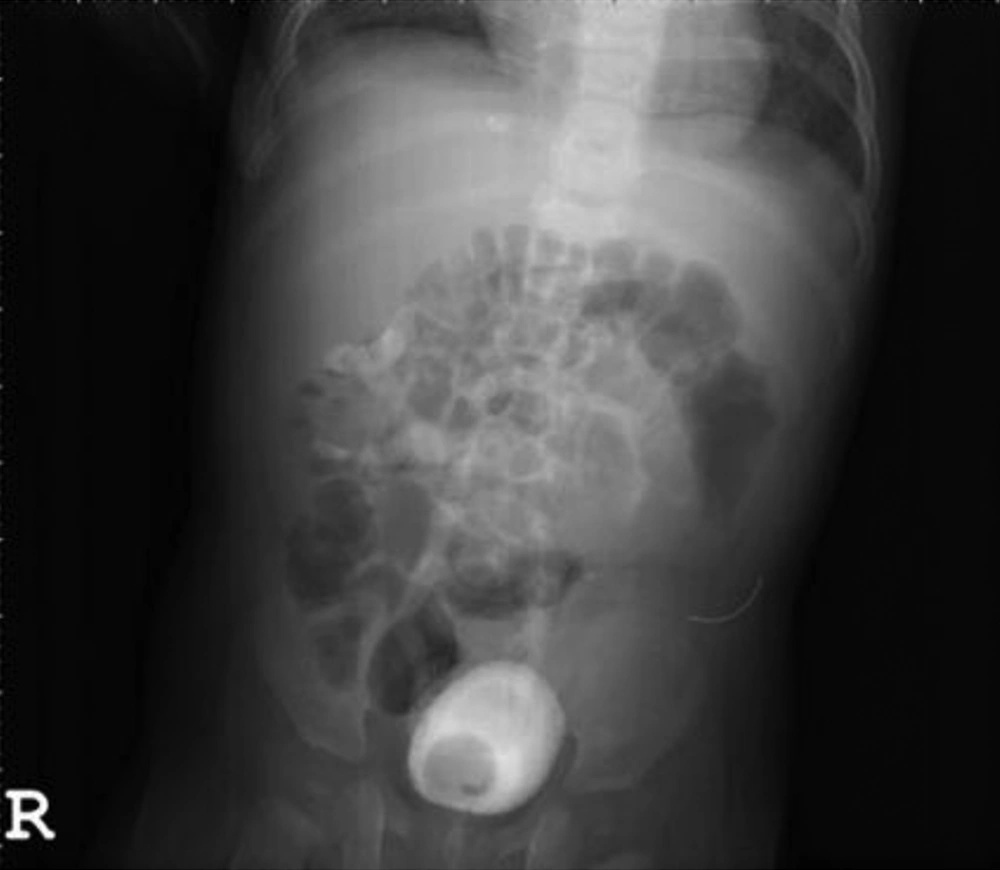
AP view of VCUG shows moderate bilateral VUR
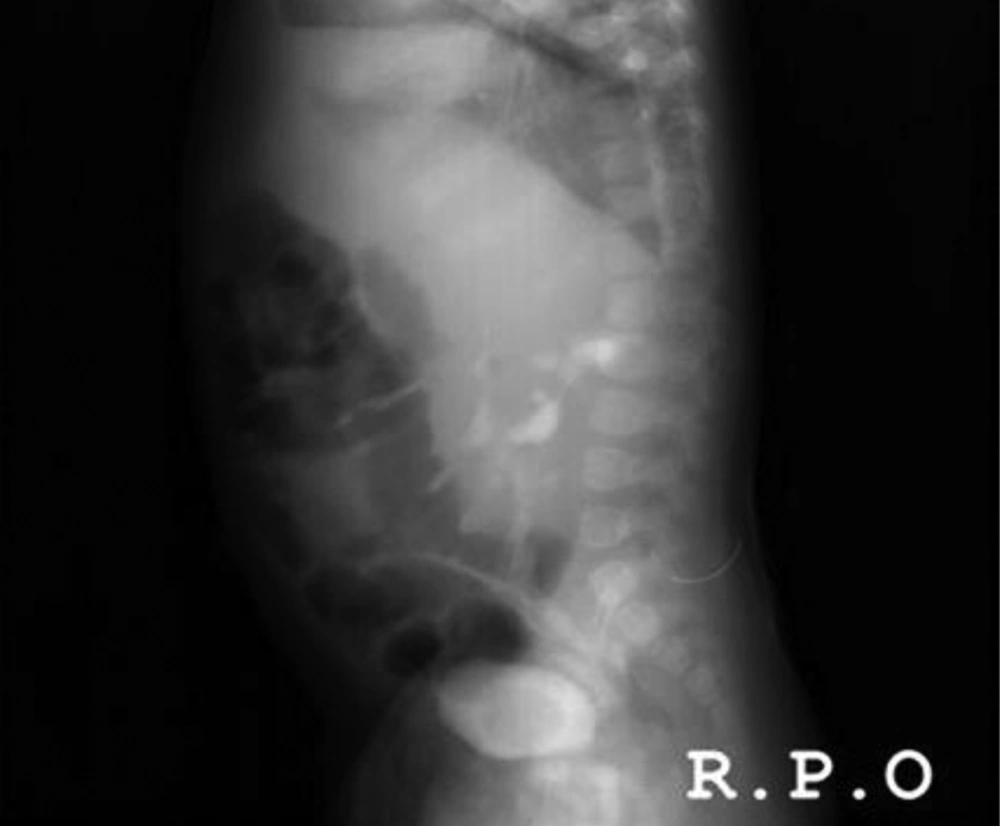
Figure 1.

AP view of VCUG shows moderate bilateral VUR

R.P.O view shows bilateral moderate VUR
Figure 2.

R.P.O view shows bilateral moderate VUR

3. Discussion

Resistant to treatment, nephrotic syndrome, and congenital anomalies of the kidney and urinary tract (CAKUT), including ureter pelvic junction obstruction and vesicoureteral reflux, are two important causes of renal impairment in children. Although the etiology of CAKUT is probably multifactorial, it is likely that many causes of CAKUT have a genetic base. There is new growing evidence that different renal and urological malformations may even be caused by gene mutation (5). On the other hand, the genetic base of CNS and some progressive forms of nephrotic syndrome like focal segmental glomerulosclerosis (FSGS) has lately been approved (6). Mammalian kidneys originate from the two compartments of embryonic mesoderm (ureteric bud and metanephric mesenchyme), whose interaction between these parts differentiated metanephric mesenchyme to nephron epithelia (5). Failure of this mechanism is considered as one of the main causes of a wide range of renal malformations. Several genes (PAX, SOX, WNT, and others) play an important role during the differentiation process, leading to the formation of nephron epithelia (5, 6). Therefore, the etiology of CAKUT is probably multifactorial (5, 7). Complicated nephrotic syndrome and CAKUT, including ureteropelvic junction obstruction, vesicoureteral reflux, hypoplastic and dysplastic kidney, are important causes of renal impairment in children, and it is likely that many of CAKUT causes are genetic. There is new growing evidence that different renal and urologic malformations may be caused by the same types of gene mutations (6). Only a few studies that support the association between nephrotic syndrome and urologic anomalies have been published. For the first time in 1972, William and his coworkers report seven children out of 21 patients who were admitted due to nephrotic syndrome and were found to have congenital anomalies of the genitourinary tract; they brought up the need for urological evaluation of all patients with nephrotic syndrome. However, they did not perform any genetic study at that time (8). After that, in 1973, Berger et al. (9) reported transient obstructive uropathy associated with nephrotic syndrome. In 2008, Seyedzadeh et al. (10) reported a case of Pfeiffer syndrome (acrocephalosyndactyly) with high-grade bilateral vesico-ureteral reflux and discussed the importance of studying urologic problems in patients with genetic diseases, especially if there are urinary symptoms. Here we report vesico-ureteral reflux in a four-month-old patient with congenital nephrotic syndrome. Owing to the definitive role of genetic mutation in the pathophysiology of CNS, the detection and presence of vesico-ureteral reflux suggest the existence of a common source of genetic disorder in this association.
Therefore, according to our findings, we recommend that patients with CNS should be considered and evaluated for probable association with urinary anomalies, although more case studies along with genetic evaluation are recommended.

Footnotes

References

  • 1.
    Jalanko H. Congenital nephrotic syndrome. Pediatr Nephrol. 2009;24(11):2121-8. [PubMed ID: 17968594]. [PubMed Central ID: PMC2753773]. https://doi.org/10.1007/s00467-007-0633-9.
  • 2.
    Holmberg C, Jalanko H. Congenital nephrotic syndrome and recurrence of proteinuria after renal transplantation. Pediatr Nephrol. 2014;29(12):2309-17. [PubMed ID: 24682440]. [PubMed Central ID: PMC4212136]. https://doi.org/10.1007/s00467-014-2781-z.
  • 3.
    Lotfi S, Mohammdzadeh A, Farhat A, Saeidi R, Mirmohammadi M. Congenital Nephrotic Syndrome: A Cases Report. Iranian Journal of Neonatology IJN. 2018;9(1):71-4.
  • 4.
    Tryggvason K, Patrakka J, Wartiovaara J. Hereditary proteinuria syndromes and mechanisms of proteinuria. N Engl J Med. 2006;354(13):1387-401. [PubMed ID: 16571882]. https://doi.org/10.1056/NEJMra052131.
  • 5.
    Gimelli S, Caridi G, Beri S, McCracken K, Bocciardi R, Zordan P, et al. Mutations in SOX17 are associated with congenital anomalies of the kidney and the urinary tract. Hum Mutat. 2010;31(12):1352-9. [PubMed ID: 20960469]. [PubMed Central ID: PMC3056145]. https://doi.org/10.1002/humu.21378.
  • 6.
    Woolf AS. A molecular and genetic view of human renal and urinary tract malformations. Kidney Int. 2000;58(2):500-12. [PubMed ID: 10916073]. https://doi.org/10.1046/j.1523-1755.2000.00196.x.
  • 7.
    Vats AN, Ishwad C, Vats KR, Moritz M, Ellis D, Mueller C, et al. Steroid-resistant nephrotic syndrome and congenital anomalies of kidneys: evidence of locus on chromosome 13q. Kidney Int. 2003;64(1):17-24. [PubMed ID: 12787391]. https://doi.org/10.1046/j.1523-1755.2003.00066.x.
  • 8.
    Demaria WJ, Krueger RP, Anderson EE. Urinary tract abnormalities in the nephrotic syndrome. Seven cases demonstrating such an association. Clin Pediatr (Phila). 1972;11(9):530-3. [PubMed ID: 5073806]. https://doi.org/10.1177/000992287201100916.
  • 9.
    Berger M, Travis LB, Lorentz WB, Carvajal HF. Transient obstructive uropathy associated with the nephrotic syndrome: Case report. The Journal of Pediatrics. 1973;83(3):456-8. https://doi.org/10.1016/s0022-3476(73)80272-0.
  • 10.
    Seyedzadeh A, Kompani F, Esmailie E, Samadzadeh S, Farshchi B. High-grade vesicoureteral reflux in Pfeiffer syndrome. Urol J. 2008;5(3):200-2. [PubMed ID: 18825630].

Similar Articles

18
Nov
2020
Nephro-Urology Monthly

Prevalence of Vesicoureteral Reflux and Urinary Tract Infection in Children with and without Urolithiasis

Parsa Yousefichaijan,
Fatemeh Safi,
Masoud Rezagholizamenjany,
Mino Safari,
Fakhreddin Shariatmadari

Yousefichaijan P, Safi F, Rezagholizamenjany M, Safari M, Shariatmadari F. Prevalence of Vesicoureteral Reflux and Urinary Tract Infection in Children with and without Urolithiasis. Nephro-Urol Mon. 2020;12(4):e103276. doi: https://doi.org/10.5812/numonthly.103276

26
Feb
2025
Arch Clin Infect Dis

Evaluation of the Laboratory and Sonographic Findings of Vesicoureteral Reflux in Children with Acute Febrile Urinary Tract Infection

Azar Nickavar,
Elham Zarei,
Mohammad Hosein Ahmadian

Nickavar A, Zarei E, Ahmadian MH. Evaluation of the Laboratory and Sonographic Findings of Vesicoureteral Reflux in Children with Acute Febrile Urinary Tract Infection. Arch Clin Infect Dis. 2025;20(3):e144861. doi: https://doi.org/10.5812/archcid-144861

6
Jun
2022
Iran J Pediatr

Correlation Between the Urine Analysis in Neonates with Renal Anomaly

Maryam Saeedi,
Kayvan Mirnia,
Razieh Sangsari,
Golnaz Alinia

Saeedi M, Mirnia K, Sangsari R, Alinia G. Correlation Between the Urine Analysis in Neonates with Renal Anomaly. Inn J Pediatr. 2022;32(3):e122680. doi: https://doi.org/10.5812/ijp-122680

1
Mar
2012

Association of Nocturnal Enuresis With Vesicoureteral Reflux and Renal Cortical Damage

Mitra Naseri

Naseri M. Association of Nocturnal Enuresis With Vesicoureteral Reflux and Renal Cortical Damage. Nephro-Urol Mon. 2012;4(2):448-453. doi: https://doi.org/10.5812/numonthly.2030

15
Apr
2019
ijp-68933

Genotypic and Phenotypic Features of Both NPHS1 and NPHS2 Genes in Infantile Nephrotic Syndrome and Prognostic Effect of E117K Polymorphism in NPHS1 Gene

Ebru Yılmaz,
Nida Dinçel,
İpek Kaplan Bulut,
Afig Berdeli,
Sevgi Mir

Yılmaz E, Dinçel N, Kaplan Bulut İ, Berdeli A, Mir S. Genotypic and Phenotypic Features of Both NPHS1 and NPHS2 Genes in Infantile Nephrotic Syndrome and Prognostic Effect of E117K Polymorphism in NPHS1 Gene. Inn J Pediatr. 2019;29(2):e68933. doi: https://doi.org/10.5812/ijp.68933

Indexed in

Crossmark
Crossmark
Checking
Share on
Cited by
Metrics

Ordering Reprints

Articles are published under the Creative Commons license stated on each article. No permission or royalty fee is required for uses permitted by that license. CCC handles optional bulk and customized reprint orders. Any quotation covers production and delivery services only, not copyright permission. > Request Reprints from CCC 

Search Relations

Author(s):

Related Articles

