

1. Introduction
Percutaneous nephrolithotomy (PCNL) was first introduced by Fernstrom et al. in 1976 (1). Due to advances in uro-technology, PCNL is currently an effective therapeutic method. The rate of successful treatment in renal calculi ranges from 78% to 95%; however, the rate of minor and major complications is as high as 83% (2). The most common complication is hemorrhage (5.8%). Hemorrhage due to PCNL may be either venous or arterial. Venous hemorrhages are treated conservatively whereas arterial ones may cause more serious conditions. Arterial complications are classified as arteriovenous fistula, arteriocalyceal fistula, aneurysm, pseudoaneurysm, or perinephric hematoma (3). Death is a rare complication of PCNL and it would occur if the arterial hemorrhage is not diagnosed or treated soon (Clavien classification, type V). Diagnosis of the arterial hemorrhage is made by selective renal angiography. Pseudoaneurysm is seen in 0.6% to 1% of the patients. Its primary treatment is by selective transarterial embolization (TAE) (4). Renal TAE was first introduced in 1964 (5) and advances in interventional radiology led to introducing super-selective TAE. Tissue loss due to embolization procedure is very important, especially in the end organs such as kidneys. Currently, super-selective TAE procedure is minimally invasive, safe, and efficient therapeutic method in the arterial hemorrhage due to PCNL (6).
2. Case Presentation
A 27-year-old man presented with left flank pain. On the hemogram, he had white blood cell of 7000/mm3, hemoglobin (Hb) of 16.6 g/dL, hematocrit of 49.6%, and platelet of 193000/mm3. Bleeding time, coagulation time, prothrombin time, and activated partial thromboplastin time values were within normal limits. Laboratory investigations were as follows: Urea, 32 mg/dL; and creatinine, 0.8 mg/dL. The results of liver function tests were within normal limits. On physical examination, tenderness was found on the left lumbar region. Examination findings of other organ-systems were normal. Ultrasonography (US) findings revealed the agenesis of the right kidney, the size of left kidney was 151 × 71 mm, its parenchymal thickness was 22 mm, and there was a 27 mm calculus in the major lower calyx. On the intravenous pyelogram, the left kidney stone was 27 mm in size and the nephrogram and pyelogram findings were insignificant (Figure 1). No activity was observed in the right kidney. Diagnosis of the solitary kidney was confirmed by DTPA and DMSA.
Under general anesthesia and after inserting a 6-Fr catheter in the left ureter, the patient was put in lithotomy position by placing cushions under his knees, iliac bones, and shoulder. The collector tract was visualized with contrast medium. An 18-gauge needle was advanced to the lower calyx. Stone-free standard PCNL procedure was performed with pneumatic lithotripter using low-pressure isotonic solution and semi-rigid Amplatz dilators under the guide of rigid nephroscope. A 20-Fr reentry was used as nephrostomy catheter. Hypotension and oliguria (400 mL/day) developed during the first 24 postoperative hours. The patient was supported with intravenous colloidal solution and blood transfusion. Abdominal computed tomography (CT) revealed retroperitoneal hematoma extending to the left fossa iliaca (Figure 2). Hb levels progressively decreased to 6.5 g/dL. Level of urea and creatinine were respectively 98 mg/dL and 5.5 mg/dL at the 48th postoperative hour. At the 72nd postoperative hour, level of urea and creatinine were 145 mg/dL and 9.3 mg/dL, respectively. The results of renal Doppler US showed a 28 mm thickness and heterogeneous parenchyma with grade II echogenicity. After consultation with nephrology department, the patient underwent hemodialysis. On the 96th postoperative hour, selective renal angiography was performed with presumed diagnosis of pseudoaneurysm. Pseudoaneurysm was found on the posterior segment of the left inferior renal artery (Figure 3). Segmental aneurysm was corrected by applying three simultaneous endocoils. Hemodialysis was done twice on the 120th and 144th postoperative hours. Following hemodialysis, urinary output increased from 3750 mL to 12000 mL, and creatinine level fell from 10 mg/dL to 1.3 mg/dL. The patient was discharged after recovery of his renal function. The findings of the patients are summarized in Table 1.
Table 1. Summary of Endovascular Intervention for the Patient
| Age/Sex | Type/Lesion No. | Anatomical Location | Etiology | Used Catheter /Embolizing Agent | Complication | Outcome |
|---|---|---|---|---|---|---|
| 27/Male | Pseudoaneurysm/1 | Left posterior subsegmental artery | Percutaneous nephrolithotomy | Microcatheter/Coil | None | Successful |
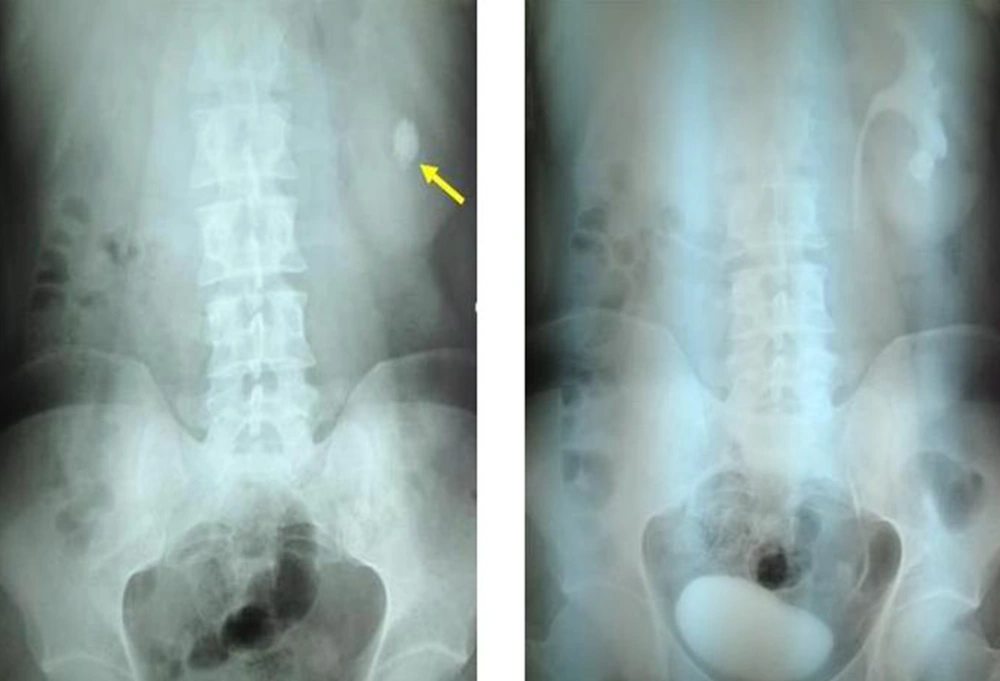
Figure 1.
Intravenous Pyelogram showing a Twenty-seven-millimeter Calculus in the Left Kidney.
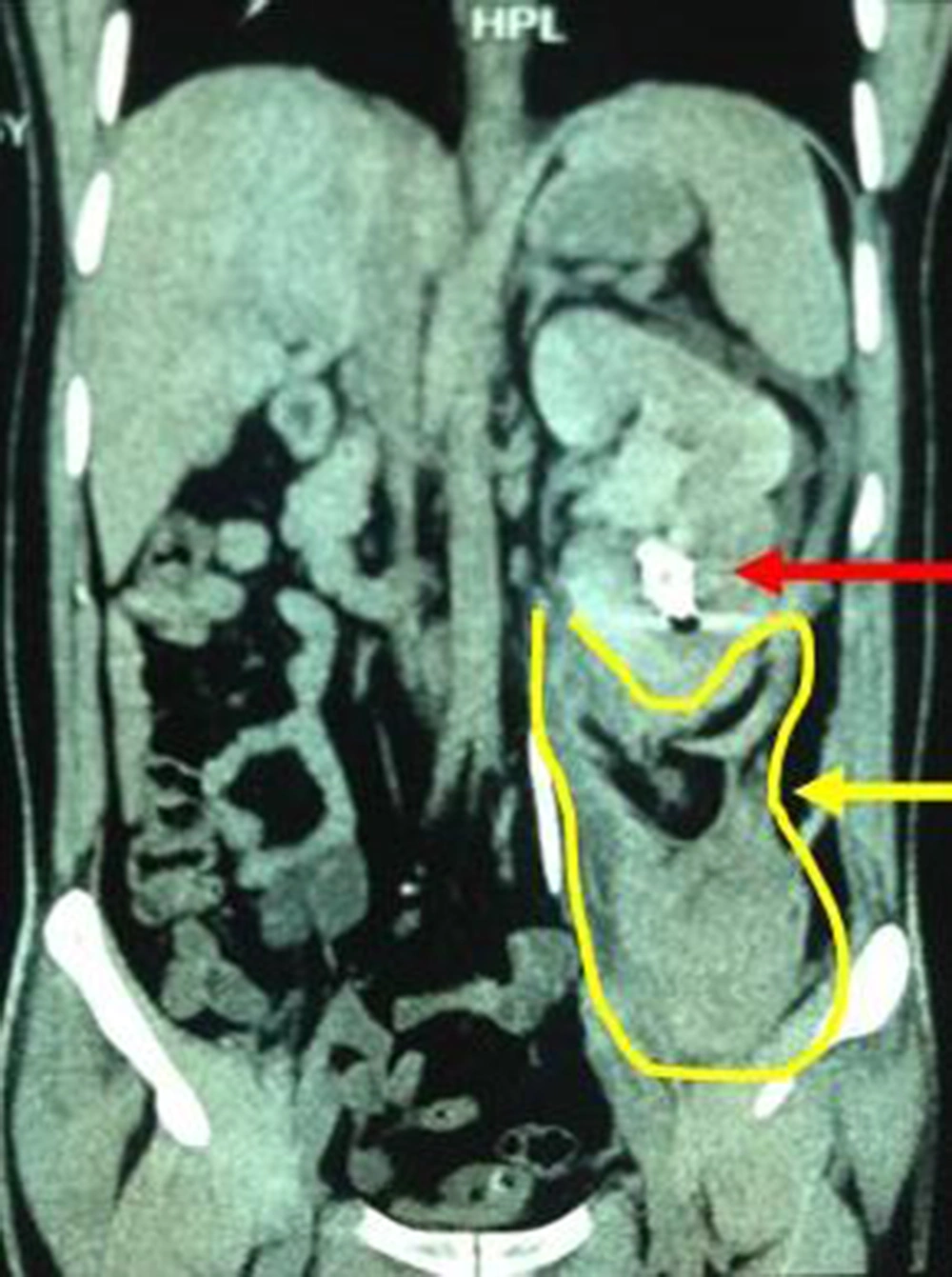
Figure 2.
Computed Tomography Substituted by Lower Calyx Reentry Catheter (red arrow) and Giant Retroperitoneal Hematoma (yellow arrow)
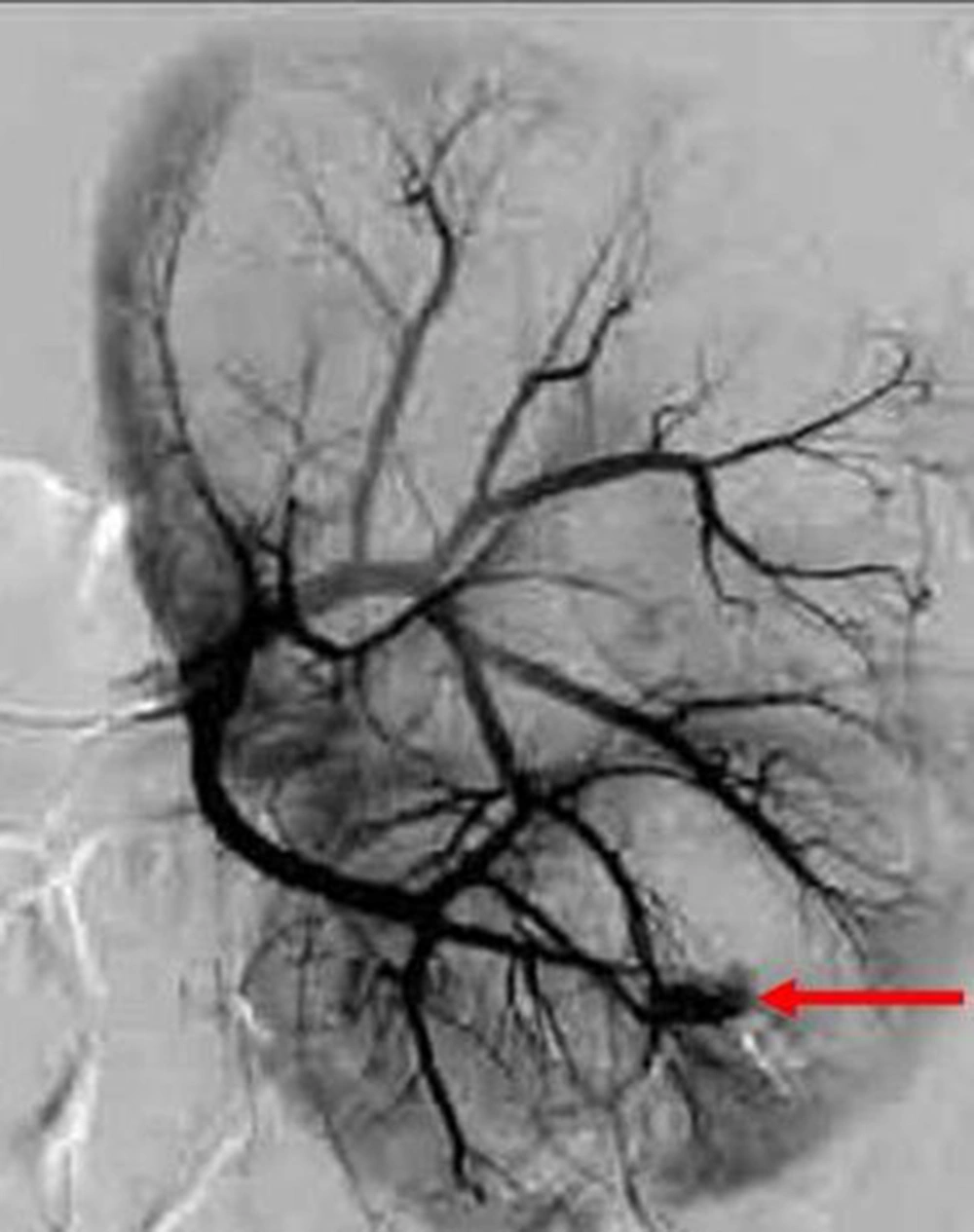
Figure 3.
Left Subsegmental Pseudoaneurysm in Super-Selective Renal Angiography
3. Discussion
Calculi requiring PCNL in the patients with solitary kidney is a matter of concern for the urologist. Failure to control the hemorrhage may require partial or total nephrectomy and the patients might be left anephric. Clinical data on this topic are limited in the literature. Particularly, there are no large series on safety of standard PCNL procedure (7). Retrograde intrarenal surgery (RIRS) is an alternative to PCNL in the patients with solitary kidney. In the literature, however, there is lack of large series of patients that have compared the success rate of PCNL with RIRS in the calculi > 2 cm. Rate of being stone-free for the calculi > 2 cm was found to be 71% and 37% for PCNL and RIRS, respectively. In the study by Chung et al. (8), the rate was 87% for PCNL and 67% for RIRS. In another study, success rates of 73.5% and 91.2% were achieved with one session RIRS and PCNL, respectively (9). In a retrospective study, Knoll et al. compared RIRS and mini-PCNL in treatment of 1 cm to 3 cm calculi in patients with solitary kidney. In their study, the calculi had almost similar size and more than half of them were located in the lower calyx. They reported that the rate of success following the first session was 96% in the mini-PCNL and 71.5% in the RIRS groups (10). According to the studies on PCNL complication, it has been found to be safe with acceptable complication rates in the patients with solitary kidney. In those studies, the rate of success was 77% and the rate of venous hemorrhage requiring transfusion was 7.3% (7). PCNL was found to be safe in the patients with solitary kidney in the study by Akman et al. (11).
Although there are several publications in the literature that show a wide safety margin of PCNL in the patients with solitary kidney, unique complication of the procedure remains problematic. The most serious complication in the cases with solitary kidney is related to the arterial system. PCNL has a wide spectrum of arterial complications. The most important issue in these complications is decision on how to diagnose the condition. CT gives valuable information in demonstrating the lesion during the early arterial phase of the complications. Disadvantages of the procedure are use of contrast medium and difficulty of performing selective angiography at the time of diagnosis. Magnetic resonance imaging enables more accurate diagnosis but nephrogenic fibrosis is an important complication (12). Selective renal angiography is the gold standard of diagnosis. The main advantage of selective renal angiography is possibility of performing simultaneous endovascular intervention (13), which is the most appropriate treatment modality for arterial complications (14).
TAE by direct percutaneous intervention is another therapeutic method. The procedure involves coil embolization of content of the pseudoaneurysm under guide of Doppler US. Important disadvantages of the procedure include arterial injury, intervention on one of the main segmental arteries, occurrence of hemorrhage to require nephrectomy (all of which are unique complications of the intra-arterial intervention), use of contrast medium, and exposure to radiation. This method reduces the risk of partial or total nephrectomy due to hemorrhage especially in the patients with solitary kidney. The method is fast and effective, and may reduce mortality and morbidity by sparing the renal tissue. Thus, it is recommended as first-line treatment for active hemorrhage due to pseudoaneurysm in the kidney (15).
In the patient presented here, using contrast medium for conventional selective renal angiography posed cumulative risk because of development of serious arterial complication and consequent acute renal failure. The contrast medium used in selective renal angiography is nephrotoxic. This problem indicates that therapeutic alternatives are very important.
Doppler US and direct percutaneous embolization may be useful in treatment of arterial complications in the patients with solitary kidney. Using heparin during hemodialysis for treatment of acute renal failure due to hemorrhage and hypotension in such patients reflects a paradoxical situation. Determining and entering the accessory renal arteries under the guide of Doppler US prior to scheduled PCNL may reduce arterial complications in the patients with solitary kidney.
In conclusion, standard PCNL is a safe procedure in the patients with solitary kidney. Arterial complications of the PCNL, however, are very important in these patients. Other endoscopic therapeutic methods, RIRS, and mini-micro-PCNL are the alternative therapeutic modalities. In the case of arterial complication, early diagnosis and treatment are of vital importance. Using contrast medium demands special attention in the patients with solitary kidney. Selective percutaneous angiographic intervention and endocoil treatment are gold standard of therapy. Direct percutaneous intervention under the guide of Doppler US, however, is an alternative therapeutic method in terms of lowering complications. This method may be preferred in patients with solitary kidney.


