


1. Background
Diabetes mellitus is a group of metabolic disorders characterized by hyperglycemia. There are several types of diabetes caused by complicated genetic reactions and environmental factors. Hyperglycemia is caused by defects in insulin secretion, reduced glucose utilization and increased glucose production depending on the type of diabetes. End organ damage is the result of metabolic disorder in patients with diabetes, which is accompanied by other important problems for patients and health care system. In the USA, diabetes is the main cause of renal disease, also known as ESRD, non-traumatic lower extremity amputation and adults' blindness. It is the fourth reason of referring patients to physicians (1-5). Diabetes nephropathy occurs in both types 1 and 2 diabetes and also in genetic types of diabetes. It is the most common cause of ESRD in developed countries and includes 30% of these cases. Type 1 diabetes is usually easy to recognize and the epidemiology of diabetic nephropathy in type 1 has been more clarified. Micro-albuminuria occurs in almost 20% - 30% of patients with type 2 diabetes after 15 years. Less than a half of patients with micro-albuminuria would progress to end-stage renal disease (2, 3, 6).
Zinc (Zn) plays a functional act in nervous and immune systems, hormones activity, growth and development, taste and smells function and wound healing as well as proteins and nucleic acids synthesis (7-9), sexual maturation, release of vitamin A from the liver and cell wall structure (10). Zn is an important micronutrient, which has a major role in synthesis, storage, secretion and function of insulin and its metabolism is altered in diabetes (11, 12). Zn deficiency is correlated with insulin resistance (13, 14). In diabetic patients, chronic hyperglycemia due to glycosylation and peroxidation leads to increased oxidative stress and thereby proteins and lipids structure are changed (15). Lipid peroxidation produces toxic aldehydes; malondialdehyde (MDA) is one of the most poisonous molecules (16). Zn acts as a strong antioxidant (17, 18) and may decrease lipid peroxidation and improve antioxidant status in patients with diabetes (19, 20).
Hyperglycemia is the most important sign of diabetes induced by increased oxidative stress, free radicals production and proteins glycosylation. Copper (Cu) ions have more desire to bind to these proteins (15, 21). Cu binding glycosylated proteins can cause oxidative reactions, increased oxidative stress and free radicals production in diabetes (22, 23). The ceruloplasmin (Cu-carrying protein) can stimulate glycation and release Cu ions by accelerating oxidative stress in diabetes. Therefore, plasma level of Cu is increased (24), which can induce oxidative activity. In contrast, antioxidant defense system reduces damages by decreasing oxidative stress (25).
Chromium (Cr) is another element, which affects insulin action. The requirement of insulin would be reduced with sufficient dietary intake of Cr, which is very critical to prevent adverse effects of diabetes. Cr deficiency in diet causes impaired glucose tolerance. Chromium supplementation has an anti-diabetic effect and improves fasting blood sugar (FBS), insulin function, insulin-receptor binding, increased pancreas beta cells sensitivity and glucagon action (26). Cr plays a vital role in lipid and protein metabolism and regulation of water and also may decrease low density lipoprotein (LDL) and β lipoprotein. Cr is an inhibitor of oxidative stress. It can also reduce the effect of free radicals in type 2 diabetes (27, 28).
2. Objectives
Regarding trace element role in pathophysiology of renal dysfunction and their importance in diabetes, we measured these elements level (Zn, Cu and Cr) in patients with diabetic nephropathy and control subjects. In addition, we evaluated these elements levels in drinking water.
3. Patients and Methods
This study was performed at Mazandaran university of medical sciences, Sari city, during 2010 - 2011. Confirmation from ethical committee was taken before the study. The number of samples was selected based on the previous studies (22, 23). After obtaining informed consents, individuals were recruited for study groups. All participants in this study were subjected to complete history taking and thorough clinical examination. In case group, there was no history of type 1 diabetes, proteinuria with other reasons, hypertension more than 140/90, dialysis, transplantation, ARF (acute renal failure), malnutrition and use of supplementary such as Zn or other evaluated elements in mineral or purified water. Demographic characteristics were obtained through interviewing subjects. Weight was calculated using a balance standard measure. Systolic and diastolic blood pressures were measured using a standard mercury sphygmomanometer.
3.1. Biochemical Studies
24-hour urine samples were obtained from all subjects for evaluation of micro-albumin. Eventually, the term microalbuminuria is determined by a lower and upper limit for the urinary albumin concentration. Lower than 30 mg/day (or 20 mg/L) is assumed normal and above 300 mg/day (or 200 mg/L) considered as macroalbuminuria. The urinary albumin was evaluated by immunonephelometric testing.
After 12 hours overnight fasting, blood samples were taken through peripheral venous and serum was separated by centrifugation at 1500 rpm for 5 minutes and stored at 4°C until assayed. Serum FBS, Hb, HbA1c, uric acid, BUN (Blood Urea Nitrogen) and creatinine levels were measured by standard kits (Pars Azmoon, Iran) using an auto analyzer (prestige 24i, Japan).
3.2. Trace element Analysis
3.2.1. Serum Samples
Immediately after separating serum, each tube was diluted (1:3) with diluted glycerol and serum Zn, Cu and Cr were assessed using a varian atomic absorption spectrometer. The serum level of metals for each sample was obtained by calibration curve and dilution of samples.
3.2.2. Water Samples
Before collecting samples of drinking water, the water supply area of Sari city was detected coming from wells. Following chlorination, well water was pumped to distribution system. There are three water distribution supplies in Sari city. For sample collection, five points were chosen from each water distribution supply and samples (1 liter) were taken from the house water tap at 8 AM, 12 MD and 4PM. The samples were then transferred into a container of 3 liter and mixed. Then 1 liter was taken from the mixed samples and pH was adjusted between 4.6 and 6.4. Testing sample was sent to the toxicology laboratory and stored below 4°C. Before analysis, the samples were fixed by nitric acid 65% and stored in the refrigerator until analyzed. Finally, the levels of mentioned metals were evaluated by an atomic absorption spectrophotometer model A100.
3.3. Statistical Analysis
Data was analyzed using SPSS v.18. Independent-samples t-test was used to compare data between the two groups. P values less than 0.05 considered significant in all studies.
4. Results
The study population included 70 patients (30 - 60 years old) with type 2 diabetic nephropathy (micro and macroalbuminuria) (cases) and 70 healthy subjects (controls) matched for age and gender and other variables. Both case and control groups were subjected to complete history taking and clinical examination; individuals with complications mentioned above were excluded from the study. Demographic data, duration of diabetes and findings of clinical and laboratory examination of both case and control groups are presented in Table 1.
Cu, Cr and Zn were assessed in both case and control groups using a varian atomic absorption spectrometer model A100. Figure 1 demonstrated the values of these elements in case and control groups.
Table 1. Demographic Parameters, Clinical and Laboratory Findings and Duration of Disease in Cases and Controls
| Cases | Controls | P Value | |
|---|---|---|---|
| Age, y | 55.17 ± 3.71 | 51.16 ± 1.94 | 0.084 |
| Weight, Kg | 77.87 ± 8.09 | 75.59 ± 4.60 | 0.59 |
| Hb, g/dL | 13.08 ± 0.62 | 14.75 ± 1.34 | 0.110 |
| FBS, mg/dL | 197.62 ± 21.81 | 92.92 ± 9.72 | 0.001 |
| SBP, mmHg | 130.11 ± 0.34 | 120.04 ± 0.13 | 0.001 |
| DBP, mmHg | 80.35 ± 0.13 | 80.01 ± 0.06 | 0.004 |
| Creatinine, mg/dL | 1.01 ± 0.06 | 0.87 ± 0.04 | 0.09 |
| BUN, mg/dL | 22.82 ± 2.15 | 9.5 ± 1.75 | <0.001 |
| Microalbuminuria, mg/d | 209.63 ± 16.39 | 13.58 ± 2.14 | 0.008 |
| Uric acid, mg/dL | 6.26 ± 1.30 | 4.90 ± 0.93 | 0.067 |
| HbA1c,% | 8.68 ± 0.40 | 5.53 ± 0.31 | <0.001 |
| Duration of diabetes | 13.21 ± 2.84 | - | - |
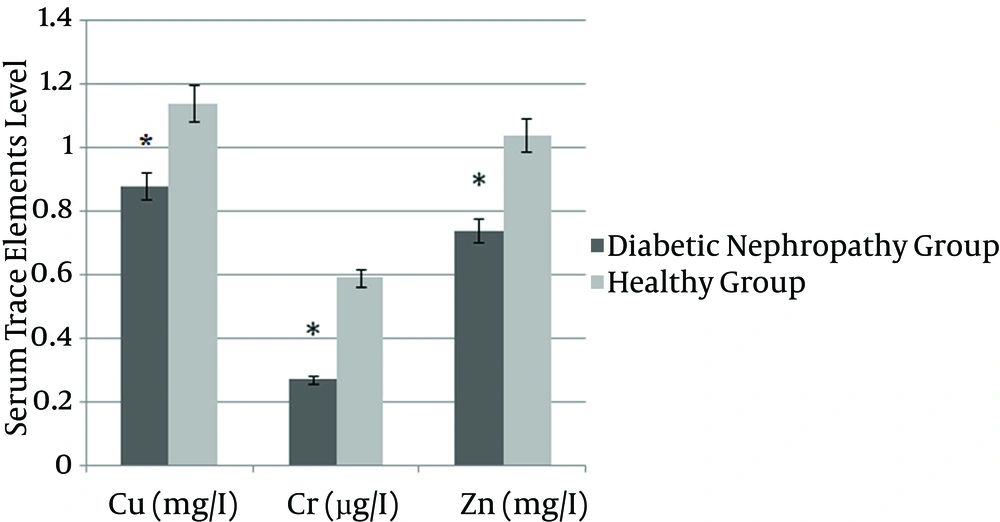
Figure 1.
Trace Elements in Cases are Significantly Lower Than Controls (*, P < 0.001). Errors Bars Represent Standard Deviation.
Albumin was evaluated on 24-hour urine samples of patients and healthy individuals. Urine protein in micro-albuminuria and macro-albuminuria were 113.43 ± 41.38 mg/dL and 514.35 ± 90.11 mg/dL, respectively. Figure 2 illustrated the comparison of serum trace elements level in patients with micro- and macro-albuminuria.
The values of trace elements in drinking water are represented in Table 2.
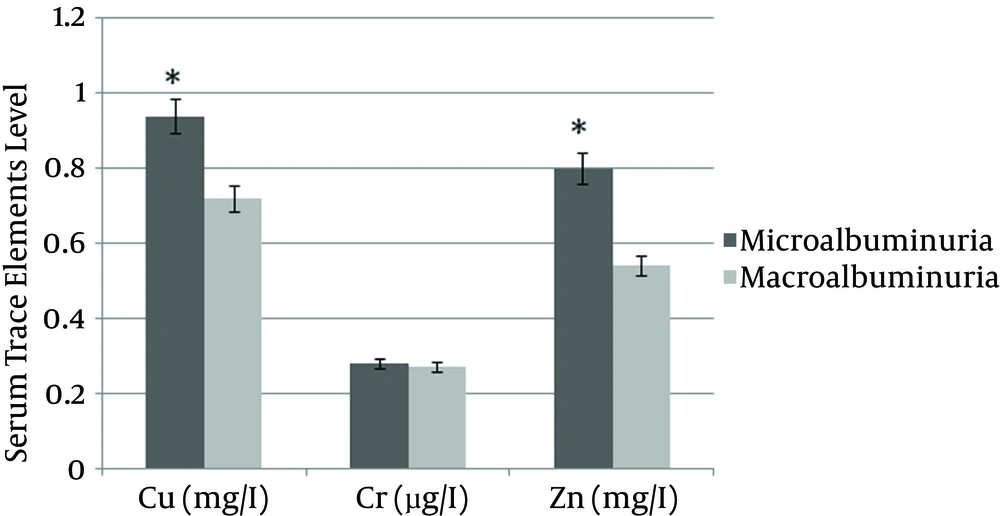
Figure 2.
There was no significant difference in Cr values in micro and macro albuminuria cases (*, P < 0.05). Errors bars represent standard deviation.
Table 2. Comparison of Serum Trace Elements Level (mean ± SD) in Drinking Water a
| Cu | Zn | Cr | |
|---|---|---|---|
| Values | 695.25 ± 11.57 | 1241.5 ± 9.59 | 28.6 ± 5.59 |
| Iran Standard | accepted limit 1000 | accepted limit 3000 | accepted limit 50 |
| WHO Standard | accepted limit 2000 | accepted limit 3000 | accepted limit 50 |
a All unit are based on µg/L.
5. Discussion
Several studies indicated that imbalance of some fundamental metals can adversely affect pancreatic islet that cause diabetes. However, imbalance of essential metals induced generation of some reactive oxygen species (ROS) during diabetes. Hyperglycemia causes oxidative stress that can lead to a reduction of gene promoter activity and expression of mRNA in pancreatic islet cells. Assessment of trace elements such as Zn, Cu and Cr in various diseases including diabetes remains contradictory with a lot of unanswered questions (6, 29).
According to the results in the present study, patients with diabetic nephropathy had lower serum concentrations of Zn, Cu and Cr than healthy individuals. Our data was in coordination with Jamshidi et al. study, which demonstrated a decrease in serum level of Zn in male and female with type 2 diabetes compared to both genders in healthy group (30). Kazi et al. reported a significant reduction in Zn level in blood and scalp hair samples and also its increase in urine of both genders in diabetic patients (31). In a study performed by Nasli-Esfahani et al. the level of elements in hair, nail, urine and serum were evaluated in type 2 diabetic patients; their results indicated a meaningful decrease in serum level of Zn in patients compared to healthy individuals (32). In a research performed by Adewumi et al. the serum level of Cu in type 2 diabetic patients of both genders was significantly decreased in patient groups compared with healthy individuals (33), which was in accordance with our study. Our results were in agreement with Kazi et al. study, in which type 2 diabetic patients had lower values of Cr in blood and scalp hair samples in men and women compared with healthy subjects (31). Nasli-Esfahani et al. and Saboori et al. demonstrated low serum Cr in diabetic patients compared to healthy individuals (32, 34), which is in accordance to our findings.
Our research displayed a significant difference in serum Cu and Zn levels between patients with macro and microalbuminuria; as serum copper and zinc concentrations in patients with microalbuminuria were remarkably higher than patients with macroalbuminuria. As well, Talaei et al. evaluated levels of proteinuria and Cu in diabetes and a positive association between microalbuminuria and urine Cu level has been found; as higher levels of urinary copper have been shown in diabetics (35). In diabetic patients with nephropathy, high levels of urinary copper may be associated with excretion of its carrier proteins, ceruloplasmin. Copper excretion in urine may also be caused by dissociations from both copper-albumin and ceruloplasmin-copper complexes filtered through the disturbed glomerulus. High urinary copper can damage renal tubules and play an important function in the development of nephropathy (35). A relationship between serum zinc and albuminuria has been detected in various researches for type 1 and type 2 diabetes (36). Decreased serum concentration of zinc assumed to be the result of increased urinary albumin excretion by microvascular injury. Regarding our survey and other studies, low levels of these elements can be considered as a risk factor for diabetes. There are inconsistent findings about the association of serum Cu level with diabetes incidence, which necessitates further investigations. In addition, results indicate that factors such as drinking water have no role in low serum levels of Cu, Zn and Cr in patients with diabetic nephropathy and the reason should be studied in other causes such as urinary excretion, amount of these elements in each meal, intervention factors in absorption and utilization and individual conditions. The dietary minerals and their effects on diabetic persons need more research and interventional studies. Excessive urination in diabetic subjects may be a potential cause fort these trace elements deficiency.
Regarding our study, serum Zn, Cu and Cr levels were low in patients with diabetic nephropathy, whereas no association was found between drinking water and serum concentration of these trace elements in patients with diabetic nephropathy. The mentioned trace elements are cofactors of different enzymes playing a major role in the etiology of diabetes. It is recommended to perform future studies to investigate the association between serum levels of these enzymes and other metals including selenium, magnesium and iron.

