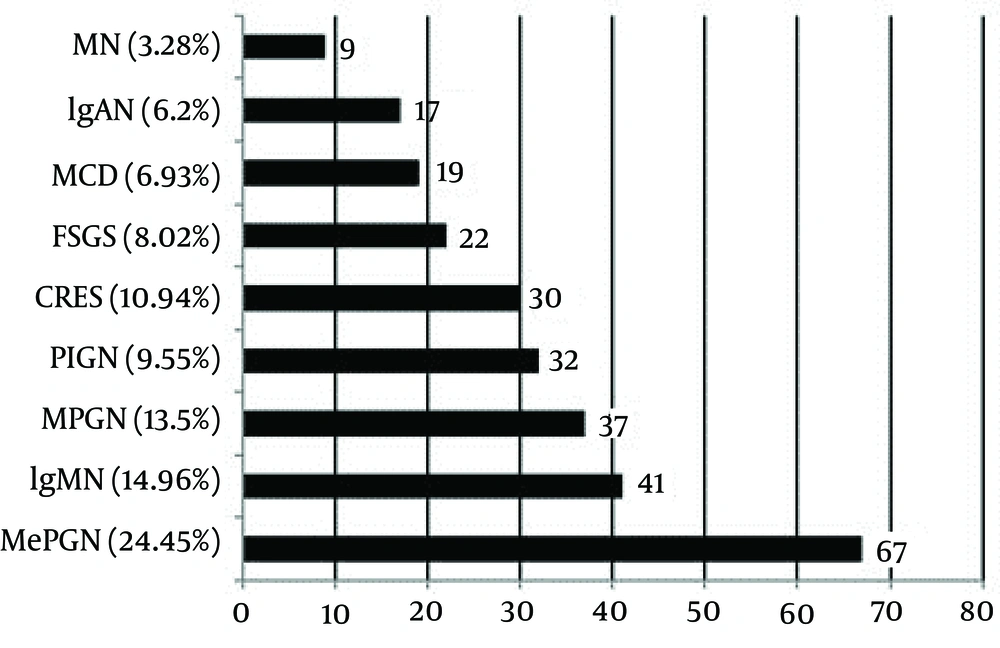
This report provides information on the histopathological pattern and epidemiology of renal diseases in children in India. To our knowledge, this is the first systematic review of histological data of children suffering from renal diseases in India. NS was the most common indication for renal biopsy in the children in that it comprised 46.2% of the total biopsies in our study. A similar observation has been reported in different series from Europe and Asia (
6-
10). In NS, MePGN (33.5%) was the most common histological lesion, followed by IgMN (21.2%), FSGS (12.2%), and MCD (12.2%). In SRNS, FSGS (25.4%) and IgMN (23.6%) were the common lesions. In their overall study of nephritic children in North India, Kumar et al. (
11) reported that MCD was the most common lesion in those under 8 years of age and that FSGS was the most common NS. Mubarak et al. (
12) reported MCD as the most common NS, followed by FSGS, in childhood NS in Pakistan. It is consensual not to perform renal biopsy in children with a recent diagnosis of NS without the following criteria: arterial hypertension; gross hematuria and/or marked elevation in serum creatinine; normal complement levels; and no external symptoms or signs suggestive of secondary GN (
3). We usually perform renal biopsies in children with SRNS, SDNS, and SDFRNS. Children with MCD usually do not undergo renal biopsy at our center; this may be the reason for the high incidence of MePGN and IgMN compared to MCD in our study. Along the same lines, Pio et al. also reported the rising prevalence of MePGN and IgM deposits for the same reason (
3). MCD with IgMN comprised one-third of the NS in our study. The IgMN morphology can vary from normal-appearing glomeruli to mesangial hyperplasia with or without segmental or global sclerosis. In the present study, IgMN comprised MePGN (73.17%), FSGS (14.63%), and MCD (12.19%). IgMN is usually steroid-resistant and has a poor prognosis compared to similar lesions without IgM deposits (
2,
13-
15). Our previous published study reported that IgMN was observed in 11.9% of the biopsies, with the most common morphology being MePGN followed by MCD and FSGS (
16).
Primary GN (81.8%) was the most common histology in our study. A similar observation has been reported in other studies (
1,
3,
10). The most common primary GN was MePGN in our study, while IgAN was reported as the most common cause of primary GN in other Asian and European series (
1,
2,
17). The low prevalence of IgAN in our study (5.07% of primary GN) is due to the low rate of renal biopsies performed in children with UA. Vanikar et al. (
18) reported an overall incidence of primary IgAN in patients with nephrotic/nephritic syndrome of 16.2% in western India, more common in young males in second/third decade of life. The Italian national registry demonstrated that 50% of biopsies were performed for isolated hematuria and non-nephrotic proteinuria (
1,
10). This shows that difference in lesions depends on the selection criteria for renal biopsy rather than difference in frequency. In the present study, secondary GN was reported in 54 (16.1%) patients. The most common lesion in secondary GN was LN (7.76%), followed by HUS (6.26%), HTN (1.19%), and amyloidosis (0.89%). Chiming in with our results, LN was the most common secondary GN observed in other studies too (
2,
3,
6). In pediatric patients, the indication and histopathological findings of renal biopsies are similar in the same region; however, they differ from those in Western and even Asian countries. As was mentioned, the difference in lesions also depends on the selection criteria for renal biopsy. The present study provides data on the epidemiology of renal diseases in Indian children and will be helpful for building up a national registry and devising therapeutic guidelines in the future.