Mean (± SD) age of the participants was 60.3 (± 10.0) years. Mean (± SD) duration of HTN was 7.2 (± 5.9) years (range, 6 months to 40 years).
Table 1 summarizes demographic characteristics of the sample.
| Demographic Characteristics | Frequency (%) |
|---|
| Gender | |
| Male | 118 (42.1) |
| Female | 162 (57.9) |
| Age, y | |
| ≤ 50 | 51 (18.2) |
| > 50 | 229 (81.8) |
| BMI, kg/m2 | |
| < 25 | 76 (27.1) |
| ≥ 25 | 204 (72.9) |
| Education | |
| Lower than high school diploma/illiterate | 164 (58.5) |
| High school diploma | 71 (25.4) |
| Academic degree | 45 (16.1) |
| Occupation | |
| Market trader/self-employed | 73 (26.1) |
| Clerk/military | 41 (14.6) |
| Housewife | 119 (42.5) |
| Retired/unemployed | 47 (16.8) |
| Current smoker | 49 (17.5) |
| Insurance coverage | 246 (87.8) |
| Residence place | |
| Urban | 273 (97.5) |
| Rural | 7 (2.5) |
General practitioners (67 patients, 23.9%) and cardiologists (65 patients, 23.2%) were the most reported physicians whom the patients visited to control their high BP. Others reported visiting internists (24 patients, 8.6%), nephrologists (9 patients, 3.2%), or more than one physician to check their BP (115 patients, 41.0%).
Nearly half of the patients (127 patients, 45.3%) were taking one class of antihypertensive medication for their condition. Over one-fourth of the patients, 74 (26.4%) were prescribed angiotensin receptor blockers, the most prevalent medication used.
Mean (± SD) overall MMAS-8 score was 5.75 (± 1.88). About half of the sample (139 patients, 49.6%) showed low adherence to antihypertensives. Ninety-five patients (33.9%) had moderate adherence and 46 patients (16.4%) showed high adherence level.
Of 280 patients, 160 patients (57.1%) had at least one comorbid condition. However, 120 patients (42.9%) did not have any comorbidity. Ninety-six patients (34.2%) had one comorbid disease, 46 patients (16.4%) had 2 comorbid diseases, and 18 patients (6.4%) had 3 diseases or more with HTN. The most common comorbid condition was ischemic heart disease (65 patients, 23.2%) with or without history of coronary artery bypass grafting or percutaneous coronary intervention, followed by diabetes mellitus (55 patients, 19.6%), dyslipidemia (51 patients, 18.2%), psychiatric conditions (8 patients, 2.8%), CKD (7 patients, 2.5%), as well as gout and hypothyroidism (each was seen in 6 patients, 2.1%). Other conditions (congestive heart failure, osteoporosis, chronic obstructive pulmonary disease, malignancies, chronic low back pain, anemia, benign prostatic hyperplasia, osteoarthritis, and so on) had frequencies of 5 patients or fewer.
Mean (± SD) MMAS-8 score in comorbid group was 5.68 (± 1.85) and in non-comorbid hypertensives was 5.83 (± 1.91) (P = 0.631).
Table 2 presents the comparison of adherence levels (low vs. moderate/high adherence) in terms of comorbidity and its mean number. As shown, no significant difference was detected between low adheres and moderate/good adherers regarding these two variables.
| Low Adherence (MMAS-8 score < 6) | Moderate/High Adherence (MMAS-8 score = 6 - 8) | P Value |
|---|
| Comorbidity | | | 0.62 |
| Yes | 77 (48.1%) | 83 (51.9%) | |
| No | 62 (51.7%) | 58 (48.3%) | |
| Number of comorbidities, mean ± SD | 1.53 ± 0.75 | 1.54 ± 0.77 | 0.98 |
a Use of the ©MMAS is protected by US copyright laws. Permission for use is required. A license agreement is available from: Donald E. Morisky, ScD, ScM, MSPH, Professor, Department of Community Health Sciences, UCLA Fielding School of Public Health, 650 Charles E. Young Drive South, Los Angeles, CA.
In
Table 3, comparison of 3 most common comorbid conditions between low adherers and moderate/high adherers is depicted. Similar to
Table 2, no significant difference was observed regarding these 3 comorbid conditions between low and moderate/high adherence levels.
| Low Adherence (MMAS-8 Score < 6), N.(%) | Moderate/High Adherence (MMAS-8 score = 6 - 8), N.(%) | P Value |
|---|
| IHD ± CABG/PCI a,b | | | 0.48 |
| Yes | 35 (53.8) | 30 (46.2) | |
| No | 104 (48.4) | 111 (51.6) | |
| Dyslipidemia | | | 0.87 |
| Yes | 26 (51) | 25 (49) | |
| No | 113 (49.3) | 115 (50.7) | |
| DM | | | 0.22 |
| Yes | 23 (41.8) | 32 (58.2) | |
| No | 116 (51.6) | 109 (48.4) | |
a Abbreviations: CABG, Coronary artery bypass grafting; DM, Diabetes mellitus; PCI, Percutaneous coronary intervention.
b Use of the ©MMAS is protected by US copyright laws. Permission for use is required. A license agreement is available from: Donald E. Morisky, ScD, ScM, MSPH, Professor, Department of Community Health Sciences, UCLA Fielding School of Public Health, 650 Charles E. Young Drive South, Los Angeles, CA.
Of 7 patients with CKD, 3 patients had only CKD; 1 patient had CKD and IHD. One patient had CKD and gout. Two patients had DM and IHD in addition to CKD. Mean (SD) MMAS-8 score in this group was 6.21 (1.72); range 3 - 8. Two patients (one with CKD and another with CKD plus gout) had good adherence (i.e., score of 8). One patient with just CKD had poor adherence (score of 3). Others had moderate adherence level.
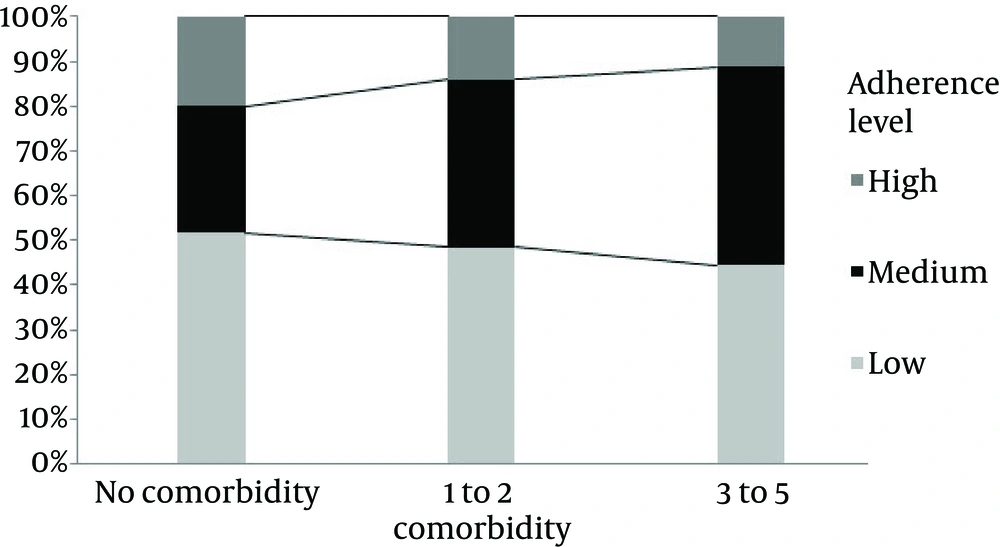
Figure 1 depicts adherence level (low, moderate, and high) with respect to the number of comorbidities. As seen, with increasing the number of comorbid conditions, the proportion of high adherers decreased. In fact, high level of adherence (i.e., MMAS-8 score = 8) was calculated in patients without comorbidity as 20.0%. It was 14.1% for those with one or two comorbid conditions, and 11.1% for those with 3 - 5 comorbid conditions.
Antihypertensive Adherence Level (Low, Moderate, and High) and Number of Comorbid Conditions