1. Background
The outbreak of the new coronavirus called SARS-CoV-2 has become a global health issue. Pneumonia caused by this virus (coronavirus diseases 2019, COVID-19) has become a pandemic and has involved most countries in the world (1). The virus has infected many people around the world, many of whom have died of infection. Because of the global outbreak of COVID-19, the World Health Organization (WHO) announced it as a pandemic and an emergency in the world.
A very high rate of virus transmission and spread and its considerable rate of fatality call for improving measures of COVID-19 prevention. An important component of such preventive measures is knowledge of people, especially health care professionals who play a major role in spreading the disease due to having close contact with their patients. Dental care settings carry the risk of 2019-nCoV-2 infection due to some factors: first, their procedures including face-to-face communication with patients and frequent exposure to the saliva, blood, and other body fluids, where a large number of droplets and aerosols could be generated, especially while using a high-speed handpiece or ultrasonic instruments, and second, the fact that the standard protective measures in daily clinical work are not effective enough to prevent the spread of COVID-19, especially when patients are in the incubation period (2-4).
Iran is one of the epicenters of this viral infection and one of the first countries that experienced the epidemic of this virus. However, no studies are available worldwide regarding the knowledge of healthcare workers, or dental professionals in particular, towards the new coronavirus infection and the measures of prevention.
2. Objectives
Therefore, this study was conducted to assess the knowledge of dental professionals towards COVID-19.
3. Methods
A cross-sectional study was conducted in the Oral and Maxillofacial Surgery (OMFS) Department of Islamic Azad University of Tehran, Iran. Undergraduate dental students, general practitioners (DDS), and board-certified dental specialists of 11 recognized specialties were considered eligible to take part in this study. The inclusion criteria were studying dentistry or being graduated from a dental school, being Iranian, and having the knowledge of the Persian language. The exclusion criterion was a lack of consent. Participants were anonymous, and no personal information was collected. The study protocol was approved by a University Committee (ethical code: IR.IAU.PS.REC.1399.062). The study started on March 25, 2020, and ended on March 31, 2020. At the beginning of conducting this study, the official number of confirmed COVID-19 cases, the number of deceased patients, and the number of recovered patients in Iran were 32332, 2378, and 11133, respectively.
The data were collected through a self-administered online questionnaire distributed to the participants by a specific link. The questionnaire was designed by a team of authors of the Buali Hospital OMFS Department after a rigorous literature review. It was sent to professionals to give their expert opinions about its simplicity, relevance, and importance. Then, a pilot study was conducted by selecting a small sample of health care professionals (n = 7) who gave their opinions on making the questionnaire more simple and shorter. The data of the pilot study were not used for the final analysis. Amendments from the participants were considered and integrated into the questionnaire. After a thorough discussion, the questionnaire was finalized by the authors and subsequently distributed to the participants for their responses. The validity of the questionnaire was assessed through the Delphi method. The reliability of the questionnaire was established by sending the questionnaire to 10 participants and resending it to the same 10 participants after a week. There was not a significant difference between the two assessments. The study instrument assessed the knowledge of the participants by asking questions about nature, etiology, symptoms, risk group, consequences, and source of transmission, prevention, and treatment of COVID-19 (Table 1). The mean time of response was 5 minutes and 42 seconds.
Table 1.
The List of Questions and Their Correct Answersa
| Questions | Correct Answer | |
|---|---|---|
| 1 | Did you research the new pandemic coronavirus? | - |
| 2 | Have you attended any meetings or lectures on the new coronavirus? | - |
| 3 | What is the most important source of information you use to get information about the new coronavirus? | - |
| 4 | What is the incubation period of the new coronavirus? (5-7) | 2-14 days |
| 5 | Which of the following is not a sign of the new coronavirus? (6-10) | Skin rash |
| 6 | Which of the following is the possible origin of the new coronavirus? (6, 11) | Bat |
| 7 | Which of the following is involved in transmitting the coronavirus? (10) | Air |
| 8 | Which of the following is not a complication of the new coronavirus? (7, 8, 10, 12, 13) | Gastrointestinal problems |
| 9 | Which method is currently used to control the new coronavirus? (14) | Antiviral and supportive treatments |
| 10 | How to reduce the risk of transmission of the new coronavirus? (14, 15) | Proper handwashing/covering the mouth while coughing or sneezing/avoiding direct contact with a patient |
| 11 | Which of the following is not a high-risk group for the new coronavirus? (16) | Children |
| 12 | What is the new coronavirus diagnostic method? (17) | PCR |
| 13 | Which organs have the highest incidence of new coronavirus infections due to the higher number of receptors? (18, 19) | Lung |
| 14 | How long does the new coronavirus stay in the air? (20) | 3 hours |
| 15 | Anyone with fever, cough, or difficulty breathing should be treated immediately and share their previous travel history with the medical staff (21). | True |
| 16 | According to the WHO guidelines on the new coronavirus, handwashing is only required if there is visible contamination (22). | False |
| 17 | Even in areas with a new coronavirus outbreak, the consumption of meat products is OK if cooked properly (23). | True |
| 18 | A treated person is immune to the new coronavirus (24). | True |
| 19 | It is necessary to disinfect the place of meat products sale and equipment used in it at least once a day. | True |
| 20 | The use of the influenza vaccine against the new coronavirus also provides immunity (25, 26). | False |
| 21 | Symptoms of a new coronavirus appear between 2 and 14 days after the initial exposure to the virus (10). | True |
| 22 | Handwashing with warm water is a must. | False |
| 23 | If soap is not available, it is enough to wash your hands with chlorine-containing water. | False |
aThe first three questions did not have a correct answer.
Descriptive statistics were calculated for each question. The role of the associated factors was assessed using the chi-square test in SPSS 25 (IBM, Armonk, NY, USA). The level of significance was set at 0.05.
4. Results
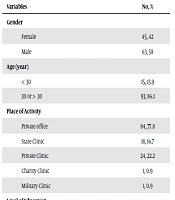
A total of 1,331 individuals visited the website, and 778 of them completed the questionnaire. Of the respondents, 54.7% were males, and 44.2% were older than 40 years. Of them, 15.4% were dental students, 58.5% were general dentists, and 26.1% were specialists. The mean age of students was 24.13 years; they were 67 women and 53 men. The mean age of general practitioners was 42.32 years, including 204 females and 251 males. The mean age of specialists was 41.08 years, including 80 women and 123 men.
About 27% of the participants had attended meetings and lectures about the new coronavirus. The most important sources of individuals’ information were official websites (45.1%), followed by social networks (39.7%), news and media (13%), and finally, family members (1.2%). In other words, 85% of the cases used the two sources of official websites and social networks.
Overall, above 70% of the respondents answered correctly to most questions, except for the questions numbered 4, 7, 12, 18, 22, and 23 (Figure 1 and Table 2). Specifically, questions 12 (method of diagnosis) and 18 (immunity after contamination and treatment) received the smallest numbers of correct answers.

Figure 1.
Percentages of correct answers to questions 4 to 23 in the whole sample (n = 778)
Table 2.
Percentages of Correct Answers to Questions 4 to 23, as Well as Top Answers to Questions 1 to 3 in Different Jobs and Specialtiesa
| Q | Dental Students (N = 120) | Dentists (N = 455) | Specialist (N = 203) | OMFS (N = 59) | Public Health (N = 7) | Radiology (N = 2) | Pathology (N = 8) | Pediatrics (N = 9) | Restorative (N = 13) | Orthodontics (N = 16) | Prosthodontics (N = 25) | Periodontics (N = 31) | Endodontics (N = 15) | Oral Disease (N = 20) | P |
|---|---|---|---|---|---|---|---|---|---|---|---|---|---|---|---|
| 1 | Yes (92.5) | Yes (96.7) | Yes (98.3) | Yes (98.3) | Yes (100) | Yes (100) | Yes (100) | Yes (88.9) | Yes (100) | Yes (100) | Yes (100) | Yes (96.8) | Yes (100) | Yes (95) | |
| 2 | No (77.5) | No (77.6) | No (67.8) | No (67.8) | No (57.1) | No (100) | No (62.5) | No (88.9) | No (84.6) | No (81.3) | No (80) | No (77.4) | No (93.3) | No (75) | |
| 3 | Social media (45) | Official websites (43.5) | Official websites (45.8) | Official websites (45.8) | Official websites (57.1) | Official websites (50) | Official websites (62.5) | Official websites (55.6) | Official websites (38.5) | official websites (43.8) | Social media (48) | Official websites (58.1) | Official websites (46.7) | Official websites (65) | |
| 4 | 48.3 | 47.5 | 49.3 | 52.5 | 57.1 | 50 | 50 | 66.7 | 46.2 | 56.3 | 48 | 45.2 | 46.7 | 35 | 0.912 |
| 5 | 87.5 | 93.2 | 93.1 | 94.9 | 100 | 100 | 87.5 | 88.9 | 84.6 | 100 | 88 | 90.3 | 93.3 | 100 | 0.102 |
| 6 | 82.5 | 84.4 | 85.7 | 79.7 | 85.7 | 100 | 75 | 77.8 | 84.6 | 81.3 | 92 | 83.9 | 100 | 95 | 0.742 |
| 7 | 53.3 | 44.4 | 47.8 | 37.3 | 57.1 | 50 | 37.5 | 44.4 | 69.2 | 31.3 | 72 | 48.4 | 60 | 40 | 0.203 |
| 8 | 78.3 | 76 | 83.7 | 88.1 | 57.1 | 100 | 100 | 100 | 92.3 | 87.5 | 84 | 67.7 | 86.7 | 80 | 0.086 |
| 9 | 90 | 89.5 | 85.7 | 83.1 | 71.4 | 100 | 87.5 | 100 | 76.9 | 81.3 | 80 | 90.3 | 93.3 | 95 | 0.329 |
| 10 | 95 | 99.3 | 99.0 | 96.6 | 100 | 100 | 100 | 100 | 100 | 100 | 100 | 100 | 100 | 100 | 0.001 |
| 11 | 87.5 | 81.8 | 82.8 | 79.7 | 100 | 50 | 87.5 | 88.9 | 84.6 | 81.3 | 84 | 87.1 | 66.7 | 90 | 0.331 |
| 12 | 8.3 | 5.3 | 10.8 | 23.7 | 0 | 0 | 0 | 0 | 0 | 6.3 | 8 | 6.5 | 13.3 | 5 | 0.034 |
| 13 | 97.5 | 98.5 | 98.5 | 98.3 | 100 | 100 | 100 | 88.9 | 100 | 93.8 | 100 | 100 | 100 | 100 | 0.742 |
| 14 | 67.5 | 70.8 | 75.9 | 83.1 | 57.1 | 50 | 75 | 66.7 | 69.2 | 62.5 | 72 | 83.9 | 80 | 70 | 0.228 |
| 15 | 71.7 | 87.3 | 85.2 | 81.4 | 42.9 | 100 | 87.5 | 100 | 84.6 | 87.5 | 92 | 87.1 | 73.3 | 100 | 0.000 |
| 16 | 95 | 95.2 | 98.5 | 100 | 100 | 100 | 100 | 100 | 100 | 100 | 96 | 100 | 93.3 | 95 | 0.104 |
| 17 | 95.8 | 95.6 | 95.1 | 94.9 | 85.7 | 100 | 100 | 88.9 | 100 | 93.8 | 96 | 90.3 | 100 | 100 | 0.938 |
| 18 | 18.3 | 24.6 | 29.6 | 27.1 | 57.1 | 50 | 37.5 | 22.2 | 30.8 | 18.8 | 28 | 29 | 33.3 | 35 | 0.077 |
| 19 | 89.2 | 89.2 | 89.2 | 84.7 | 100 | 100 | 100 | 77.8 | 92.3 | 75 | 92 | 96.8 | 93.3 | 90 | 1.0 |
| 20 | 99.2 | 98 | 99.0 | 98.3 | 100 | 100 | 100 | 100 | 92.3 | 100 | 100 | 100 | 100 | 100 | 0.501 |
| 21 | 90 | 88.4 | 93.6 | 91.5 | 85.7 | 100 | 87.5 | 100 | 100 | 93.8 | 96 | 96.8 | 86.7 | 95 | 0.118 |
| 22 | 46.7 | 48.8 | 57.1 | 69.5 | 42.9 | 0 | 50 | 55.6 | 38.5 | 68.8 | 52 | 58.1 | 53.3 | 45 | 0.090 |
| 23 | 65 | 50.5 | 9.4 | 55.9 | 42.9 | 50 | 37.5 | 44.4 | 46.2 | 56.3 | 60 | 51.6 | 73.3 | 55 | 0.000 |
aThe P value is calculated using the chi-square test, comparing dental students, dentists, and specialists.
The chi-square test showed that age, specialization, and attendance at lectures and meetings did not play a role in grasping accurate information (all P values > 0.1). Men had less information than women (P = 0.014), and the sources of information were mostly official websites and social networks (P = 0.000).
Dental students knew the correct answer to question 10 (95%) significantly worse than dentists (99%) and specialists (99%, chi-square P < 0.05, detailed p values in Table 2). There was also a significant difference between dental students (8.3%), dentists (5.3%), and specialists (10.8%) in response to question 12 (PCR as the method of detection, Table 2). In question 15, dental students (71.7%) acted worse than dentists (87.3%) and specialists (85.2%, P < 0.05, detailed P values in Table 2). In question 23 (lack of soap), dental students (65.0%) and dentists (50.5%) acted much better than specialists (9.4%, P < 0.05, detailed P values in Table 2).
5. Discussion
Our findings indicated that a relatively high proportion of dentists and dental students had basic coronavirus protection and general knowledge. However, when the questions became more technical, the percentage of correct answers reduced. According to the social cognitive theory, behaviors are shaped by subjective norms, perceived behavioral control, and personal attitudes, which are influenced by personal knowledge and experience (27-29). Proper knowledge of a contagious disease can result in better attitudes and more effective practices towards protection and prevention; therefore, it is essential to have proper knowledge (30-32). This is of utmost importance as the willingness of healthcare professionals to treat patients depends on their attitude and knowledge. While most jobs are recommended to work from home (due to the pandemic situation), healthcare professionals should be even more willing to attend clinics and hospitals, putting themselves at even higher risk of infection (33). Thus, their willingness to treat should be properly high, and they should be able to protect themselves and their patients from cross-infection appropriately. This higher willingness can itself result in healthcare-associated infections that can increase the mortality and costs (28), again needing the knowledge to prevent cross-infection.
An important factor in COVID-19 is its very long latency period. About half of the respondents did not know the correct answer. Another important information that was answered incorrectly by about half of the cases was the transmission medium, i.e., air. Many participants selected the oral-fecal choice or other less relevant ones. Immunity against the coronavirus was one of the most difficult questions. Most respondents chose no immunity. However, coronavirus might still induce short-term or even moderate-term immunity in some people (24). Two other questions with poor answers were related to handwashing, which showed that not a proper knowledge of handwashing might exist among dentists. Handwashing is extremely important in controlling diseases such as MERS (28) or COVID-19 and should be taken seriously.
The knowledge of dental students, dentists, and specialists was rather similar in terms of most questions. Questions that needed a greater education level (like PCR) were answered better by specialists and/or dentists than by dental students. Another reason could be that dental students used social media as their main source of information, while dentists and specialists used official websites as their main source. Since there is no literature at all in this regard, we cannot compare our results with other studies.
This study was limited by some factors. The sample size of this pilot study was not based on any calculations. Many of the questions asked had ambiguous answers at the time of assessment or even months after it. Therefore, it was not possible even for experts to know the correct answers to many questions at the time. Although it seems that the comparison of dental students with dental specialists might not be completely rational, it should be noted that both groups were similarly exposed to a major source of education towards COVID-19, i.e., media. Immunity against COVID-19 is temporary, and this is being shown by every new research published in this regard. However, it is not very realistic that we expect dental professionals know about it, especially at earlier times of disease spread. The answers to some questions might not be correct, such as bat as the source of the disease, which is quite debatable now, and the coronavirus stays in the air for three hours only in laboratory conditions using specialized devices to produce aerosols and not in normal situations.
Regarding the 13th question, it is suggested that salivary glands can be affected by this disease (34). There are still many points to debate since there are still many uncovered issues on COVID-19. For example, gastrointestinal involvement is reported in COVID-19 (35). Future studies are warranted to conduct more accurate surveys. The generalizability of our findings was limited to Iranian dentists in the first three months of COVID-19 spread. Indeed, day by day, more facts are revealed about this disease, and dentists and other health workers are more and more educated in this regard. Therefore, future studies can rely on more technical and more comprehensive surveys.
5.1. Conclusions
The knowledge of dentists, dental students, and specialists towards SARS-CoV-2 is generally rather good, except for more technical questions that need more education (especially regarding handwashing). The most important sources of information were official websites and social media. Dentists, dental students, and specialists acted almost similarly in the case of most questions, except for more difficult ones.