1. Background
Dysmenorrhea or painful menstruation is the most common periodic pain in women, which is divided into primary and secondary types based on the presence or absence of underlying pathological causes (1). The prevalence of painful menstruation in Iran has been reported as 74 - 90% in different studies (2-5). Primary dysmenorrhea usually occurs in younger women within one or two years of menstruation onset as the ovulation cycles stabilize. Pain in the primary dysmenorrhea usually begins a few hours before or just after the start of menstrual cycle and can last for 48 to 72 hours. This pain is characterized by suprapubic pain, low back pain, radiating pain to anterior thigh, increased frequency of urination, nausea, vomiting, and diarrhea (1).
Although primary dysmenorrhea is not a life-threatening condition and does not cause organ failure, it can affect women's quality of life and lead to disabilities and poor performance at school and workplace in severe cases (6). About 1% of women of childbearing age do not attend work for one to three days a month due to painful contractions, and about 14% of teenage girls miss school because of this condition (1). Dysmenorrhea reduces the girls' ability to concentrate on their lessons and affects their school attendance. It also has individual and social consequences for them (7). Various factors affect the perception of pain severity, and social support plays a decisive role in this regard (8). Social support is a social network that provides individuals with psychological resources to cope with stressful life conditions (9). Moreover, it is a broad concept that has many applications in different physical, psychological, and social aspects of human life (8). Research has shown that an increase in perceived social support is associated with increased mental function and physical/mental health, reduced sense of loneliness, and greater compatibility (10).
Perceived social support is associated with increased self-esteem, expansion of social associations, prevention of adverse physiological complications of the disease, and higher physical, mental, and social health (11). Studies also showed that social support can have a positive effect on the perception of menstrual pain. However, the existing literature on the association between dysmenorrhea and social support have reported contradictory results (12-15).
Considering the social, economic, physical, and psychological problems caused by primary dysmenorrhea, the high prevalence of primary dysmenorrhea and its importance in reducing women's quality of life (QoL) and social activities, and since the researchers found few studies on social support and severity of dysmenorrhea in Iran and the world, this study was conducted to determine the association between severity of dysmenorrhea and social support among female students of Ilam University of Medical Sciences, Iran.
2. Objectives
The present study aimed to evaluate the association between severity of dysmenorrhea and social support among female students of Ilam University of Medical Sciences.
3. Methods
3.1. Study Design and Setting
Using purposive sampling, this descriptive-analytical study was conducted on 286 female students of Ilam University of Medical Sciences in 2018. Inclusion criteria were female gender, age range of 18 - 28 years, having regular menstruation, being single, and willingness to participate in the study. The exclusion criteria were having a history of abdominal and hip surgery, chronic disease, and medication use. In consultation with a statistical expert and based on the aim of the study, the sample size was calculated to be 270 subjects using Cochran formula (CI: 95%, Z = 1.96 p = q = 0.5 and d = 0.06). To eliminate the possibility of error and possible sample drop, 300 individuals were initially considered, but the data of 286 participants were analyzed.
3.2. Questionnaires
The data collection tools in this study included a demographic information questionnaire (which also collected information on menstrual symptoms and some daily habits, including drinking tea, coffee, and beverages, consuming chocolate and exercising), the Visual Analogue Scale (VAS) to measure the severity of pain, and the Social Support Questionnaire (SSQ). The researchers prepared the demographic information questionnaire by using scientifically valid articles and resources. Then, to ensure face validity and content validity of the questionnaire, views, and opinions of ten experts in the areas of tool making, midwifery, reproductive health, nursing, and healthcare were used. The VAS scale is a standard tool, and its scientific validity has been proven in many studies. For example, Hawker et al. (2011) reported a good validity and acceptable reliability for VAS in measuring pain intensity (15). The SSQ questionnaire is also a standard tool, and its scientific validity has been proven in many studies. Hooman and Livarjani (2008) examined the validity of this questionnaire by using Cronbach’s coefficient (0.81) and showed that data obtained from this questionnaire can be trusted. Also, Hooman and Livarjani showed a positive correlation between the items of this questionnaire by tetrachoric correlation coefficient, indicating its convergent validity (16).
The social support questionnaire consists of 25 items in four dimensions, which include friendly support (7 items), family (7 items), social (6 items), and general support (5 items). The scoring system of this scale ranges from zero (0) and one (1). This means that, except for items 7, 15, 16, 17, 18, 20, 21, and 24 that are scored in reverse, so that a wrong answer gets a score of one, and a correct answer gets a score of zero. In other items, a wrong answer gets a score of zero, and a correct answer gets a score of one. In general, the total scores of social support questionnaire are interpreted as low, moderate, and high. Thus, the total score of this questionnaire (100) is divided into three categories of low social support (scores less than or equal to 33.3), moderate social support (scores between 33.3 and 66.6), and high social support (scores more than 66.6).
3.3. Data Collection
After initial communication with the students and explaining the importance and purpose of the study to them, and ensuring them about the confidentiality and anonymity of their information, the questionnaires were given to the participants. In total, 286 questionnaires were completed and used in the final analysis.
3.4. Statistical Analysis
Descriptive statistical methods including frequency, percentage, mean, and standard deviation were used to describe and analyze the data using Pearson’s correlation coefficient.
3.5. Ethical Considerations
The Ethics Review Board of Ilam University of Medical Science and Health Services, Ilam, Iran (approval number: 910671) approved the study. Written consent was obtained from the participants before entering the study. All participants were reminded that their participation was voluntary, and they had the right to withdraw from the research at any stage. All personal data, such as names, were anonymized. Paper-based data (consent) was stored securely in a locked cupboard, and electronic data was stored in a secure server through password-protected documents.
4. Results
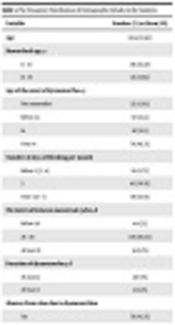
The mean age of the samples was 21.62 ± 2.10 years, and the mean age of menarche was 13.57 ± 1.33 years. The majority of the subjects (94.7%) were under 25 years of age. More than half of them (55.2%) reported a family income of 150 - 200$). According to the data, 78% of participants consumed two cups or less of coffee per day, 64% consumed three cups or less of tea per day, and 74.5% consumed less than 100 grams of chocolate per day, which is an acceptable amount of daily caffeine intake. More than two-thirds of subjects (69.9%) rarely exercised during the day (Table 1).
Table 1.
Frequency Distribution of Demographic Variables in the Studied Samples
| Variables | No. (%) | Mean ± SD |
|---|---|---|
| Age (y) | 21.62 ± 2.106 | |
| 20 years and less | 100 (35) | |
| 21 - 25 | 169 (59.1) | |
| 26 - 30 | 17 (5.9) | |
| Family income status ($) | ||
| Less than 150 | 51 (17.9) | |
| Between 150 - 200 | 178 (55.2) | |
| More than 200 | 77 (26.9) | |
| The age of menarche (y) | 13.57 ± 1.33 | |
| 10 | 1 (0.4) | |
| 11 | 13 (4.6) | |
| 12 | 50 (17.4) | |
| 13 | 87 (30.4) | |
| 14 | 71 (24.8) | |
| 15 | 39 (13.6) | |
| 16 years and more | 25 (8.8) | |
| Daily tea consumption (cups) | ||
| 3 cups or less | 223 (78) | |
| 4 cups or less | 61 (21.3) | |
| I do not consume | 2 (0.7) | |
| Daily consumption of coffee (cups) | ||
| 2 cups or less | 183 (64) | |
| 3 cups or less | 6 (2.1) | |
| I do not consume | 97 (33.9) | |
| Daily consumption of chocolate (g) | ||
| Less than 100 | 213 (74.5) | |
| More than 100 | 35 (12.2) | |
| I do not consume | 38 (13.3) | |
| Doing exercise during the day | ||
| Seldom | 200 (69.9) | |
| Sometimes | 74 (25.9) | |
| Always | 12 (4.2) | |
| Total | 286 (100) |
The prevalence of primary dysmenorrhea was 86% among the subjects. Findings also showed that 86% of the subjects were suffering from varying degrees of menstrual pain. The highest frequency (30.4%) was related to moderate menstrual pain, followed by severe pain (24.5%) and mild pain (19.6%).
Of the 286 students, 23 subjects (8%) had a low social support, 112 subjects (39.2%) had a moderate social support, and 151 subjects (52.8%) had a high social support. The highest frequency was related to high social support, and the lowest frequency was related to low social support. The results showed that out of the total number of respondents, 40 subjects (13.9%) did not feel pain during menstruation, of whom 1 (0.3%) subject had a low social support, 6 subjects (2.1%) had a moderate social support, and 33 subjects (11.5 %) had a high social support. Students who had mild dysmenorrhea pain during menstruation made up 56 subjects (19.7%) of the samples, with few students receiving poor social support, 24 subjects (8.4%) receiving moderate, and 26 subjects (9.2%) receiving very high social support. About 89 subjects (31.1%) of the students had a moderate pain during menstruation, with few students receiving a poor social support and the rest receiving approximately moderate to high level of social support. Also, 83 subjects (29.1%) of the students experienced severe pain during menstruation, of whom 4 subjects (1.4%) had a poor social support, 35 subjects (12.3%) had a moderate social support, and 42 subjects (14.7%) had a high social support. Moreover, 18 subjects (6.2%) of the subjects reported very severe pain during their period, with 1.4% receiving a poor social support, 2.4% receiving a moderate, and 2.4% receiving a high level of social support from the community. In general, 8% of the students had a low social support, 39% had a moderate social support, and 53% had a high social support (Table 2).
Table 2.
Frequency Distribution of Respondents by Severity of Dysmenorrhea to Social Support a
| Variables | Social Support | Total | P Value | ||
|---|---|---|---|---|---|
| High | Moderate | Low | |||
| Dysmenorrhea severity | 0.005 | ||||
| No pain | 33 (11.5) | 6 (2.1) | 1 (0.3) | 40 (13.9) | |
| Mild pain | 26 (9.2) | 24 (8.4) | 6 (2.1) | 56 (19.7) | |
| Moderate pain | 43 (15) | 40 (14) | 6 (2.1) | 89 (31.1) | |
| Severe pain | 42 (14.7) | 35 (12.3) | 6 (2.1) | 83 (29.1) | |
| Very severe pain | 7 (2.4) | 7 (2.4) | 4 (1.4) | 18 (6.2) | |
| Total | 151 (52.8) | 112 (39.2) | 23 (8) | 286 (100) | |
a Values are expressed as No. (%).
There was a significant association between social support and severity of dysmenorrhea so that Pearson’s correlation coefficient showed an inverse association between the two variables (r = -0.187, P = 0.002). The correlation was weak and negative (inverse), meaning that with an increase in social support, the severity of dysmenorrhea decreased.
5. Discussion
The results of this study showed an association between social support and the severity of dysmenorrhea in female students of Ilam University of Medical Sciences, so that with increase in social support, the severity of dysmenorrhea decreased.
The prevalence of dysmenorrhea was 86% among the students. The high prevalence of dysmenorrhea has been reported in various studies. For instance, the prevalence of dysmenorrhea has been reported 74.5% among Asian girls (7), 64.5% in Mexican students (17), 74.3% in Lebanese girls (18), 78.35% among Pakistani girls (19), and 79% in Indian students (20). Also, at the national level, this prevalence has been reported 91.9% in girls living in Ardebil (21) and 85.5% in Rafsanjan (22). Differences in the severity and prevalence of dysmenorrhea may be due to cultural differences in pain perception and pain tolerance threshold.
The findings of this study showed that 82% of the subjects were suffering from varying degrees of menstrual pain. The highest frequency (30.4%) was related to moderate menstrual pain, followed by severe pain (24.5%) and mild pain (19.6%). In Akhavanakbari and Ahangar Davoudi’s study (2010), 22% of students had mild dysmenorrhea, 67% had moderate dysmenorrhea, and 11% had severe dysmenorrhea (23). A study by Ortiz (2010) also reported severe, moderate, and mild dysmenorrhea among 17.4, 49.7, and 32.9% of the high school girls, respectively (24). Ortiz (2010), in a study of Mexican students, estimated the prevalence of severe, moderate, and mild dysmenorrhea to be 20.1, 43.8, and 36.1%, respectively (17). A study conducted in Pakistan (2009) showed severe dysmenorrhea in 8.05% of medical students and moderate to mild dysmenorrhea in 32.21 and 59.7% of them, respectively (25). The results of Gilasi (2015) study showed that among students with dysmenorrhea, 30.90% had a mild pain, 43.2% had a moderate pain, and 26.29% had a severe pain (26).
Overall, 8% of the subjects in this study had a low social support, 39% had a moderate social support, and 53% had a high social support. The highest frequency was related to high social support and the lowest frequency was related to low social support. Faramarzi and Salmalian (2014) showed that in women with dysmenorrhea, 27.9% had a moderate/high social support and 67.3% had a low social support (12). Therefore, since dysmenorrhea can affect different aspects of students' lives, including personal, family, and academic life, plans must be made at family and community level to promote social support for women during menstruation.
Results of this study showed an association between social support and severity of dysmenorrhea in students. Also, this association was -0.17, which was weak and negative (inverse) meaning that with increase in social support, the severity of dysmenorrhea decreased and vice versa. In line with our study, Faramarzi and Salmalian (2014) found that the strongest predictor of primary dysmenorrhea is a low social support (P < 0.001) (12). Hailemeskel et al. (2016) reported a significant correlation between primary dysmenorrhea and low level of social communication with family, friends, and loved ones (P = 0.014), (13). However, Unsal et al. (2010) emphasized that social functioning may not affect dysmenorrhea (14). The differences in the results of the above studies may be attributed to the fact that other factors such as personality traits, environmental stress, and inadequate communication with friends in this age group could have influenced the results of these studies; this highlights the need for further studies in this area.
Considering the inverse association between the severity of dysmenorrhea and the level of social support in this study, it is necessary to reduce the effects that dysmenorrhea can have on the physical, mental, and social health of individuals by creating and enhancing the social support of students at family and community level.