
1. Background
It has been shown that delayed recognition of hearing impairment in children has negative consequences on their speech and language development and social skills. Furthermore, late recognition of HL in children population could limit their academic achievements, reduce their professional and social opportunities, and increase their anxiety level (1, 2).
It has been demonstrated that earlier recognition of HL in children, along with early benefiting from auditory amplification and aural rehabilitation services, will improve their speech and language developments proportional to their age (3-7). Yoshinaga-Itano (8) reported that children who were identified before six months old revealed remarkably higher expressive language abilities than children diagnosed after that age, irrespective of the rate of HL or communication modality (9).
Cochlear implantation (CI) is widely known as a standard therapeutic option for patients with intense-to-deep sensorineural hearing loss (SNHL) (10-13). It has been shown that the language skills of children who receive CIs at early ages develop at a similar rate to that of children with hearing impairment. It seems that CI operation in children at a younger age may be associated with enhanced hearing and speech recognition performances, compared to those who are implanted at older ages (14).
2. Objectives
The objective of this research was to assess the age of hesitancy, recognition, reinforcement, and interposition in children with bilateral severe to deep HL in children undergoing CI surgery in a CI center in the southwest of Iran.
3. Methods
3.1. Participants
The type of research was a cross-sectional study. In this study, 389 prelingually deaf children (205 boys and 184 girls) participated who were approved for CI under the state government CI program from September 2015 to September 2020. These children were recognized within the new-borns hearing screening plan in the southwest of Iran (15). The inclusion criteria entailed being affected by bilateral severe to profound SNHL, having normal temporal bone imaging, complete electrodes insertion into the cochlea, no post-op adverse sequels, and regularly attending pre-and post-operative auditory rehabilitation sessions. Exclusion criteria, overt cognitive delay, or inner ear abnormalities in children were considered. The protocol of the current research was approved by the local Ethics Committee (Registration Number: IR.AJUMS.REC. 1397.958).
3.2. Procedures
For the current investigation, the ages of parental hesitancy, recognition, reinforcement, and interposition in hearing-impaired children who were referred to our CI center were recorded in months. The “age of hesitancy” was described as the primary distrust of a child's HL. The “age of recognition” was defined as the first time to pass a hearing examination to confirm the child's HL. The “age of reinforcement” was defined as when a child receives a hearing aid (such as a hearing aid) for the first time and starts using it. Furthermore, the “age of interposition” was defined as the time at which the child began to take auditory training and educational programs. According to the gathered evidence, the course of “hesitancy and recognition”, “recognition and reinforcement”, and “reinforcement and interposition” were computed.
3.3. Data Analysis
All statistical analyses were carried out with SPSS V.24 software. The Kolmogorov-Smirnov test was utilized to evaluate the normality of data distribution for numeric variables. Descriptive statistics were also applied to brief quantitative variables, and stratified variables were reported as percentages. Paired sample t-test was used to evaluate the middle ages of hesitancy, recognition, reinforcement, and interposition was investigated among the “high-risk” and “not-high risk” groups. The P < 0.05 level was accepted to statistical significance.
4. Results
The middle age of hearing loss hesitancy, hearing loss recognition, fitting the hearing reinforcement devices, and interposition was 10.7 ± 7.1, 15.75 ± 9.4, 21.81 ± 8.1, and 26.32 ± 9.2 months, respectively (Table 1). According to our findings, the middle lags among the ages of hesitancy and recognition: 3.74 (P < 0.0001); recognition and reinforcement: 5.05 (P < 0.0001); reinforcement and interposition: 4.83 months (P < 0.001) were obtained. These discrepancies were statistically considerable.
Table 1.
The Middle Ages of Hesitancy, Recognition, Reinforcement, and Interposition for High-risk and not High-risk Children
| Group | Age (mo) | |||
|---|---|---|---|---|
| Hesitancy | Recognition | Reinforcement | Interposition | |
| High-risk children (n = 129) | 10.46 ± 8.65 | 15.51 ± 7.91 | 21.72 ± 10.05 | 27.06 ± 9.33 |
| Not high-risk children (n = 260) | 10.99 ± 7.63 | 15.92 ± 8.37 | 21.88 ± 7.43 | 25.67 ± 8.82 |
| Total (n = 389) | 10.73 ± 7.15 | 15.75 ± 9.45 | 21.81 ± 8.19 | 26.32 ± 9.21 |
In our study, 129 (33.16%) children were in “high-risk” team. As you can see in Table 1, the averages of 4 studied ages are shown for “high-risk” and “not-high risk” children. Also, our findings showed that there were no considerable statistical differences among both groups (P > 0.05). Figure 1 shows the comparison of the ages of children at hesitancy, recognition, reinforcement, and interposition among different studies.
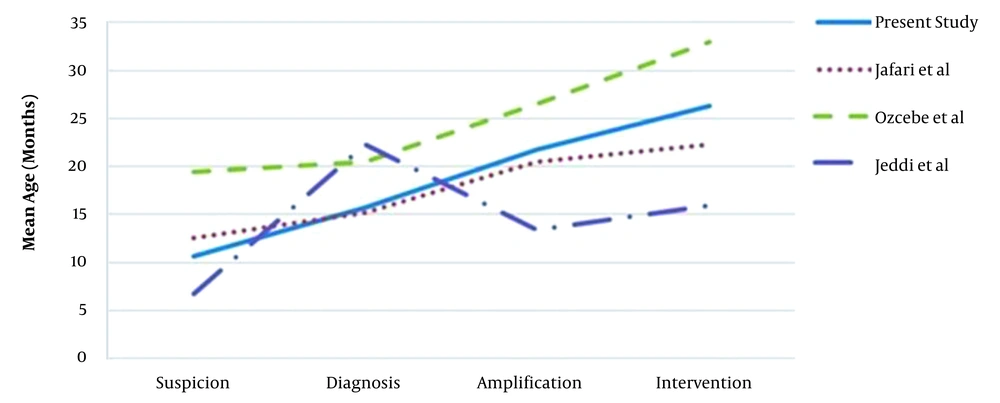
Figure 1.
Comparison of the ages of children at hesitancy, recognition, reinforcement, and interposition among different studies
5. Discussion
Early recognition and interposition of hearing loss play an essential role in speech and language development. It has been recommended that identification of children suffering from hereditary HL before six months of age and starting hearing rehabilitation will improve their interpersonal and academic skills and improves children's language skills, general language skills, speech intelligibility, vocabulary, and phoneme repertoires, compared to children who have not received their rehabilitation services timely (15, 16).
In this research, the middle age of recognition HL was 15.75 months, which is similar to the results of Prendergast et al. (16) and Jafari et al. (17). However, the findings of the present study show obvious differences with the reported cases by Kittrell and Arjmand (18), Lotfi and Jafari (19), and Ozcebe et al. (14) (Table 2).
Table 2.
The Middle Ages of Hesitancy, Recognition, Reinforcement, and Interposition (Months) in the Current Study Compared to Similar Studies
| Study | Age (mo) | |||
|---|---|---|---|---|
| Hesitancy | Recognition | Reinforcement | Interposition | |
| Present study | 10.73 ± 7.15 | 15.75 ± 9.45 | 21.81 ± 8.19 | 26.32 ± 9.21 |
| Jafari et al. (17) | 12.6 ± 8.9 | 15.2 ± 9.3 | 20.5 ± 11.1 | 22.3 ± 11.6 |
| Ozcebe et al. (14) | 12.5 ± 7.9 | 19.4 ± 14.8 | 26.5 ± 14.8 | 33 ± 20 |
| Lotfi and Jafari (19) | 19.4 ± 15.1 | 25.9 ± 16.8 | 34.8.5 ± 21.3 | 43.6 ± 24.5 |
| Jeddi et al. (11) | 6.73 ± 5.79 | 9.35 ± 5.79 | 13.41 ± 6.10 | 41.25 ± 11.12 |
| Prendergast et al. (16) | 8.16 | 14.58 | 19.05 | - |
Our findings demonstrated that the mean age for reinforcement was 21.81 months which is similar to the results of Prendergast et al. (16) and Jafari et al. (17). Our finding, however, indicated lower age at amplification (hearing aid fitting) time compared to those reported by Kittrell and Arjmand (18), and Lotfi and Jafari (19) (Table 2).
In the present study, the middle age of interposition was 26.32 months which is analogous to Prendergast et al.’s (16) findings. In a similar study, Jafari et al. (17) reported that the mean age of interposition for severely hard of hearing children was 22.3 months.
Cochlear implantation has been recommended to enhance relationship proficiency and quality of life in kids with inherent deafness. As a result, these children have the chance to go to regular schools alongside their hearing peers. Currently, it is strongly intended to perform cochlear implantation at very young ages because this period is critical to learning. Delay in identifying severe to deep childhood hearing loss may lead to losing the best periods for learning a language. In turn, this limits educational achievement, decreases occupational and social opportunities, and it upsets and worries the families of hearing-impaired children (20-24).
Our research results show that there is no significant difference between high or not-high-risk and children at risk ages of hesitancy, recognition, reinforcement, and interposition. Jafari et al. (17), Kittrell and Arjmand (18), and Harrison and Roush (25) studies reported similar results and, in this regard, confirmed the findings of our research.
The main goal of neonatal hearing screening programs is to start the intervention at an early age, which can reduce the negative effects of hearing loss in children (< 6 months). On the other hand, it should be noted that early screening only helps to diagnose the disease quickly, achieving normal language and speech development is very difficult unless there is initial reinforcement and early education at the right age (26). The JCIH suggested general hearing screening in the 1th month, recognition of HL by three, and enrolment in primary interposition by six months of age (Guidelines 1-3-6) (27, 28).
5.1. Conclusions
The results indicated that the mean ages of HL hesitancy, recognition, reinforcement, and interposition were hopeless compared to the previous studies in Iran and other middle-east countries. However, there is still a noticeable gap between our results and the mean ages reported by the Joint Committee on Infant Hearing (JCIH) statement. Therefore, conducting a comprehensive protocol is highly recommended for primary recognition of HL and interposition.