
Two Scorpion Species Similar in Appearance with Two Completely Different Treatments for Their Stings

Authors

Hossein Sanaei-ZadehHossein Sanaei-Zadeh ORCID1,*
1Department of Emergency Medicine, Shiraz University of Medical Sciences, Shiraz, Iran
*Corresponding Author: Emergency Room, Division of Medical Toxicology, Hazrat Ali-Asghar (p) Hospital, Meshkinfam Street, 7143918796 Shiraz, Iran. Email: [email protected]

Shiraz E-Medical Journal:Vol. 26, issue 2; e150652
Published online:Dec 06, 2024
Article type:Letter
Received:Jul 02, 2024
Accepted:Nov 24, 2024
How to Cite:Sanaei-Zadeh H. Two Scorpion Species Similar in Appearance with Two Completely Different Treatments for Their Stings. Shiraz E-Med J. 2025;26(2):e150652. doi: https://doi.org/10.5812/semj-150652

Dear Editor,
Scorpion stings are a prevalent medical issue across all provinces of Iran (1, 2). Each year, approximately 40,000 to 50,000 scorpion stings and 16 to 18 fatalities are reported in Iran, with the majority of deaths occurring in the southern regions of the country. The most lethal scorpion species in Iran are Hemiscorpius lepturus (commonly known as Gadim in Persian) and Androctenus crassicauda (3). Identifying the Gadim scorpion is relatively straightforward compared to other yellow scorpions. It features a tall, narrow tail and broad claws with dark tips (4, 5). Another species with a similar appearance is Scorpio maurus, but the treatment for stings from these two species differs significantly (5).
Hemiscorpius lepturus stings are often painless but can result in hemolysis and hemoglobinuria several hours to a week after the sting. Based on experience (unpublished data), S. maurus stings typically cause mild to moderate pain lasting 4 - 5 hours. For a long time, S. maurus has been excluded from the list of dangerous and medically significant scorpions in Iran. Furthermore, the anti-scorpion venoms available in Iran (produced by the government-owned Razi Institute and the private company Padra Serum) do not include antiserum targeting S. maurus (5).
Treatment for S. maurus stings primarily involves pain relief and, if necessary, injections of tetabulin and tetanus toxoid (5). Conversely, H. lepturus stings necessitate hospital admission and one or two doses of scorpion antivenom (5, 6). Additionally, urine analysis should be performed every 4 - 6 hours on the first day and every 12 - 24 hours thereafter for up to a week to monitor for hemoglobinuria. If blood is detected in the urine, further doses of intravenous scorpion antivenom are administered (5, 6).
The clinical manifestations of H. lepturus stings typically appear late and may include cutaneous symptoms, systemic effects, and laboratory abnormalities (5). Therefore, if the scorpion responsible for the sting is brought in with the patient or if a photo of it is available, distinguishing between H. lepturus and S. maurus is essential. Figure 1 presents images of both species, highlighting the differences in claw size, body size, and tail size and shape. Paying close attention to these details is critical for ensuring proper treatment for their stings.
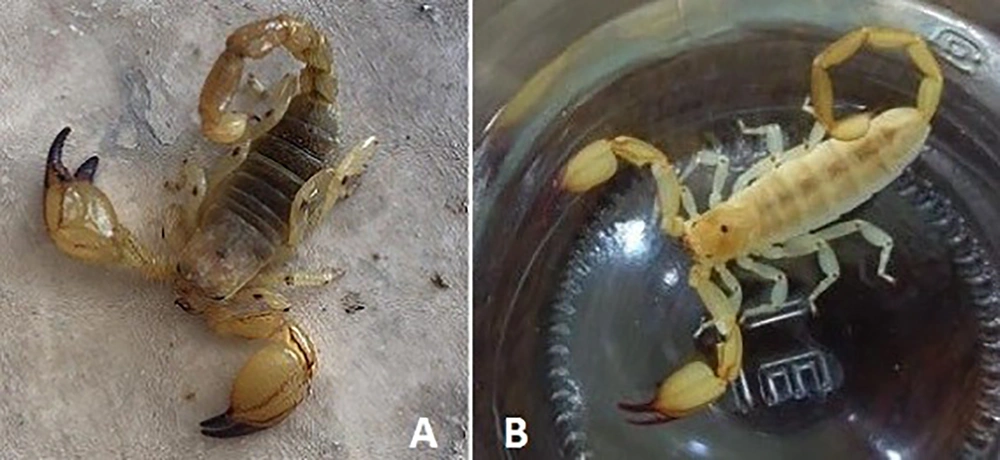
A, <i>Scorpio maurus</i>; B, <i>Hemiscorpius lepturus</i>. Both scorpion species have wide claws with dark tips, but the claws, body and tail of <i>S. maurus</i> are wider than those of <i>H. lepturus</i>. Additionally, its tail is shorter than that of H. lepturus. In other words, it could be said that <i>S. maurus</i> is plumper than <i>H. lepturus</i>. Photos are original.
Figure 1.
A, Scorpio maurus; B, Hemiscorpius lepturus. Both scorpion species have wide claws with dark tips, but the claws, body and tail of S. maurus are wider than those of H. lepturus. Additionally, its tail is shorter than that of H. lepturus. In other words, it could be said that S. maurus is plumper than H. lepturus. Photos are original.
As shown in Figure 1, S. maurus, like Gadim scorpions, has very broad claws with dark tips. However, upon closer inspection, the claws and body of S. maurus are much broader than those of Gadim scorpions, and its tail is shorter and wider (5). Scorpio maurus is endemic to Iran, while H. lepturus is endemic to Iran, Iraq, Yemen, and Saudi Arabia (4).
Footnotes

  • Authors' Contribution: This letter has only one author.

  • Conflict of Interests Statement: The author declared no conflict of interests.

  • Funding/Support: There was no funding for this letter to the editor.

References

  • 1.
    Mohammadi Bavani M, Saeedi S, Saghafipour A. Spatial Distribution of Medically Important Scorpions in Iran: A Review Article. Shiraz E-Med J. 2020;22(5). https://doi.org/10.5812/semj.102201.
  • 2.
    Vazirianzadeh B, Alizadeh I, Taghavi Moghadam A, Rahdar M. Determination of scorpion venom LD50 of four species in Khuzestan province (Southwest of Iran). Biochem Cell Arch. 2019;19(Suppl 1):2351-4. https://doi.org/10.35124/bca.2019.19.S1.2351.
  • 3.
    Sanaei-Zadeh H, Marashi SM, Dehghani R. Epidemiological and clinical characteristics of scorpionism in Shiraz (2012-2016); development of a clinical severity grading for Iranian scorpion envenomation. Med J Islam Repub Iran. 2017;31:27. [PubMed ID: 29445656]. [PubMed Central ID: PMC5804458]. https://doi.org/10.18869/mjiri.31.27.
  • 4.
    Barahoei H, Navidpour S, Aliabadian M, Siahsarvie R, Mirshamsi O. Scorpions of Iran (Arachnida: Scorpiones): Annotated checklist, DELTA database and identification key. J Insect Biodivers Sys. 2020;6(4):375-474. https://doi.org/10.52547/jibs.6.4.375.
  • 5.
    Sanaei-Zadeh H. [Diagnosis and Treatment of Acute Poisoning]. 4th ed. Shiraz: Moalefan Farhikhteh; 2023. FA.
  • 6.
    Valavi E. [Step by Step Treatment of Scorpion Sting in South West of Iran]. Jundishapur Sci Med J. 2016;15(1):117-24. FA.

Copyright

Copyright © 2024, Sanaei-Zadeh. This open-access article is available under the Creative Commons Attribution 4.0 (CC BY 4.0) International License (https://creativecommons.org/licenses/by/4.0/), which allows for unrestricted use, distribution, and reproduction in any medium, provided that the original work is properly cited.

Similar Articles

30
Apr
2017

Neutralization Capacity of Monovalant Antivenom Against Existing Lethal Scorpions in the Turkish Scorpiofauna

Ozcan Ozkan,
Ersen Aydın Yağmur

Ozkan O, Yağmur EA. Neutralization Capacity of Monovalant Antivenom Against Existing Lethal Scorpions in the Turkish Scorpiofauna. Iran J Pharm Res. 2017;16(2):e125023. doi: https://doi.org/10.22037/ijpr.2017.1995

30
Jun
2003

Effects of day length on activity lifetime of 8 species of Irans scorpions‌

J Zargan,
K Tahernejad,
A Gandomi,
AR Farahmandzad,
A Mehrabi tavana

Zargan J, Tahernejad K, Gandomi A, Farahmandzad A, Mehrabi tavana A. Effects of day length on activity lifetime of 8 species of Irans scorpions‌. J Inflamm Dis. 2024;7(1):e154918. doi:

31
Jul
2014

Epidemiological Review of Scorpion Envenomation in Iran

Amir Jalali,
Fakher Rahim

Jalali A, Rahim F. Epidemiological Review of Scorpion Envenomation in Iran. Iran J Pharm Res. 2014;13(3):e125506. doi: https://doi.org/10.22037/ijpr.2014.1559

3
Feb
2016

Effects of Different Time Protocols Treatment on Coagulation Parameters of Sheep Injected With Hemiscorpius lepturus Venom

Mohamad Javaheri Koupaei,
Alireza Ghadrdan Mashhadi,
Aria Rasooli,
Mohamad Razi-Jalali,
Babak Mohammadian

Javaheri Koupaei M, Ghadrdan Mashhadi A, Rasooli A, Razi-Jalali M, Mohammadian B. Effects of Different Time Protocols Treatment on Coagulation Parameters of Sheep Injected With Hemiscorpius lepturus Venom. Jundishapur J Nat Pharm Prod. 2016;11(2):e30065. doi: https://doi.org/10.17795/jjnpp-30065

1
Mar
2020
A Brief Review on Biting/Stinging of Animals and Its Risk of Infection

A Brief Review on Biting/Stinging of Animals and Its Risk of Infection

Rouhullah Dehghani,
Hamid Kassiri,
Mousa Dehghani

Dehghani R, Kassiri H, Dehghani M. A Brief Review on Biting/Stinging of Animals and Its Risk of Infection. Arch Clin Infect Dis. 2020;15(1):e97499. doi: https://doi.org/10.5812/archcid.97499

More by these authors

Hossein Sanaei-ZadehPubMedScholar
Share
Cited by
Metrics
Indexed in