Decline in HIV Prevalence Among People Who Inject Drugs in Iran

Author(s):
SeyedAhmad SeyedAlinaghiSeyedAhmad SeyedAlinaghiSeyedAhmad SeyedAlinaghi ORCID1, 2, Pegah MirzapourPegah Mirzapour1,*
1Iranian Research Center for HIV/AIDS, Iranian Institute for Reduction of High-Risk Behaviors, Tehran University of Medical Sciences, Tehran, Iran
2Research Development Center, Arash Women Hospital, Tehran University of Medical Sciences, Tehran, Iran

Shiraz E-Medical Journal:Vol. 27, issue 5; e170394
Published online:May 31, 2026
Article type:Letter
Received:Feb 15, 2026
Accepted:May 17, 2026
How to Cite:SeyedAlinaghi S, Mirzapour P. Decline in HIV Prevalence Among People Who Inject Drugs in Iran. Shiraz E-Med J. 2026;27(5):e170394. doi: https://doi.org/10.5812/semj-170394

Dear Editor,
From the 1980s to the late 2000s, the primary driver of the HIV epidemic in Iran was transmission through injecting drug use. Over time, however, the dominant mode of transmission has gradually shifted toward unprotected sexual contact, which currently represents the main route of HIV transmission in the country. According to the most recent data, only 7% of current HIV transmissions are attributed to injecting drug use, whereas approximately 64% occur through sexual transmission (1-3).
Since the 1990s, when HIV prevalence among people who inject drugs (PWID) was estimated at approximately 25%-30%, a steady decline has been observed. Specifically, HIV prevalence among PWID decreased to approximately 15% in 2010, 8% in 2011, 4% in 2020, and 1% in 2024 (Figure 1) (2-4). These figures indicate a substantial reduction in HIV prevalence among PWID over recent decades. This decline can largely be attributed to the initiation of harm reduction programs in Iran in 2000 and their continued implementation thereafter. In addition, field studies have documented a shift in substance use patterns from injecting to non-injecting routes of administration (5).
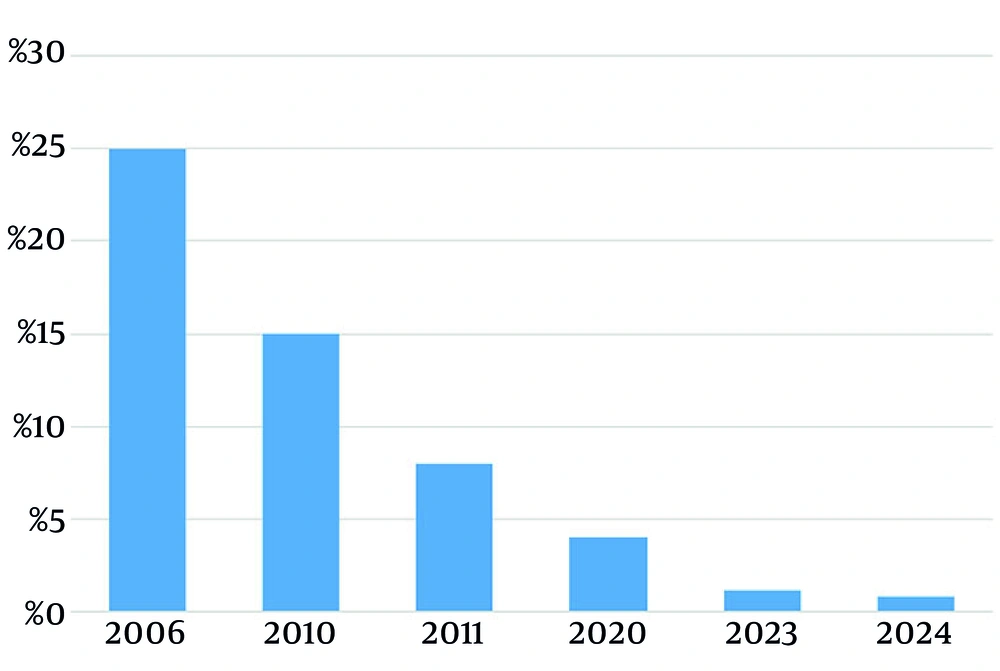
Trend of HIV prevalence among PWID in Iran
Figure 1.

Trend of HIV prevalence among PWID in Iran

Harm reduction programs in Iran have primarily included needle and syringe programs, methadone maintenance treatment, and condom distribution. The provision of free sterile needles and syringes through drop-in centers (DICs) has been widely implemented and has played a critical role in preventing HIV transmission among PWID (1-3). Currently, individuals who inject drugs can also obtain sterile disposable syringes from pharmacies without stigma or restriction.
Methadone maintenance treatment has had a particularly significant impact on controlling the HIV epidemic among PWID in Iran, especially by preventing HIV transmission in Iranian prisons. Furthermore, condom distribution programs are currently implemented in DICs, positive clubs, defined as community-based support centers for people living with HIV, and selected prisons across the country. These interventions have the potential to substantially reduce sexual transmission of HIV. However, given that sexual transmission is now the predominant route of HIV transmission, further strengthening and expansion of these programs are essential (2, 3). In light of the demonstrated effectiveness of harm reduction programs in controlling HIV among PWID, these interventions should be further reinforced. Sustaining and expanding harm reduction efforts is crucial to preventing any resurgence in HIV incidence and prevalence among PWID and avoiding a return to previous epidemic levels.


Footnotes

References

  • 1.
    Jahani MR, Kheirandish P, Hosseini M, Shirzad H, Seyedalinaghi SA, Karami N, Valiollahi P, Mohraz M, McFarland W. HIV seroconversion among injection drug users in detention, Tehran, Iran. AIDS. 2009;23(4):538-540. [PubMed ID: 19182678]. https://doi.org/10.1097/QAD.0b013e3283269e3c.
  • 2.
    SeyedAlinaghi S, Taj L, Mazaheri-Tehrani E, Ahsani-Nasab S, Abedinzadeh N, McFarland W, et al. HIV in Iran: onset, responses, and future directions. Aids. 2021;35(4):529-542. [PubMed ID: 33252485]. [PubMed Central ID: PMC7924262]. https://doi.org/10.1097/QAD.0000000000002757.
  • 3.
    SeyedAlinaghi S, Roozbahani MM, Farhoudi B, Manshadi SA, Jahanfar S. HIV infection in Iran: An update on epidemiology, testing and gaps. Acta Medica Iranica. 2024. https://doi.org/10.18502/acta.v62i4.17430.
  • 4.
    Kheirandish P, Seyedalinaghi SA, Hosseini M, Jahani MR, Shirzad H, Foroughi M, et al. Prevalence and correlates of HIV infection among male injection drug users in detention in Tehran, Iran. JAIDS Journal of Acquired Immune Deficiency Syndromes. 2010;53(2):273-275. [PubMed ID: 20104123]. https://doi.org/10.1097/QAI.0b013e3181be6dde.
  • 5.
    Rahimi Y, Gholami J, Amin‐Esmaeili M, Fotouhi A, Rafiemanesh H, Shadloo B, et al. HIV prevalence among people who inject drugs (PWID) and related factors in Iran: a systematic review, meta-analysis and trend analysis. Addiction. 2020;115(4):605-622. [PubMed ID: 31631425]. https://doi.org/10.1111/add.14853.

Similar Articles

13
Jul
2024

Cognitive Impairments and Its Related Factors in People Who Injects Drugs in Iran

Mohammad Sayadnasiri,
Mohammad Hasan Farhadi,
Alireza Noroozi,
Narges Dostkaramooz,
Jafar Babapour,
Ali Nazeri Astaneh
,et al.

Sayadnasiri M, Farhadi MH, Noroozi A, Dostkaramooz N, Babapour J, et al. Cognitive Impairments and Its Related Factors in People Who Injects Drugs in Iran. Iran J Psychiatry Behav Sci. 2024;18(3):e145292. doi: https://doi.org/10.5812/ijpbs-145292

25
Oct
2017

Hepatitis C Virus Seroprevalence and Associated Risk Factors Among Male Drug Injectors in Kermanshah, Iran

Asaad Sharhani,
Yadollah Mehrabi,
Alireza Noroozi,
Maryam Nasirian,
Peter Higgs,
Ahmad Hajebi
,et al.

Sharhani A, Mehrabi Y, Noroozi A, Nasirian M, Higgs P, et al. Hepatitis C Virus Seroprevalence and Associated Risk Factors Among Male Drug Injectors in Kermanshah, Iran. Hepat Mon. 2017;17(10):e58739. doi: https://doi.org/10.5812/hepatmon.58739

26
Sep
2016

Impact of Needle and Syringe Program Coverage on HIV Incidence in People Who Inject Drugs

Mehdi Noroozi,
Alireza Noroozi,
Ali Mirzazadeh,
Ahmad Hajebi,
Yadoallah Mehrabi,
Sayed Saeed Hashemi
,et al.

Noroozi M, Noroozi A, Mirzazadeh A, Hajebi A, Mehrabi Y, et al. Impact of Needle and Syringe Program Coverage on HIV Incidence in People Who Inject Drugs. Int J High Risk Behav Addict. 2017;6(1):e28929. doi: https://doi.org/10.5812/ijhrba.28929

31
Jul
2012

Seroepidemiology of Human Immunodeficiency Virus in Illicit Substance Users in Ahvaz, Iran: 2005-2006

Seyed Mohammad Alavi,
Mohammad Nadimi,
Shahram Shokri,
Gholamabbas Zamani

Alavi SM, Nadimi M, Shokri S, Zamani G. Seroepidemiology of Human Immunodeficiency Virus in Illicit Substance Users in Ahvaz, Iran: 2005-2006. Jundishapur J Microbiol. 2012;5(3):. doi: https://doi.org/10.5812/jjm.3446

28
Apr
2018
Hepatitis C Infection Among HIV-Positive Injection Drug Users and Non-Injection-Drug Users in Tajikistan

Hepatitis C Infection Among HIV-Positive Injection Drug Users and Non-Injection-Drug Users in Tajikistan

Arash Alaei,
Kathryn Mishkin,
Saifuddin Karimov,
Dilshod Saidi,
Kamiar Alaei

Alaei A, Mishkin K, Karimov S, Saidi D, Alaei K. Hepatitis C Infection Among HIV-Positive Injection Drug Users and Non-Injection-Drug Users in Tajikistan. Hepat Mon. 2018;18(3):e64860. doi: https://doi.org/10.5812/hepatmon.64860


Crossmark
Crossmark
Checking
Share on
Cited by
Metrics

Ordering Reprints

Articles are published under the Creative Commons license stated on each article. No permission or royalty fee is required for uses permitted by that license. CCC handles optional bulk and customized reprint orders. Any quotation covers production and delivery services only, not copyright permission. > Request Reprints from CCC 

Search Relations

Author(s):

Related Articles