
1. Background
As one of the most fundamental social institutions in Iran, the family plays a pivotal role in shaping meaning, identity, and social relations. Despite extensive social, economic, and cultural transformations in recent decades, the Iranian family has retained its significance and continues to serve as a central setting for reproducing social values and norms. Within this context, childbearing is regarded as one of the most important elements that gives meaning to the family. For many individuals, having children is perceived not merely as a functional aspect of family life but as a primary reason for forming a family (1).
In the Iranian cultural context, a complete family is often defined by the presence of a father, a mother, and children. Consequently, childlessness or limiting a family to one child may call the family’s social legitimacy into question (2). This dominant framework gives rise to diverse and sometimes contradictory attitudes toward childless families, ranging from pity and compassion to sarcasm, resentment, and social exclusion (3). Such reactions are not merely individual attitudes; they reflect prevailing systems of meaning and social norms that are reproduced through everyday interactions (4).
From a social constructionist perspective, infertility is not merely a biological or medical condition; it is also a social phenomenon whose meaning is shaped by relationships, discourse, and expectations. Women’s perceptions of infertility develop through ongoing interactions with family members, relatives, formal and informal institutions, and cultural structures, which may substantially influence major life decisions. These perceptions reflect the social structures and systems of meaning in which infertile women live and through which they reconstruct their identities (5).
In patriarchal cultural contexts, power structures establish motherhood as a central element of feminine identity through cultural symbols, myths, and archetypes (6). Linguistic and cultural remnants, such as the term “issueless,” illustrate how infertility has become embedded in collective memory and social meaning as a major stigma (7). Infertility may therefore function as an identity marker that exposes women to social judgment, surveillance, and systemic pressure (8). Consequently, women may need to manage their identities, reinterpret dominant meanings, and conceal or redefine their infertility status (9, 10).
When motherhood is treated as the primary measure of womanhood, the inability to fulfill this normative role can challenge women’s self-perceptions and intensify feelings of worthlessness, marginalization, and social exclusion (11, 12). Rather than being solely an individual consequence, this experience reflects the interplay of cultural meanings, social expectations, and power structures in women’s everyday lives (13).
In medical discourse, infertility is defined as the failure to achieve pregnancy after 1 year of regular, unprotected intercourse; this interval is reduced to 6 months for women older than 35 years. Infertility may be classified as primary or secondary. However, medical institutions often focus predominantly on biological and treatment-related dimensions, overlooking the social, cultural, and semantic contexts of infertility (14).
Despite the dominance of medical discourse, sociocultural contexts create a substantial gap between the formal definition of infertility and its social perception. Although infertility is medically framed as a diagnosable and treatable biological condition, it socially acquires meanings rooted in cultural norms, gendered expectations, and power relations. Women navigating treatment pathways therefore encounter a network of meanings that represents infertility not only as a clinical condition but also as a failure to fulfill normative feminine roles (15). When medical institutions overlook these meanings, they may fail to fully address women’s needs and may reproduce inequalities in access to support and care (16).
Most couples in young and middle adulthood desire children (17), yet a substantial proportion experience infertility (18). Unequal access to medical services, limited public awareness, and pressure arising from social expectations can make infertility an erosive social experience and intensify hopelessness, isolation, and perceived injustice among women (19).
Because the prevalence of infertility in Iran is higher than the global average (18), and recent population policies have increased symbolic and normative pressures on women (20), sociological research on the perception and meaning-making of infertility is needed. Such research can move beyond purely medical approaches and deepen understanding of the sociocultural consequences of infertility.
2. Objectives
This study aimed to explore the sociocultural perceptions of infertile women, analyze the meanings they attribute to infertility during social interactions, and examine the consequences constructed from these perceptions. The findings may provide a basis for comprehensive support strategies tailored to the Iranian sociocultural context.
3. Methods
3.1. Study Design and Methodological Approach
A review of the literature indicates that most studies of infertility in Iran have used quantitative methods, whereas qualitative studies have predominantly used phenomenological and ethnographic designs (21). Consequently, the inductive, interpretive, and meaning-centered dimensions of individual perception have received less attention. Because perceptions of infertility in Iran are strongly influenced by culture, social norms, religion, and familial and social power relations, understanding this phenomenon requires a flexible approach that is sensitive to social context and interpersonal nuance (5).
Accordingly, the study used Kathy Charmaz's constructivist grounded theory approach. This methodology enabled analysis of infertile women's perceptions from their own perspectives and the identification of sociocultural meanings within their specific context. Within a constructivist framework, data and analyses are viewed as social constructions and are interpreted in relation to time, place, culture, and situation. This approach recognizes that perceptions are influenced by values, beliefs, and social structures.
Charmaz's grounded theory emphasizes participants' active interpretation and role in meaning-making. Rather than prioritizing only the researcher's perspective, it clarifies the complex relationship between individual experience and social structures. It also offers flexibility to account for cultural context, power relations, and social interactions and to integrate implicit perceptions and meanings into a theoretical framework.
3.2. Researcher Characteristics and Reflexivity
All interviews were conducted by the first author, Fatemeh Saberi. She had participated in several qualitative research methodology workshops, completed university courses in qualitative research methods, and conducted her master's thesis using a qualitative grounded theory approach. The interviewer had no prior relationship with the participants.
Before data collection, the researchers documented their initial assumptions in reflexive memos. These assumptions were that infertility in Iran is primarily a woman-centered experience, mother-centered norms place intense pressure on women, and infertile women generally use individual and cultural strategies to cope with their suffering. Throughout coding and analysis, these assumptions were continuously compared with the data to avoid imposing them on the findings.
3.3. Setting and Participants
Interviews were conducted in a separate private room provided by the infertility clinic, creating a safe and confidential environment that encouraged trust and open discussion. The target population comprised infertile women undergoing treatment at a clinic serving couples from different regions of Iran. This setting provided considerable sociocultural diversity. Eligible participants were married, childless women with primary infertility who were undergoing active treatment and had no history of neuropsychiatric disorders or severe psychological conditions.
3.4. Sampling and Data Collection
Sampling was conducted in 2 stages. During initial purposive sampling, clinic midwives helped identify eligible participants. After the first 10 interviews were coded, 2 initial categories emerged: unequal gender pressures and differences in coping strategies. During theoretical sampling, women with male-factor infertility, treatment histories longer than 5 years, and residence in smaller and diverse cities, including Arsanjan, Asaluyeh, and Chabahar, were purposefully included to saturate these categories.
Data were collected through in-depth, semistructured interviews, observations, and note taking with 23 women. Interview questions addressed women's initial encounters with infertility, their own and others' reactions, changes in interpersonal relationships, particularly with spouses, and strategies used to manage sociocultural pressures. The demographic and infertility-related characteristics of participants are presented in Table 1.
Table 1.
Demographic and Infertility-Related Characteristics of Participants (N = 23)
| No. | Age (y) | City | Education | Treatment duration (y) | Infertility cause |
|---|---|---|---|---|---|
| 1 | 30 | Arsanjan | Bachelor | 5 | Both |
| 2 | 38 | Shiraz | Diploma | 3 | Female-factor |
| 3 | 35 | Arsanjan | Diploma | 7 | Both |
| 4 | 24 | Asaluyeh | Illiterate | 5 | Both |
| 5 | 30 | Shiraz | Diploma | 12 | Male-factor |
| 6 | 37 | Jahrom | Bachelor | 5 | Female-factor |
| 7 | 22 | Shiraz | University student | 3 | Female-factor |
| 8 | 37 | Neyriz | Diploma | 10 | Male-factor |
| 9 | 36 | Shiraz | Bachelor | 5 | Male-factor |
| 10 | 42 | Bushehr | Under diploma | 11 | Male-factor |
| 11 | 49 | Lar | Illiterate | 7 | Male-factor |
| 12 | 42 | Shiraz | Master | 10 | Female-factor |
| 13 | 27 | Chabahar | Illiterate | 6 | Both |
| 14 | 45 | Shiraz | Master | 15 | Male-factor |
| 15 | 43 | Shiraz | Diploma | 21 | Male-factor |
| 16 | 41 | Shiraz | Under diploma | 20 | Female-factor |
| 17 | 30 | Kangan | Master | 13 | Male-factor |
| 18 | 29 | Bandar Abbas | Diploma | 7 | Both |
| 19 | 42 | Jahrom | Diploma | 15 | Male-factor |
| 20 | 39 | Shiraz | Diploma | 17 | Female-factor |
| 21 | 49 | Fasa | Illiterate | 19 | Female-factor |
| 22 | 29 | Khan Zeniyan | Grade 10 in high school | 11 | Female-factor |
| 23 | 33 | Marvdasht | Diploma | 5 | Female-factor |
Theoretical saturation was reached when the final 3 interviews yielded no new codes, subcategories, or properties of existing categories. In total, 23 in-depth interviews, each lasting 40 - 60 minutes, were conducted over 2 months, from December 2025 to February 2026. No eligible woman refused to participate. Interviews were audio-recorded with informed consent and transcribed verbatim.
During interviews, the researcher occasionally took brief notes with participants' permission while primarily focusing on active listening. Each recording was reviewed repeatedly. Field notes documented nonverbal observations and the setting; analytic memos recorded initial ideas, conceptual connections, and emerging questions; and reflexive memos recorded the researcher's assumptions and feelings. These materials contributed directly to initial coding, subcategory formation, development of core categories, and construction of the final grounded theory.
3.5. Data Analysis and Trustworthiness
Data were managed and analyzed using MAXQDA software. Analysis involved initial coding, focused coding, and development of a grounded theory. Initial coding was performed by the first author, and the consulting advisor reviewed the coding and provided feedback. Disagreements or alternative interpretations were discussed and resolved by returning to the data and analytic memos.
For example, participant P4's statement, "My husband has a sperm problem." was initially coded as "threat of divorce despite male-factor infertility," focused as "spousal pressure and inequality in blame," assigned to the subcategory "reduced quality of marital relations," and ultimately incorporated into the core category "challenges to identity and marital relations" (Table 2).
Table 2.
Core Categories and Subcategories of Infertility Perceptions Among Infertile Women
| Core Categories | Subcategories | Illustrative Quotations |
|---|---|---|
| Sociocultural structural pressures and constraints | Societal judgments and sarcasm; inadequate familial support and limited social networks; economic constraints and insufficient insurance coverage | 1. "In our community, having a child is mandatory; otherwise, you face sarcasm and judgment." (P4: 24 years, illiterate, Asaluyeh, combined cause) 2. "My husband's family stopped inviting me to gatherings. They said a house without a child has no blessing." (P13: 27 years, illiterate, Chabahar, combined cause) |
| Shared structural suffering among infertile women | Suffering rooted in social and familial constraints; pressure from the medical system and society; reproduction of gender inequality | 1. "My husband has a low sperm count and I have diminished ovarian reserve, yet he tells me, 'If you do not bear a child, I will take another wife.'" (P4: 24 years, illiterate, Asaluyeh, combined cause) 2. "Even though the doctors said the problem is with my husband, my mother-in-law still blames me. She says a woman must be able to have children no matter what." (P11: 49 years, illiterate, Lar, male-factor infertility) |
| Challenges to identity and marital relations | Crisis of feminine identity; deterioration in the quality of marital relations and spousal pressure; dependence of feminine identity on childbearing | 1. "My husband told me he would divorce me if I did not have a child." (P5: 30 years, diploma, Shiraz, male-factor infertility) 2. "I feel I am not a real woman. Every time I see a pregnant woman, I cry inside." (P2: 38 years, diploma, Shiraz, female-factor infertility) |
| Sociocultural strategies for coping with suffering | Maintaining hope and persistence in seeking treatment; reconstructing the meaning of womanhood; relying on faith and cultural-religious values | 1. "God is with me; He helps me in ways that feel like a miracle." (P6: 37 years, bachelor's degree, Jahrom, female-factor infertility) 2. "I pray every day and ask God to give me patience. This is the only thing that keeps me going." (P10: 42 years, below diploma, Bushehr, male-factor infertility) |
Constant comparative analysis was used to support the credibility and consistency of the findings. Selected participants provided direct feedback on some analyses, enabling the researchers to assess whether the interpretations reflected participants' perceptions and experiences.
4. Results
Analysis of interviews with 23 women using Charmaz's constructivist grounded theory yielded 290 initial codes. As summarized in Table 2, women's perceptions of infertility extended beyond biological impairment and acquired meaning within social, cultural, and gendered structures. Infertility-related suffering reflected a complex interaction among structural pressures, familial and social relations, and women's perceptions of their identity and status. Four core categories emerged.
4.1. Sociocultural Structural Pressures and Constraints
The findings indicated that social and structural pressures play a pivotal role in shaping infertility-associated suffering. These pressures encompass societal judgment and sarcasm, a lack of adequate familial support, limited social networks, economic constraints, and insufficient insurance coverage. For instance, one participant stated: "In our community, having a child is mandatory; otherwise, you face sarcasm and judgment." This underscores that, in societies where motherhood is perceived as the dominant norm of womanhood, infertile women are subjected to persistent social and familial pressures.
These pressures are not confined solely to the individual level; rather, they are reproduced through interactions with family and close social networks, indicating that infertility-associated suffering is structural. Understanding these pressures from the perspective of women's perceptions is crucial, as these perceptions shape their experiences and influence subsequent responses and coping strategies.
"My husband's family stopped inviting me to gatherings. They said a house without a child has no blessing." (P13: 27 years, illiterate, Chabahar, combined cause)
"In our community, having a child is mandatory; otherwise, you face sarcasm and judgment." (P4: 24 years, illiterate, Asaluyeh, combined cause)
4.2. Challenges to Identity and Marital Relations
Data analysis showed that infertility precipitates an identity and relational crisis for many women. Because female identity is deeply dependent on childbearing, failure in this role often leads to destabilization of feminine identity and a decline in the quality of marital relations. One specific instance highlights this pressure: "My husband told me he would divorce me if I did not have a child." This example demonstrates that, even in cases of male-factor infertility, the primary sociocultural pressure is disproportionately imposed on women, reflecting gender inequality in the distribution of the social consequences of infertility.
These findings suggest that women's perceptions of themselves and their social standing are directly influenced by power structures and gender norms, with feminine identity continuously shaped through interactions with these pressures. In other words, infertility is not merely an individual issue but also a product of sociocultural structures that influence women's identities and interpersonal relationships.
A step-by-step illustration of how a quotation was coded from the initial code to the core category is provided in the Methods section.
"I feel I am not a real woman. Every time I see a pregnant woman, I cry inside." (P2: 38 years, diploma, Shiraz, female-factor infertility)
"My husband told me he would divorce me if I did not have a child." (P5: 30 years, diploma, Shiraz, male-factor infertility)
4.3. Sociocultural Strategies for Coping with Suffering
The findings revealed that infertile women, despite structural constraints and pressures, are active agents in managing their suffering. They employ sociocultural strategies to mitigate pressures and redefine their sense of self. A representative example of this approach is captured in the sentiment: "God is with me; He helps me in ways that feel like a miracle." By maintaining hope for medical treatment, demonstrating persistent effort, reconstructing the meaning of womanhood, and relying on cultural-religious beliefs and values, these women strive to manage their suffering.
These findings suggest that female agency is constructed within the nexus of structural and social constraints. Women actively engage in redefining meaning and maintaining identity coherence, although these efforts are invariably accompanied by external pressures and societal constraints.
"I pray every day and ask God to give me patience. This is the only thing that keeps me going." (P10: 42 years, under diploma, Bushehr, male-factor infertility)
"God is with me; He helps me in ways that feel like a miracle." (P6: 37 years, bachelor's degree, Jahrom, female-factor infertility)
4.4. Shared Structural Suffering Among Infertile Women
Data analysis further revealed that the primary source of infertility-associated suffering is not confined to biological incapacity; rather, it is deeply intertwined with social and familial structures and dominant discourses surrounding motherhood. This suffering establishes a shared pattern among infertile women and is perpetually reproduced through interactions with family, spouses, the medical system, and society. One participant's account exemplifies this collective suffering: "My husband has a low sperm count and I have diminished ovarian reserve, yet he tells me: 'If you do not bear a child, I will take another wife.'"
"Even though the doctors said the problem is with my husband, my mother-in-law still blames me. She says a woman must be able to have children no matter what." (P11: 49 years, illiterate, Lar, male-factor infertility)
"My husband has a low sperm count and I have diminished ovarian reserve, yet he tells me, 'If you do not bear a child, I will take another wife.'" (P4: 24 years, illiterate, Asaluyeh, combined cause)
We compared women's experiences according to the cause of infertility: male-factor, female-factor, or combined. Women in all 3 groups experienced substantial social pressure, stigma, and suffering.
- Women with male-factor infertility, including P5, P10, and P11, were blamed by their husbands' families as though infertility was their personal fault.
- Women with female-factor infertility, including P2 and P6, expressed feelings of incompleteness and worthlessness.
- Women with combined causes, including P4 and P13, described the dual burdens of medical treatment and social shame.
However, we found no fundamental differences in how suffering was imposed on women. In every case, the cultural expectation of motherhood and the resulting social pressure were the main sources of distress. Infertility-related suffering is therefore inherently gendered and affects women regardless of the biological cause.
These findings highlight the importance of revising dominant medical approaches and health policies and addressing the sociocultural dimensions of infertility alongside biological treatment.
Overall, infertility among Iranian women is a multilayered phenomenon shaped by the intersection of power structures, mother-centered cultural norms, and women's constrained agency. Understanding these dimensions may support the design of more comprehensive interventions, effective social support, and gender-sensitive women's health policies. Any analysis of infertility is incomplete without consideration of perception, meaning, and sociocultural context.
The reproductive cycle of infertility-related suffering shown in Figure 1 was derived by synthesizing the 4 core categories and their relationships. Participants' accounts indicated that structural pressures led to identity and marital challenges, which in turn prompted coping strategies. When these strategies did not resolve the suffering, the same pressures were reproduced, creating a self-perpetuating cycle through the interaction of social structures and individual agency. Figure 1 therefore represents the grounded theory that emerged from the data.
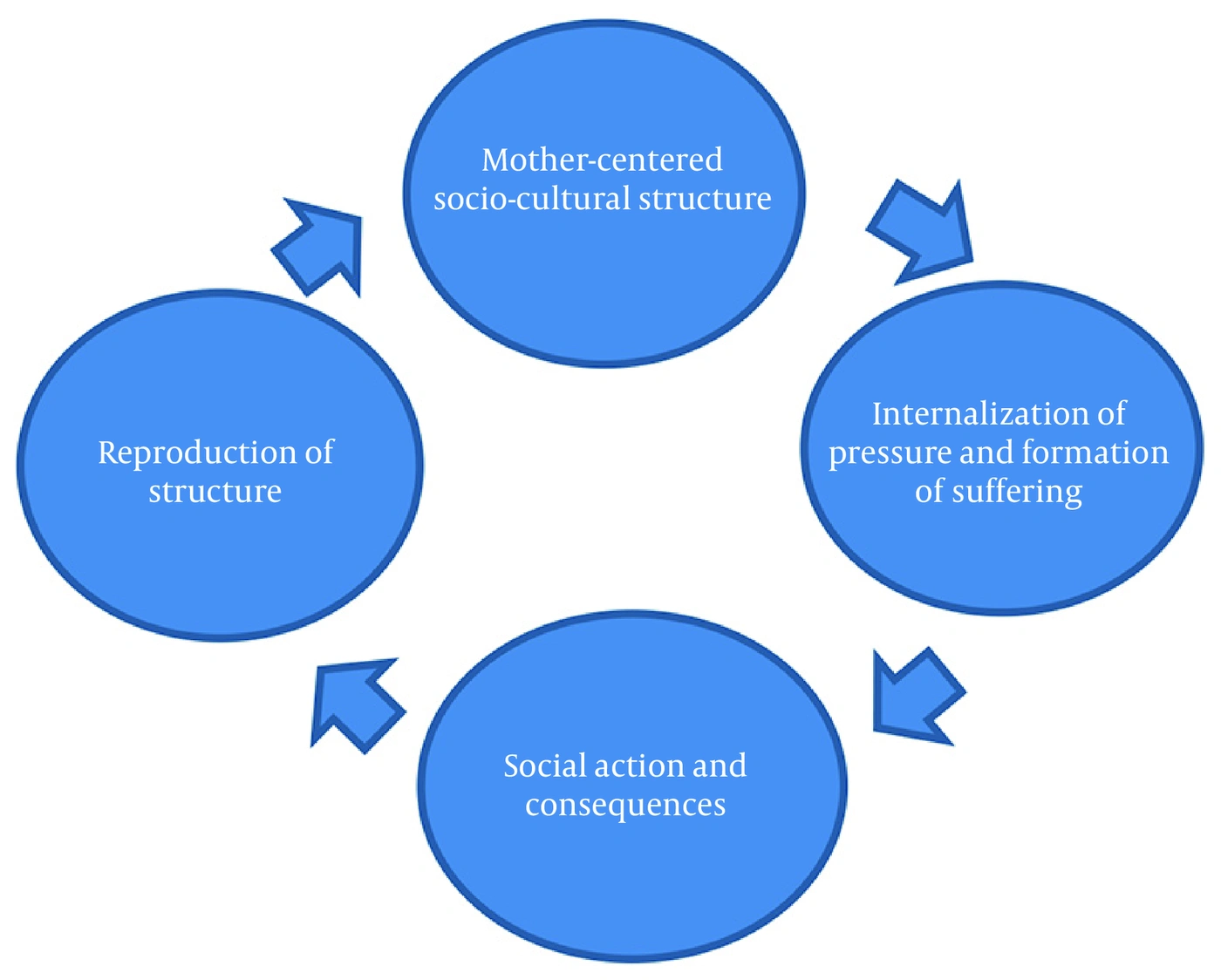
Figure 1.
The Reproduction Cycle of Infertility-Related Suffering: From Structural Pressure to Shared Structural Suffering
All quotations are participants' own words. The core categories and reproductive cycle are analytical constructs derived through constant comparison with participants' perceptions and were kept distinct from the researchers' preconceptions.
5. Discussion
The experience of infertility among Iranian women cannot be fully explained within a purely biological or medical framework.
As described in the Methods section, the researchers documented their initial assumptions about infertility as a woman-centered experience, mother-centered pressure, and individual and cultural coping strategies in reflexive memos before data collection. These assumptions were continuously compared with the data throughout analysis and interpretation. Therefore, the discussion presented here is grounded in participants' accounts rather than being imposed by the researchers' preconceptions.
5.1. Sociocultural Structural Pressures and Constraints
According to participants' accounts, social and structural pressures play a fundamental role in shaping perceptions of infertility. Infertile women are continually confronted with social judgment, sarcasm, expectations from their spouses' families, and economic and institutional constraints, including high treatment costs and insufficient insurance coverage. This finding is consistent with previous studies in Iran (8, 10) and other Middle Eastern societies (11, 22), which have shown that infertility becomes a social label that exposes women to stigma in contexts dominated by mother-centered norms.
Conversely, studies conducted in Western societies have reported that infertility is predominantly perceived as an individual or couple-oriented issue and that women experience less pronounced social pressure (23, 24). This difference may reflect cultural variation, the weakening of traditional gender roles, and greater separation of feminine identity from motherhood. Nevertheless, the present findings indicate that cultural structures and collective expectations remain dominant influences on infertility-associated suffering in the Iranian context.
5.2. Challenges to Identity and Marital Relations
For many women, infertility is not merely a biological crisis but also a crisis of identity and relationships. The dependence of feminine identity on childbearing means that an inability to fulfill this role may lead to a sense of incompleteness, diminished self-esteem, and instability in marital relations. These results align with previous research demonstrating that infertility can increase marital conflict, threats of divorce, and gender inequality, even when male-factor infertility is the primary cause (25).
In contrast, some studies have reported that spousal support may protect against the psychological consequences of infertility (24). Although such support is important, the present findings suggest that support from a spouse may not always neutralize extensive social and familial pressure. Women's identities may therefore remain vulnerable to structural threats.
5.3. Sociocultural Strategies for Coping with Suffering
The findings indicate that infertile women are not passive despite living under restrictive conditions. They use diverse strategies to manage their suffering, including maintaining hope in medical treatment, persisting with treatment, reconstructing the meaning of womanhood, and relying on cultural-religious beliefs and values. These findings align with qualitative studies emphasizing spirituality, religion, and reconstruction of meaning as important resources for resilience during infertility (26-28).
At the same time, some critical studies have suggested that these strategies may occasionally promote passive acceptance of unequal conditions, encouraging women to adapt to existing structures rather than transform them (29). The present findings support this duality: women's agency develops alongside structural constraints and remains accompanied by external pressure.
5.4. Shared Structural Suffering Among Infertile Women
Infertility-associated suffering among the women in this study followed a shared structural pattern that extended beyond individual differences. This suffering appeared to arise not only from biological incapacity but also from interactions with family members, spouses, the medical system, and dominant mother-centered discourses. This finding is consistent with studies that conceptualize infertility as a sociostructural phenomenon and emphasize the roles of power, gender, and inequality in suffering (15, 30).
In contrast, medically centered approaches predominantly conceptualize infertility as a physical impairment and focus on biological interventions (14, 31). The present findings challenge these perspectives, as they do not fully explain infertile women's perceptions and neglect sociocultural dimensions that may reproduce structural suffering.
The gap between medical approaches and the sociocultural reality of women's suffering has direct implications for health policymaking. It may perpetuate inequalities in access to appropriate care and reinforce the structural pressures that generate suffering.
5.5. Study Limitations
Despite the richness of the qualitative data, this study has several limitations. First, although participants came from several Iranian cities, including Arsanjan, Asaluyeh, Chabahar, and Bushehr, all were recruited from a single infertility clinic in Shiraz. This may limit transferability to women attending other clinics or those who do not seek treatment. Second, the study focused exclusively on women's perceptions. This was a deliberate design choice because the study aimed to understand how infertility-related pressure and suffering are imposed on women. The absence of male partners' perspectives should therefore be understood in relation to the study scope. Third, as in all qualitative research, the findings are context-bound and should be transferred cautiously to other sociocultural settings. Future studies using different sampling strategies and cultural contexts may enrich understanding. Male partners' perceptions could also be examined as a separate line of research without altering the purpose of the present study.
5.6. Conclusions and Practical Implications
The findings indicate that infertility among Iranian women is a multilayered sociocultural phenomenon deeply intertwined with social perceptions and expectations.
Social, cultural, and familial pressures affect women's identities and social status, thereby reproducing suffering. Infertility-related suffering is not solely individual; it arises from a self-perpetuating cycle shaped by women's perceptions, social structures, and culture. A purely biological therapeutic approach is therefore insufficient, and comprehensive support should address social, cultural, and psychological dimensions.
Despite structural constraints and pressure, women exercise agency by redefining their identities and managing their suffering. Through sociocultural strategies, spiritual resources, and peer support, they seek to maintain identity coherence and preserve meaning in life. This agency remains constrained and is shaped by power structures, mother-centered cultural norms, and gender relations.
Based on the double pressure experienced by women even in male-factor infertility, the direct effects of social pressure on women's identities, and the role of cultural-religious coping strategies, the following practical interventions are proposed:
- Develop social support programs and peer-led groups that facilitate the exchange of perceptions and experiences, strengthen belonging, and help women reconstruct identities beyond motherhood.
- Provide cultural education and sensitivity training for medical staff to address the sociocultural dimensions of women's perceptions and reduce pressure arising from an exclusively biomedical approach.
- Provide counseling and awareness-raising programs for families and spouses to reduce social pressure and promote a shared understanding of infertility, particularly when women are blamed despite male-factor infertility.
- Develop educational and cultural resources that help women redefine their roles, strengthen their agency, and improve coping skills.
Conceptualizing infertility as a multilayered sociocultural phenomenon while recognizing women's agency and structural constraints can support more comprehensive interventions and gender-sensitive policies in women's health. In addition to medical treatment, this approach can provide social, cultural, and psychological support, improve women's quality of life, and enhance their social standing. Because this qualitative study was conducted in a specific context, the findings should be regarded as preliminary and hypothesis-generating for other settings rather than directly generalizable.