
1. Background
Dermatomyositis (DM) and polymyositis (PM) are chronic autoimmune muscle diseases that primarily affect the proximal limbs and neck region muscles. Immune cells, such as CD4+ cells, CD8+ cells, B cells, dendritic cells, and macrophages, infiltrate the myofibers and endomysial capillaries. This infiltration leads to damage of muscle fibers through the production of humoral factors, i.e., antibodies and different interleukins. It has been demonstrated that inflammatory cytokines, such as TNF-α, IL-1, and IL-15, play a pivotal role in the pathogenesis of DM and PM (1, 2).
Interleukin-18 (IL-18) is a member of the IL-1 cytokine superfamily that has been revealed as an important modulator of immune responses. IL-18 is expressed in autoimmune disorders, chronic inflammation, many infectious diseases, and some cancers. Primarily, IL-18 known as an interferon-γ (IFN-γ) inducing factor. Expression of IL-18 has been demonstrated in various mammalian cells, such as macrophages, skeletal muscle, microglial cells, osteoblasts, endothelium, and synovial fibroblasts. IL-18 is recognized for its function in inflammation, whereby proinflammatory stimuli, including lipopolysaccharide and tumor necrosis factor-α, induce caspase-1 related cleavage of proIL-18 into mature IL-18. IL-18 induces cytokine production, reactive oxygen species release, neutrophil activation, and degranulation (3-5). Recent research proposed that IL-18 induces vascular cell adhesion molecule-1 (VCAM-1) and intracellular adhesion molecule-1 (ICAM-1) on fibroblasts of synovium and endothelial cells (6). The effects of IL-18 can begin through transmembrane heterodimeric IL-18 receptors containing α and β chains and through a toll-like receptor signaling cascade. Finally, this causes the activation of nuclear factor-κB and modulation of gene transcription (7).
Interleukin-6 (IL-6) is a typical pleiotropic and potent Th2 cytokine that plays roles in the inflammation and immune system. IL-6 has dual function as a proinflammatory and anti-inflammatory cytokine and plays a pivotal role in the movement from the acute to the chronic stage of the inflammatory response (8, 9). Increased IL-18 and IL-6 serum levels have been reported in a variety of autoimmune diseases, including rheumatoid arthritis and inflammatory bowel disease (10, 11).
2. Objectives
In the present study, we tried to evaluate IL-18 and IL-6 serum levels in patients with DM and PM compared to healthy controls.
3. Patients and Methods
3.1. Patients
This cross-sectional study consists of patients attending the rheumatology clinic in Zahedan from October 1, 2011 to July 31, 2013. All of the registered patients were diagnosed based on the criteria of Bohan and Peter for the diagnosis of PM and DM (12, 13). Fifteen patients with DM (11 women and four men with a mean age of 51.3 ± 14.5) and five patients with PM (three women and two men with a mean age of 54.6 ± 13.6) were recruited. Twenty healthy control subjects whose gender and age were matched to the DM and PM patients were also recruited (14 women and six men with a mean age of 52.1 ± 13.8). The control group consisted of healthy subjects of students and medical staff who have not suffered from DM or PM or any other autoimmune disorder and have no family history of autoimmune diseases.
Patients with overlapping disorders, such as infection and allergy, were excluded. Blood samples were collected from the patients prior to treatment and three months after treatment. The present study was approved by the ethics committee of Zahedan University of Medical Sciences. All patients received written, informed consent for taking part in the study. Blood tests were taken to determine the levels of C-reactive protein (CRP), creatine kinase (CK), and triglyceride (TG) and were measured by standard methods. Furthermore, serum IL-18 and IL-6 were measured by the enzyme-linked immunosorbent assay (eBioscience, Sandiego, USA). The limits of detection were 9 pg/mL for IL-18 and 0.92 pg/mL for IL-6. Serum IL-18 and IL-6 levels were also measured in healthy control subjects whose age and gender were matched to the patient subjects.
All patients were medically treated with corticosteroids (prednisone 1 mg/kg/day, administered orally), azathioprine (2 mg/kg/day), methotrexate (15 - 25 mg/week), cyclophosphamide (1 - 2 mg/kg/day), and folic acid (1 mg/day).
3.2. Statistical Analysis
Data was processed to determine the mean ± SD. Statistical analyses were performed using the Mann-Whitney U-test with a non-Gaussian population. Spearman’s correlation coefficient was used to test the correlations between two variables using SPSS 19 (SPSS Inc., Chicago, IL) software.
4. Results
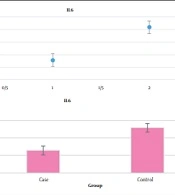
As shown in Table 1 and Table 2, Serum IL-18 levels were significantly higher in DM patients and PM patients before treatment compared to the healthy control subjects. As shown in Table 3, the serum levels of CK were significantly higher in patients with DM and PM on admission than in those with healthy controls. CRP levels were also significantly higher in DM patients and there were no significant differences observed in PM patients compared to the healthy controls.
Table 1.
The Serum Levels of IL-18 and IL-6 in DM Patients and Healthy Controls
| Interleukin | Control Group (A), Mean ± SD | DM Group Before Treatment (B), Mean ± SD | DM Group Three Month After Treatment (C), Mean ± SD | Comparison Between A and B, P Value | Comparison Between A and C, P Value | Comparison Between B and C, P Value |
|---|---|---|---|---|---|---|
| IL-18, mg/dL | 249.9 ± 37.24 | 935.08 ± 82.28 | 831.75 ± 61.27 | P < 0.001 | P < 0.001 | P < 0.25 |
| IL-6, mg/dL | 8.69 ± 1.80 | 9.34 ± 1.66 | 8.42 ± 1.38 | P < 0.51 | P < 0.72 | P < 0.74 |
Table 2.
The Levels of Serum IL-18 and IL-6 in PM Patients and Healthy Controls
| Interleukin | Control Group (A), Mean ± SD | PM Group Before Treatment (D), Mean ± SD | PM Group Three Month After Ttreatment (E), Mean ± SD | Comparison Between A and D, P Value | Comparison Between A and E, P Value | Comparison Between D and E, P Value |
|---|---|---|---|---|---|---|
| IL-18, mg/dL | 249.9 ± 37.24 | 578.44 ± 53.07 | 478 ± 42.69 | P < 0.01 | P < 0.04 | P < 0.52 |
| IL-6, mg/dL | 8.69 ± 1.80 | 8.79 ± 6.91 | 8.34 ± 4.72 | P < 0.47 | P < 0.43 | P < 0.71 |
Table 3.
Comparison in Clinical Data of DM and PM Patients Before Treatment to the Control Group
| Variable | Control (A) | DM (B) | PM (C) | Comparison Between A and B, P Value | Comparison Between A and C, P Value |
|---|---|---|---|---|---|
| Number | 20 | 15 | 5 | - | - |
| Sex, F/M | 14/6 | 11/4 | 3/2 | - | - |
| CK, IU/L | 96.11 ± 16a | 106.33 ± 73.2a | 700.66 ± 118.07a | P < 0.01 | P < 0.001 |
| TG, mmol/L | 89.66 ± 9.12a | 287.77 ± 35.04a | 124.03 ± 27.67a | P < 0.01 | P < 0.013 |
| CRP, mg/dL | 4.70 ± 1.13a | 14.75 ± 11.35a | 5.78 ± 0.83a | P < 0.031 | P < 0.69 |
aValues are expressed as mean ± SD.
5. Discussion
Idiopathic inflammatory myopathy, which is characterized by muscle weakness and chronic inflammation, consists of diseases such as DM and PM. Involvement of the immune system in these disorders is confirmed by the invasion of macrophages, T cells, and dendritic cells and the presence of autoantibodies in muscle fibers. The invasion of T cells may induce direct and indirect harmful effects on muscle tissues, causing necrosis and weakness of muscle tissues, but the target of the immune response is not well known. The immune cells that enter the muscle fibers may not only have direct harmful effects on muscle fibers, but may also affect molecules like cytokines that are produced and secreted in the area and in the blood circulation (14-16). Therefore, it was necessary to investigate the role of cytokines in DM and PM disorders. There are very few reports on the serum levels of IL-6 and IL-18 in DM and PM patients. Thus, we focus on the changes of serum levels of IL-6 and IL-18 in DM and PM patients compared to healthy control subjects.
Our result showed that the level of serum IL-18 is significantly higher in both DM and PM patients before treatment compared with the healthy control group. The results are in agreement with the study done by Gono et al. in 2010 (17). IL-18 is a molecule that has been demonstrated in muscle tissue and was produced by both macrophages and dendritic cells surrounding perivascular and perimysium areas, and endomysium in DM and PM respectively (18, 19). Indeed, IL-18 plays a crucial role in the Th1 and proinflammatory response and exerts its functions through the interaction with IL-18R. In situ hybridization and immunohistochemical studies have revealed that the main sources of IL-18 in muscle fibers were macrophages and dendritic cells, whereas endothelial cells, CD8+ cells, and smooth muscle fibers expressed increased amounts of IL-18R. On the other hand, blockade of the IL-18/IL-18R pathway impairs DC migration and postpones the initiation of autoimmunity in experimental studies (18, 20, 21). An increased level of IL-18 serum indicates its muscular release where it induces damage to the muscle fibers. Therefore, serum production of IL-18 was related to the activity of the disease and it might be applied as a predictive biomarker for the diagnosis and treatment of both DM and PM.
In vitro studies have revealed that IL-18 contributes to nitric oxide release by rheumatoid arthritis synovial membrane culture. Production of nitric oxide might be the second mechanism for the destruction of muscle fibers in DM and PM that will require further investigations for clarification. Furthermore, inhibition of caspase 1 activity by nitric oxide provides a potential feedback route whereby IL-18 may modulate its own cleavage (22). Interestingly, the serum IL-18 level was not significantly decreased three months after treatment compared to DM and PM patients before treatment. A high dosage of glucocorticoids is the basis of the treatment of these autoimmune diseases, but their applications are limited due to the induction of many unwanted side effects. On the other hand, the clinical effect of such a treatment also has limited effect on muscle performance in various patients and certain patients do not respond at all and suffer from continuing inflammation in muscle fibers (15). Obtaining increased knowledge of the pathophysiology, including the immune mechanisms in these diseases, is important to improve treatment. In this study, we investigated the correlation between IL-18 and CRP in DM and PM patients and no correlation was observed (r = 0.35, P = 0.18 and r=0.22, P = 0.71 respectively). CRP levels were not significantly changed in PM patients compared to healthy controls. The reason might be the small number of PM subjects.
Our study showed that the level of serum IL-6 was not significantly changed in DM and PM patients before treatment and three months after treatment compared to the healthy control group. IL-6 plays a crucial role in the regulation of humeral and cell-mediated autoimmune reactions, such as B cell differentiation and T cell proliferation and differentiation (23). In literature, evidence regarding the pathologic function of IL-6 in DM and PM patients is scattered. The study of Yang et al. showed that IL-6 serum levels increased in DM patients compare to the control group, but, compared to systemic lupus erythematosus (SLE) and Jorgen’s syndrome (SS), was slightly lower in DM patients and no significant difference was demonstrated (24). A study by Sugiura et al. (25) showed that interaction between CD40-CD40 ligand (CD40L) could contribute to IL-6, IL-8, and IL-15 production by myoblasts in DM and PM patients. Our results and the results of Yang et al. showed that IL-6 plays a minor role in the pathogenesis of DM and PM. Therefore, we can conclude that, although blockade of IL-6 and IL-6 signaling have been shown to be effective in the treatment of various inflammatory disorders, including rheumatoid arthritis and inflammatory bowel disease, its effect in DM and PM should be limited. However, further investigations need to clarify the role of IL-6 in the pathology of DM and PM.
5.1. Conclusion
IL-18 is a substance which has been found in skeletal muscles and was produced by immune cells surrounding perivascular and perimysium areas, and endomysium in DM and PM, respectively. IL-6 also plays a pivotal role in the modulation of humoral and cell-mediated autoimmune responses, such as B cell differentiation and T cell proliferation. Our results showed that IL-18 may contribute to immunopathogenesis of idiopathic inflammatory diseases, including DM and PM. It might be a useful biomarker for the diagnosis and clinical management of both DM and PM along with other factors. IL-6 might be a less important cytokine in the pathophysiology of DM and PM. Large samples and prolonged research are needed to clarify the relationship between IL-18 and IL-6 with idiopathic inflammatory diseases.