
1. Background
Multiple sclerosis (MS) is a progressive autoimmune disease of the central nervous system that affects the brain and the spinal cord and is characterized by degradation of the myelin of the neural cells and the formation of bone tissue, causing impairment in the conduction and transmission sped of the nervous and electrical currents. Its prevalence is increasing worldwide, so that it is calling as the disease of the century (1, 2). In Iran, its prevalence is about 52.9 per 100,000 persons, while the global average is 3 per 100,000. MS often occurs between the ages of 20 to 45, and more affects the women than the men (3-5). A study conducted by Wens and colleagues showed that resistance training of people with MS, resulted in strengthening the legs and lower fatigue (6). On the other hand, Ahmadi Kakavandi et al. (7) and Hayes et al. (8) reported increased muscle strength and increased balance and improvement in muscle endurance. However, Klusiewicz et al. (9) investigated the effects of exercise on pulmonary function of male and female and did not observe any change in the results of pulmonary function tests, excepts for peak expiratory flow rate (PEFR) in men. The results of studies conducted by Osho et al. (10) that examined the effects of 12 weeks of incremental and aggressive aerobic exercise on pulmonary function revealed a significant increase in FVC and FEV1 levels. Mohammad Zadeh et al. (11) reported that eight weeks of exercise activity (i.e., upper limb and combined activity) significantly increased the FVC, FEV1, and MVV. Besides, VO2Max, VT, and end-tidal oxygen tension (PETO2), and oxygen ventilation indices increased significantly (proportionate to before exercise) after three training groups for 8 weeks. The significant ratio of VE/MVV, which indicates the shortness of breath, was also reduced (11). Fatigue is the most common and annoying symptom in MS patients. Afrasiabifar et al. (12) that performed their research in the United States showed that 50% - 75% of MS patients suffer from fatigue. They also found that fatigue is an important factor that declines the quality of life of these patients (12). Does resistance training improve the physical disability scale of MS patients? This is one of the necessities of the present study, and several studies have reported that resistance training in people with MS resulted in, improved leg strength (13), reduced fatigue (6-23), increased muscle strength (23), increased balance (8-24), and improved muscular endurance (25). In the case of simultaneous study of the effect of resistance training with two different intensities on pulmonary function and physical function, it is possible to investigate the effects of exercise on patients with MS in a wider range.
In the field of chronic illness, research is limited to improving the performance indicators in MS patients. On the other hand, few studies investigated the effects of sole training (with one intensity or aerobic exercise), and the intensity of resistance training has not been studied yet. The current study aimed to determine the effect of resistance training with different intensities on airway resistance indices, fatigue, and muscular endurance in women with MS.
2. Objectives
The current study aimed to investigate the effect of resistance training with different intensities on airway resistance indices of women with MS.
3. Methods
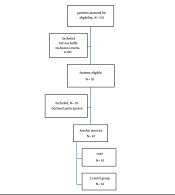
This is a pretest-posttest with a control group semi-experimental study. The research population was all women with MS who had an active record in the MS Society of Ahvaz.
After coordinating with the community authorities and informing and Invitation to convene sessions based on entry and exit criteria the study, the subjects were selected from the eligible volunteer women in a purposeful and accessible manner.
Before any physical activity, participants were examined by a neurologist, and their EDSS was determined. A total of 36 women with MS with a physical disability (one to four) were examined using the Krutzke Expanded Disability Status Scale. EDSS inclusion criteria were as follows: no history of cardiovascular disease, no previous history of epilepsy, no history of metabolic diseases, lack of mental diseases, lack of a history of the orthopedic disease (such as knee pain), having a physical disability scale between 1 - 4.
Participants were selected using the purposive sampling method among the volunteers and then were randomly assigned to each of the three groups (each consisting of 12 participants). The initial health condition was an important factor in selecting the participants. The first group received resistance training for 12 weeks, 3 sessions per week with 60% 1RM. The mean age of participants was 34.2 ± 1.8 years, and their body mass index (BMI) was 31.9 ± 4.32 kg/m2. The second group received resistance training for 12 weeks, 3 sessions per week with 80% 1RM. The mean age and BMI of its participants were 3.8 ± 30.08 years and 28.4 ± 4.22 kg/m2, respectively. For the control group, no exercise program was planned. the mean age and BMI of its participants were 28.98 ± 4.11 and 30.43 ± 4.57 kg/m2, respectively.
FVC was significantly decreased after performing high-intensity resistance training (P = 0.001) and moderate-intensity training (P = 0.0004). FEV1 was significantly decreased after performing the high-intensity exercise training (P = 0.001) and moderate-intensity training (P = 0.038). For the control group, the p-value was equal to 0.004. The FEV1/FVC variation pattern was significantly decreased after the high-intensity exercise (P = 0.001), While the reduction in this ratio was not significant with moderate intensity exercise (P = 0.819)
3.1. Measuring Variables
The inclusion criteria were living in the city of Ahwaz, lack of history of diseases such as cardiovascular disease, epilepsy, metabolic diseases, orthopedic diseases, and having non-attack conditions at least two months before participating in the exercise program. Lack of regular participation in sports activities, no history of drug consumption, neuroses, supplements, and drugs, and cigarettes, the ability to walk without help and auxiliary supplies, and not using a particular diet. A written consent form was taken from participants. Besides, they committed to comply with the provided program and to refrain from performing other exercises. Before starting the research, the physical health of participants was examined by a neurologist, and their degree of disability was determined. The maximum heart rate was calculated using the formula 220-age (26, 27). The program of resistance training was conducted at the Health Center of the University under the supervision, and required cautions were observed.
Experimental groups practiced three sessions each week for 55 minutes. Two weeks before the training program, participants were invited to the health center to obtain data on age, height, weight, body mass index (Table 1).
Table 1.
The Mean and Standard Deviation of Anthropometric Indices in Study Groupsa
| Variable | Group (N = 12) | Before Intervention | After Intervention | Percentage of Change, % | P |
|---|---|---|---|---|---|
| Weight, kg | HIRT | 88.4 ± 4.92 | 86.8 ± 4.58 | -1.96% | 0.233 |
| MIRT | 74.19 ± 4.32 | 75.16 ± 4.85 | +0.332% | ||
| Control | 79.43 ± 6.57 | 78.93 ± 6.53 | -0.59% | ||
| Body mass index, kg/m² | HIRT | 28.4 ± 4.22 | 26.5 ± 3.78 | -1.49% | 0.095 |
| MIRT | 31.9 ± 4.32 | 32.04 ± 3.64 | +0.356 | ||
| Control | 30.43 ± 4.57 | 30.99 ± 6.54 | +0.255 | ||
| Height, cm | HIRT | 168.18 ± 4.8 | 168.18 ± 4.8 | 0 | 0.595 |
| MIRT | 159.08 ± 3.8 | 159.08 ± 3.8 | 0 | ||
| Control | 152.63 ± 7.6 | 152.63 ± 7.6 | 0 | ||
| Age, y | HIRT | 30.08 ± 3.8 | 30.08 ± 3.8 | 0 | 0.812 |
| MIRT | 34.2 ± 1.88 | 34.2 ± 1.88 | 0 | ||
| Control | 31.9 ± 4.32 | 31.9 ± 4.32 | 0 | ||
| Waist to hip ratio | HIRT | 0.909 ± 0.57 | 0.882 ± 0.63 | -0.27% | 0.515 |
| MIRT | 0.920 ± 0.604 | 0.902 ± 0.701 | -0.25% | ||
| Control | 0.903 ± 0.528 | 0.908 ± 0.68 | +0.12% | ||
| EDSS (scale) | HIRT | 2.95 ± 1.12 | 2.95 ± 1.12 | 0 | 0.281 |
| MIRT | 2.33 ± 0.66 | 2.33 ± 0.66 | 0 | ||
| Control | 2.16 ± 0.86 | 2.16 ± 0.86 | 0 |
Abbreviations: HIRT, high-intensity resistance training; MIRT, moderate-intensity resistance training.
aValues are expressed as mean ± SD.
Spirometry testing was performed on spirometers (German CUSTO MED model) to determine the pulmonary function, pulmonary capacity, and volume both before and after 12 weeks of resistance training. The spirometry test had two stages. In the first stage, participants were told to inhale and exhale normally, and At the sign of the test taker, the subject performed a deep breath. In the second stage, participants were asked to draw short and fast and, with a test taker’s mark, carried a deep tail and exhalation. Pulmonary tests were monitored by a general practitioner and a laboratory expert, and all data were recorded. All participants had three spirometry tests, and results of the best and most accurate test were recorded. Fatigue was measured using the Fatigue Severity Scale (FSS) questionnaire (14). One of the factors that may affect the accuracy of the results was the nutrition of the participants that was as confounding factor. However, to make required adjustments, all participants were asked to complete the food recall questionnaire, and 24 hours before the second sampling, participants were asked to observe the nutrition regime that was filled in the form.
One week before starting the project, a maximum repeat 1RM test was carried out as a part of the first session using the Berserk method for all resistance movements. Finally, the intensity of the training was based on the determined percentage of a maximum repeat for each person. Also, in another session, the muscular endurance and fatigue tests were performed. The movements included a shoulder press, front arm, back of the arm, the front leg, back of the leg, and the axillary stretch (LAT). In each session, the movements for the experimental group 1 were performed in three sets of 10 - 12 repetitions with 60% of one maximum repetition, and for the experimental group 2, in four sets, 6 - 8 repeats with 80% of one maximum repetition. The rest intervals between sets, 1 minute, and between movements, were considered for 2 minutes (Table 2). Each training session included three stages of warming up, special movements and cooling. To control the intensity of the training and to adhere to the principle of overload and progressive progression of 1RM, the movements were recorded every two weeks (7).
Table 2.
The Exercise Protocol
| Pre-test | 12 weeks of resistance training, 3 sessions per week (Rest intervals: Between sets, 1 min and Between movements, 2 min) | Post-test | ||
|---|---|---|---|---|
| Measurement of airway resistance indicators (PEF, FEV1, FVC, Fatigue and Muscular endurance) | Experimental 1 (n = 12) (60% 1RM) | movements included: chest press, shoulder press, front arm, back of the arm, front leg, back of leg, LAT | 3 sets of 10 - 12 reps | Measurement of airway resistance indicators (PEF, FEV1, FVC, Fatigue and Muscular endurance) |
| Experimental 2 (n = 12) (80% 1RM) | 4 sets of 6 - 8 reps | |||
| Control (n = 12) | - | - | ||
Dynamic Muscular Endurance test Battery was used to measure muscle endurance. Seven movements (from the arm, back of the arm, chest press, LAT, from the leg, back of the leg, and sit-up) were considered in this test. Moreover, to perform the test, according to the weight, different weights were considered for each movement of the person. Participants were free to perform as many repetitions as possible in each movement. Then, the sum of all iterations was placed in the norm defined for the test (28) A standard questionnaire (Fatigue Severity scale) was used to measure fatigue. This is a self-report fatigue measurement designed to assess the effect of fatigue on daily performance, which includes 9 items related to daily activities. Participants were assessed using a seven-point scale (1 = strong disagree, and 7 = strong agree) to measure how fatigue affects 9 activities (29).
3.2. Statistical Analysis
Shapiro-Wilk test was used to examine the distribution of variables, in which all data were normally distributed. Parametric tests were used to conduct statistical computations. In the current study, all information is provided based on a mean ± standard deviation significance level. Statistical significance was considered as P ≤ 0.05. Analysis was conducted using SPSS version 16.
4. Results
The physical and physiological characteristics of participants are described in Tables 1 and 3. FVC was significantly decreased after high-intensity resistance training (P = 0.001) and moderate-intensity training (P = 0.0004). The FEV1 variation pattern after high-intensity exercise training (P = 0.001) and moderate-intensity training (P = 0.038) and control group (P = 0.004) was significantly decreased. The FEV1/FVC variation pattern was significantly decreased after high-intensity exercise (P = 0.001), while the decrease in this ratio was not significant after the moderate-intensity exercise (P = 0.819).
Table 3.
Changes in the Variables of the Study After 12 Weeks of Moderate and High-Intensity Resistance Training in Women with MSa
| Variable | Group | Before Intervention | After Intervention | Sig. | t |
|---|---|---|---|---|---|
| FEV1(L) | HIRT | 3.97 ± 0.58 | 3.69 ± 0.54 | 0.001b | 5.56 |
| MIRT | 3.17 ± 0.54 | 3.06 ± 0.47 | 0.038b | 2.18 | |
| Control | 3.65 ± 0.74 | 3.86 ± 0.44 | 0.004b | 3.146 | |
| FVC(L) | HIRT | 4.69 ± 0.72 | 4.57 ± 0.67 | 0.001b | 5.917 |
| MIRT | 3.77 ± 0.47 | 3.65 ± 0.52 | 0.004b | 3.155 | |
| Control | 3.65 ± 0.48 | 3.05 ± 0.57 | 0.277 | 1.107 | |
| FEV1/FVC, % | HIRT | 0.84 ± 0.047 | 0.806 ± 0.074 | 0.001b | 4.297 |
| MIRT | 0.83 ± 0.086 | 0.82 ± 0.07 | 0.819 | 0.232 | |
| Control | 0.79 ± 0.097 | 0.78 ± 0.05 | 0.598 | 0.546 | |
| PEF(L) | HIRT | 5.701 ± 1.15 | 6.109 ± 0.26 | 0.001b | -4.98 |
| MIRT | 4.87 ± 0.81 | 5.01 ± 0.78 | 0.82 | -1.801 | |
| Control | 5.12 ± 0.42 | 4.24 ± 0.01 | 0.012b | -2.66 | |
| Muscular endurance, kg | HIRT | 23.1 ± 4.72 | 52.5 ± 9.1c, d | 0.001b | 127.2 |
| MIRT | 23.7 ± 5.39 | 58 ± 7.02c, d | 0.001b | 144.7 | |
| Control | 22.8 ± 3.45 | 22.4 ± 2.59 | 0.479 | 1.75 | |
| Fatigue (1 - 7 score) | HIRT | 4.6 ± 1.3 | 2.5 ± 0.9c, d | 0.001b | 45.6 |
| MIRT | 4.1 ± 0.88 | 2.06 ± 0.7c, d | 0.001b | 49.7 | |
| Control | 4.8 ± 0.86 | 4.7 ± 0.82 | 0.221 | 2.08 |
Abbreviations: FVC, forced vital capacity; FEV1, forced expiratory volume in first second; HIRT, high-intensity resistance training; MIRT, moderate-intensity resistance training; MVV, maximum ventilatory volume; VC, vital capacity.
aValues are expressed as mean ± SD.
bsignificant difference between the pre-test and post-test scores of each factor in the training and control groups.
cSignificant difference with pre-test.
dSignificant difference with the control group.
The changes of muscular endurance, balance, fatigue, FEV1, MVV, FEV1/FVC, FVC, and VC were calculated both after-before the intervention and then changes in each parameter were compared using the ANOVA and Tockey as post hoc.
5. Discussion
According to the guidelines of the American Pulmonary Disease Association, lung function tests include VC, FVC, FEV1, and PEF (7). In the current study, FVC was significantly decreased in two training groups, and the observed decline in the control group was not significant. FVC is one of the dynamic pulmonary volumes that depends on age, physical activity, body composition, and health status. Measuring this index provides useful information on the strength of respiratory muscles, lung functions, and the degree of chest compilation (15, 16). Aydin and Koca (17) reported that swimming training and bodybuilding, because of pressure over the respiratory muscles, more increase the FVC. Pereira and colleagues found that women obesity was thought to reduce pulmonary function indicators, such as FVC and FEV1 (18). Azizi et al. also reported that obesity was a risk factor for asthma. By decreasing the strength of the respiratory muscles, increasing the resistance of the airways, reducing the volume of the lungs, obesity, and other factors negatively affect the pulmonary function (19). However, Hulk et al. reported that no significant changes were observed among the training groups in terms of respiratory indices (9). Shaw et al. (20) concluded that aerobic exercise had no significant effect on the improvement of FEV1, FVC, and VO2Max. These studies mentioned to lack of duration and intensity of exercise as the reason for observing these findings (20). FEV1 was significantly decreased in all three groups. FEV1 lower values may be a sign of air resistance or airway closure. This index indicates the resistance to air movements in the lungs (15). Resistance training on EFV1, FVC, and other respiratory indices are described as ineffective, and even the high volume of these exercises does not sufficiently stimulate respiratory muscles to lead to functional changes (11, 12, 14-21). FEV1/FVC was significantly decreased after high-intensity exercise.
Meanwhile, they did not change significantly after the moderate-intensity exercise. In the control group, FEV1/FVC values were significantly decreased. FEV1/FVC ratio was less than 70% of the symptoms of obstructive pulmonary disease. Lower levels of this index indicate increased airway resistance and reduced ventilation efficiency (15, 16). Torino and colleagues reported that the effects of the interval exercises extreme on moderate-intensity exercises affect FEV1, FVC, and FEV1/FVC indices (19). Dunham and colleagues suggested that there is no difference in the degree of influence on the respiratory volume between endurance training and continuous endurance exercises (21). The results of the current study also showed that high and medium intensity resistance training had significant effects on muscular, and the complementary therapy was effective in reducing the fatigue severity endurance in women with MS. Pre-and-post-test changes in the experimental groups showed 127 and 144% increase in the experimental groups. Besides, high and moderate-intensity were significantly higher than the control group, respectively (22). Exercise can increase mobility, improve neurological activity, lose weight, improve psychological factors (reduce depression and anxiety), and increase muscle strength to reduce the severity of fatigue in people with multiple sclerosis. It improves the quality of life of patients. Exercises can be based on the patient's interest, and it is recommended that professionals use these exercises as non-pharmacological therapies along with medication to assist MS patients. The results of the present study are consistent with the results of some previous studies and contradict with others. This may be due to the use of different training plans and practices, or different exercise protocols, characteristics of participants, or the presence of pulmonary duct obstruction or the lack of participants’ homogeneity in terms of age and sex.
5.1. Conclusions
According to the findings, in addition to improving balance, fatigue, and muscle endurance, high-intensity resistance training had similar effects to moderate-intensity exercise on pulmonary function indices in women with MS.