
1. Background
Multiple sclerosis (MS) is a chronic inflammatory demyelinating disease of the central nervous system (CNS). The prevalence of multiple sclerosis is increasing at an alarming rate in adulthood. The disease can lead to functional limitations in daily activities, progressive disability, and ultimately reduced health-related quality of life (HRQoL) (1). Previous studies have shown that aerobic activity is inversely related to MS symptoms and may be restorative and possibly protective (2, 3). Some of these studies have identified that aerobic exercise improves the quality of life (4), fatigue, aerobic power (5), and depression (6) in MS patients.
Contrary to these studies, other studies have demonstrated no significant effect of this type of exercise (7, 8). Then the study data are controversial and there is no general agreement about the effects of aerobic exercise. High-intensity functional exercise (HIFT) is a type of short-term explosive aerobic exercise that emphasizes functional and multimodal movements; it can improve any level of physical fitness and can increase muscle tone more than traditional aerobic exercise (9). HIFT is a type of aerobic exercise, but in that short period of intense activity separated by a short period of rest is done.
So far, there have still been no attempts to examine scientifically the effect of HIFT exercises and the comparison of this type of exercise with aerobic exercise on the functional readiness of MS patients then there is a notable paucity of studies investigating HIFT exercises.
2. Objectives
This study investigated and evaluated the effectiveness of HIFT exercises and aerobic exercise on functional fitness, psychological factors, Expanded Disability Status Scale (EDSS) level, fatigue, cognitive impairment and endurance, health-related quality of life, and stability of female patients with MS.
3. Methods
3.1. Design
This study was a quasi-experimental and applied clinical trial with a pre-test and post-test design. A case-study approach was chosen to evaluate the effectiveness of HIFT and aerobic exercise. It is a well-established approach in randomized studies. This study was performed at the Department of Sports Physiology, Mazandaran University, between October 2018 to June 2019.
3.2. Participants
In this study, a random sample of participants was recruited according to the inclusion criteria with the simple sampling method. The researcher attended the Booalisina hospital MS clinic at Mazandaran University of Medical Sciences for one month and a half and negotiated with the patients. Then a stratified multistage sampling approach was used in selecting respondents.
3.3. Exposure
When inviting the participants, the purpose of the research was clearly explained. The study was started with 150 patients who had frequent visits to the MS clinic. 100 patients were included in the study according to the criteria. Of these, 50 patients successfully completed the training protocol, which consisted of two separate weeks. But only 30 patients remained until the end of the study. Among eligible individuals, thirty female patients with relapsing-remitting MS (RRMS) were voluntarily selected for the study. They were equally and randomly categorized into three groups aerobic exercise (n = 10), high-intensity functional training (n = 10), and control group (n = 10) (Figure 1).
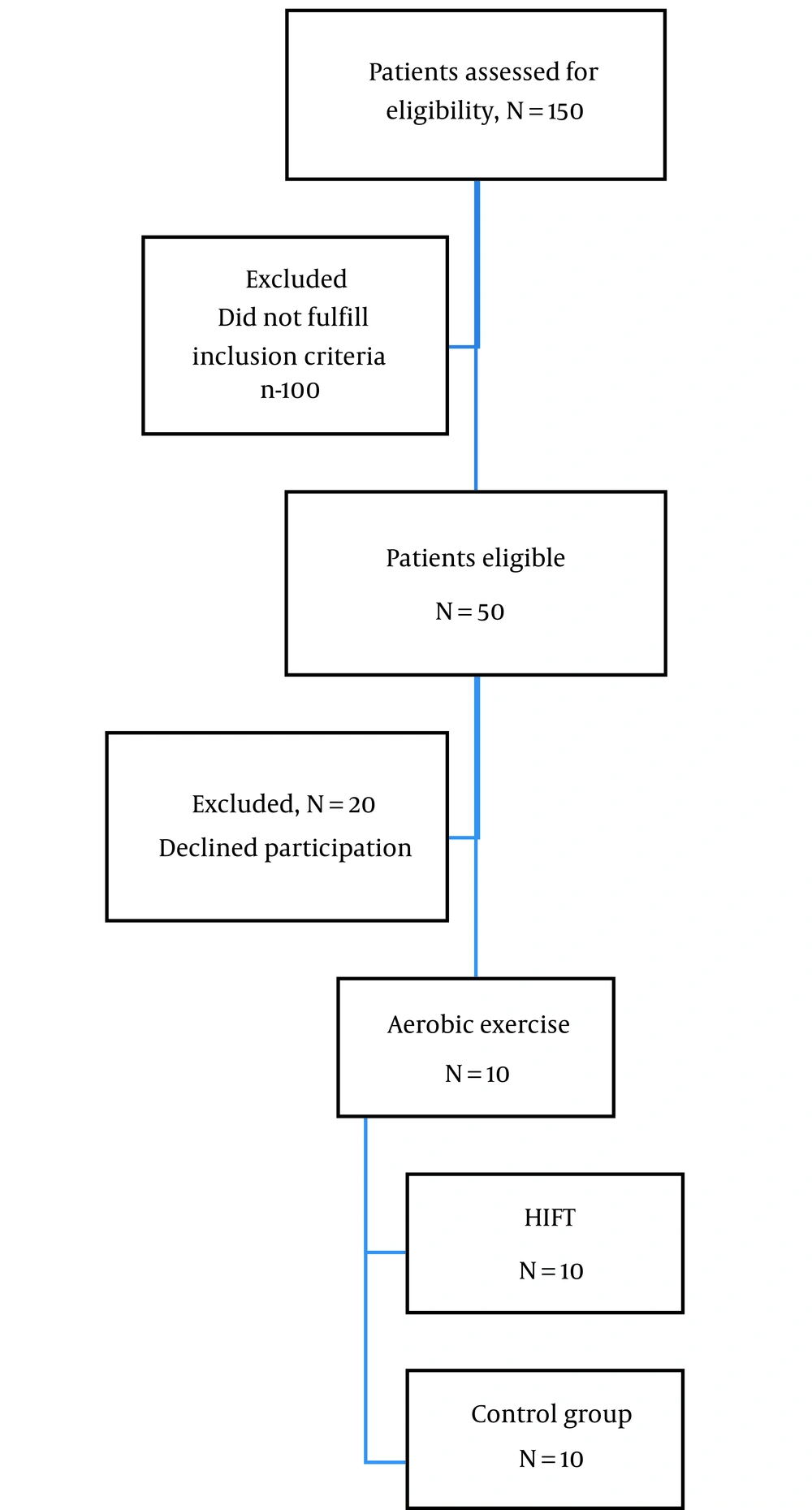
Figure 1.
Study flow chart
Then, to facilitate the test, the subjects were trained to perform the exercises in three separate sessions, and the next day, pre-test measurements were performed on them. Experimental group members, in addition to taking prescribed medications, did exercises following the principle of overload training according to their specific training protocol, for one month and a half (6 weeks), three sessions per week, and each session for a minimum of 20 minutes (first session) to a maximum of 60 minutes (final session). The control group was asked not to participate in any organized sports program during this period. In the follow-up phase of the study and after completing the exercise protocol, post-tests were retaken from all three groups (HIFT training, aerobic training, and control) to measure the difference between the groups and the effect of the interventions performed.
3.3.1. Inclusion Criteria
Criteria for selecting the subjects were as follows: the existence of accurate information about the person, consent to participate in the research project, age range between 20 to 50 years, diagnosis and confirmation of MS by a neurologist by the revised McDonald criteria 2017, ability to walk independently equivalent to at least 500 meters without walking assistance, no history of underlying diseases, for example, orthopedic problems, rheumatic diseases, or other neurological diseases, absence of heart and respiratory diseases, no history of epilepsy, no history of metabolic diseases, no mental illness, no cognitive system involvement, no severe visual system involvement, no dizziness, no musculoskeletal disorders, no participation in other sports activities in the two months before the present study, and not developing MS relapse during the three months ago.
3.3.2. Exclusion Criteria
Individuals were excluded from the study based on not doing regular exercise for any reason and the acute phase of the disease, lack of access to the correct information, absenteeism in the exercise activity protocol even for one session, illness in the acute phase, drug addiction, taking immunosuppressive drugs, pregnancy, not being able to walk for 15 minutes, and dissatisfaction with participating in research, diabetes, thyroid disorders, gout, and movement limitations, taking antispasmodics and prednisone, and those who were not able to participate in the exercise program with the above time and intensity.
3.4. Data Collection
3.4.1. Measurements
The subjects' physical characteristics measured included upper body strength via forearm test (10), lower body strength through the standing-up test for 30 seconds (10), the static balance by single-leg-stance-time (SLST) (11), and the dynamic balance via time get and go (TUG) (12). The psychological characteristics of the subjects measured included three variables of depression (13), anxiety (13), and stress by the 21 DAS questionnaire (13), fatigue via the Fatigue Intensity Scale (FSS) (14), quality of life through the SF-36 questionnaire (15), plus the degree of EDSS (16), Cognitive Impairment Scale (17), Broadbent Standard Cognitive Disability Questionnaire (17), and Endurance and Stability Questionnaire Duckworth (18).
3.4.2. Exercise Protocols
In general, two protocols, HIFT, and aerobic exercise were used for the two experimental groups in the present study. The training process in both experimental groups consisted of three warm-ups, main training, and cooling stages, respectively. Subjects performed the exercise activity protocol in the morning (9 to 10 and 10 to 11 in the morning) under a female trainer and sports physiologist's supervision. The aerobic group in each session of training performed brisk walking exercises. The selected functional exercises were performed by the HIFT group and in each session of the exercise in a circle and accordance with the principle of overload.
The protocol was performed in the first two weeks at 20 minutes with an intensity of 40 to 50% of maximum heart rate, in the second two weeks at 40 minutes with a power of 50 to 60% of maximum heart rate, and in the third two weeks, 60 minutes with an intensity of 60 to 70% maximum cardiac frequency. Exercise intensity was also monitored using a Finnish-made polar heart rate monitor during exercise protocols. The training intensity was calculated using the Karvonen formula (19).
Target Heart Rate= [(max HR−resting HR) × %Intensity] + resting HR
The subjects were advised to dress appropriately and take a cold shower before exercising and bring a cool drink (20). Other notes were avoidance of eating, smoking, alcohol or caffeine, severe physical activity on the day of the test, as well as getting enough sleep the night before the test (6 to 8 hours) (10).
This study used descriptive statistics to report the mean, tables, standard deviation, and graphs. Also, to assess the default normality of data distribution of variables in all three groups, the Shapiro-Wilk test was used. The Shapiro-Wilk test was employed as fewer research samples were than 50. Levene variance test was used to assess the homogeneity of dependent variances between different samples. It was found that the data have a normal distribution. Thus, the assumption of data normality for all variables was accepted (P > 0.05). Accordingly, parametric tests were used to assess the hypotheses. In the inferential statistics section, a one-way assessment of variance test was used to investigate and detect the differences plus percentage of changes and the effectiveness of training protocols in the three groups on each data of the research variables. Tukey's post hoc test was utilized to examine the differences between the groups and make pairwise comparisons between them. The Pearson correlation coefficient test was used to determine the linear relationship between functional and psychological measurements according to the variable type. Significant levels were set at the 0.05 level (with a 95% confidence level). Data management and analysis were performed using SPSS software version 25. To control for bias, measurements were conducted by another person.
4. Results
A total of thirty females from 150 patients with MS were included in this study voluntarily with mean and standard deviation in age range: 31.0 69 ± 5.69 years, height: 159.6 ± 36 6.36 cm, weight: 64.3 ± 8.15 kg, and BMI: 25.1 ± 2.14 kg / m2, respectively (Table 1). According to the level of disability, they were divided into three groups: HIFT (10 people), aerobic exercise (10 people), and control (10 people). Patients were pre-tested before and after the primary protocol. The average EDSS of the HIFT group before exposure was 2.35 ± 0.9 changed to 1.35 ± 0.8 after exposure. The average EDSS in the aerobic group from 2.7 ± 0.6 before exposure changed to 1.7 ± 0.9 after exposure and the average EDSS in the control group was changed from 2.85 ± 0.6 before exposure to 3.2 ± 0.7 after it. We recorded a significant meaningful change in EDSS in the HIFT and aerobic group compared to the control group (P ≤ 0.001). The mean lower body strength of the HIFT group before exposure was 13.7 ± 1.8 and changed to 23.7 ± 2.8. In the aerobic group mean of this measurement was changed from 11.1 ± 2.1 to 13.6 ± 1.9 and in the control group from 9.6 ± 2.2 to 8.2 ± 1.8. Lower body strength changes in HIFT and the aerobic group were significantly improved compared to the control group (P ≤ 0.001). we know that lower body strength weakness is one of the most important problems of MS patients and its improvement could make EDSS better. Based on the DAS-21 questionnaire mean level depression in HIFT, aerobic, and control groups were changed from 24.1 ± 1.9, 24.1 ± 1.9, and 24.4 ± 2.1 to 20.8 ± 2.5, 13.2 ± 2.2 and 27.9 ± 2.0. Significant depression improvement in HIFT and the especially aerobic group was seen compared to the control group (P ≤ 0.001). Fatigue is the most common complaint of MS patients. The mean of the MS fatigue scale in the HIFT group was decreased from 41.3 ± 3.1 to 39.8 ± 2.3 and in the aerobic group from 41.3 ± 3.0 to 34.0 ± 3.2 significantly (P ≤ 0.001). However, changes in this scale in the control group from 39.9 ± 3.8 to 40.3 ± 3.4 were incremental. One of the most important questions in our study was the effect of exercise on patients’ quality of life. The mean of patients’ HRQL in the HIFT group was 483.4 ± 2.7 increased significantly to 512.4 ± 806. These changes in the aerobic group were significantly meaningful and recovered from 483.2 ± 2.6 to 509 ± 9.4 (P ≤ 0.001).
Table 1.
Mean and Scattering Indices of Demographic and Anthropometric Characteristics of the Subjects Participating in the Present Study Separately in the Three Study Groups
| Variables | Group | Total | ||
|---|---|---|---|---|
| HIFT | Aerobic | Control | ||
| Age, y | 30.40 ± 4.90 | 31.40 ± 7.23 | 32.20 ± 4.39 | 31.0 ± 5.69 |
| Height, cm | 157.2 ± 6.01 | 158.5 ± 6.81 | 163.1 ± 5.15 | 159.6 ± 6.36 |
| Weight, kg | 60.8 ± 9.46 | 63.7 ± 7.05 | 68.4 ± 6.50 | 64.3 ± 8.15 |
| Body mass index, kg/m2 | 24.4 ± 3.14 | 25.2 ± 1.62 | 25.6 ± 1.21 | 25.1 ± 2.14 |
The results of the Shapiro-Wilk test showed that the data distribution was normal. Thus, one-way assessment of variance (ANOVA), Tukey post hoc test and Pearson correlation coefficient (Pearson correlation) were used to analyze the data. The following results were obtained by comparing the data before and after the exercises.
The present study results revealed that The HIFT group was more effective than the aerobic exercise group in the lower body strength, upper body strength, static balance, and dynamic balance, of female patients with MS (Table 2).
Table 2.
Summary of the Analysis of the Results of Training Protocols on Physical Factors and Psychological and Behavioral Indices Using the Tukey HSD Test in the Three Groups Studied Multiple Comparisons a
| Variables | Groups | Tukey HSD | |||
|---|---|---|---|---|---|
| Mean Difference | Std. Error | P-Value | |||
| Upper body strength | HIFT | Aerobics | 6.000* | 0.775 | 0.001 |
| Control | 9.200* | 0.775 | 0.001 | ||
| Aerobics | HIFT | -6.000* | 0.775 | 0.001 | |
| Control | 3.200* | 0.775 | 0.001 | ||
| Control | Aerobics | -3.200* | 0.775 | 0.001 | |
| HIFT | -9.200* | 0.775 | 0.001 | ||
| Lower body strength | HIFT | Aerobics | 7.500* | 0.602 | 0.001 |
| Control | 11.400* | 0.602 | 0.001 | ||
| Aerobics | HIFT | -7.500* | 0.602 | 0.001 | |
| Control | 3.900* | 0.602 | 0.001 | ||
| Control | Aerobics | -3.900* | 0.602 | 0.001 | |
| HIFT | -11.400* | 0.602 | 0.001 | ||
| Static balance | HIFT | Aerobics | 2.000* | 0.744 | 0.032 |
| Control | 9.400* | 0.744 | 0.001 | ||
| Aerobics | HIFT | -2.000* | 0.744 | 0.032 | |
| Control | 7.400* | 0.744 | 0.001 | ||
| Control | Aerobics | -7.400* | 0.744 | 0.001 | |
| HIFT | -9.400* | 0.744 | 0.001 | ||
| Dynamic balance | HIFT | Aerobics | -0.100 | 0.415 | 0.969 |
| Control | -4.200* | 0.415 | 0.001 | ||
| Aerobics | HIFT | 0.100 | 0.415 | 0.969 | |
| Control | -4.100* | 0.415 | 0.001 | ||
| Control | Aerobics | 4.100* | 0.415 | 0.001 | |
| HIFT | 4.200* | 0.415 | 0.001 | ||
| Depression | HIFT | Aerobics | 7.600* | 0.814 | 0.001 |
| Control | -6.800* | 0.814 | 0.001 | ||
| Aerobics | HIFT | -7.600* | 0.814 | 0.001 | |
| Control | -14.400* | 0.814 | 0.001 | ||
| Control | Aerobics | 14.400* | 0.814 | 0.001 | |
| HIFT | 6.800* | 0.814 | 0.001 | ||
| Anxiety | HIFT | Aerobics | -5.900* | 0.908 | 0.001 |
| Control | -9.200* | 0.908 | 0.001 | ||
| Aerobics | HIFT | 5.900* | 0.908 | 0.001 | |
| Control | -3.300* | 0.908 | 0.003 | ||
| Control | Aerobics | 3.300* | 0.908 | 0.003 | |
| HIFT | 9.200* | 0.908 | 0.001 | ||
| Stress | HIFT | Aerobics | 9.800* | 0.828 | 0.001 |
| Control | -3.900* | 0.828 | 0.001 | ||
| Aerobics | HIFT | -9.800* | 0.828 | 0.001 | |
| Control | -13.700* | 0.828 | 0.001 | ||
| Control | Aerobics | 13.700* | 0.828 | 0.001 | |
| HIFT | 3.900* | 0.828 | 0.001 | ||
| Fatigue | HIFT | Aerobics | 5.800* | 2.102 | 0.027 |
| Control | -2.100 | 2.102 | 0.584 | ||
| Aerobics | HIFT | -5.800* | 2.102 | 0.027 | |
| Control | -7.900* | 2.102 | 0.002 | ||
| Control | Aerobics | 7.900* | 2.102 | 0.002 | |
| HIFT | 2.100 | 2.102 | 0.584 | ||
| HRQoL | HIFT | Aerobics | 2.700 | 10.226 | 0.962 |
| Control | 34.500* | 10.226 | 0.006 | ||
| Aerobics | HIFT | -2.700 | 10.226 | 0.962 | |
| Control | 31.800* | 10.226 | 0.012 | ||
| Control | Aerobics | -31.800* | 10.226 | 0.012 | |
| HIFT | -34.500* | 10.226 | 0.006 | ||
| EDSS | HIFT | Aerobics | 0.000 | 0.251 | 1.000 |
| Control | -1.350* | 0.251 | 0.001 | ||
| Aerobics | HIFT | 0.000 | 0.251 | 1.000 | |
| Control | -1.350* | 0.251 | 0.001 | ||
| Control | Aerobics | 1.350* | 0.251 | 0.001 | |
| HIFT | 1.350* | 0.251 | 0.001 | ||
| Cognitive failure | HIFT | Aerobics | 8.900* | 3.290 | 0.030 |
| Control | -7.600 | 3.290 | 0.071 | ||
| Aerobics | HIFT | -8.900* | 3.290 | 0.030 | |
| Control | -16.500* | 3.290 | 0.001 | ||
| Control | Aerobics | 16.500* | 3.290 | 0.001 | |
| HIFT | 7.600 | 3.290 | 0.071 | ||
| Endurance & sustainability | HIFT | Aerobics | -0.200 | 0.941 | 0.975 |
| Control | 4.000* | 0.941 | 0.001 | ||
| Aerobics | HIFT | 0.200 | 0.941 | 0.975 | |
| Control | 4.200* | 0.941 | 0.001 | ||
| Control | Aerobics | -4.200* | 0.941 | 0.001 | |
| HIFT | -4.000* | 0.941 | 0.001 | ||
a * The mean difference is significant at the 0.05 level.
The Pearson correlation coefficient test results showed a meaningful relationship between lower body strength, upper body strength, anxiety, quality of life, and endurance and stability of patients. Still, there was no meaningful relationship between upper body plus lower body strength and depression, stress, fatigue, and patients' cognitive impairment (Table 2).
Static balance showed a meaningful relationship with anxiety while no meaningful relationship was found with fatigue or cognitive function (Table 2). Dynamic balance did not show any meaningful relationship either with anxiety, fatigue, and cognitive functions (Table 2).
Also, the aerobic activity group was more effective than HIFT on depression, stress, and fatigue, but HIFT showed more effect on anxiety, EDSS, and cognitive disturbances than aerobic exercises did in female patients with MS. Both HIFT and aerobic exercises showed a meaningful effect on Health-related quality of life (HRQoL) equally (Table 2).
5. Discussion
The results of the present study indicated that there was a meaningful difference between the mean scores in the intervention groups compared to the control group. Specifically, the level of upper body strength, lower body strength, static balance, and dynamic balance, in the experimental groups increased significantly after six weeks of training compared to the control group. Also, the high-intensity functional training (HIFT) group was better than the aerobic group in other functional components except for dynamic balance. On the other hand, regarding psychological factors and cognitive function, the experimental groups showed a meaningful decrease in depression scores, stress, and anxiety compared to the control group. When comparing the two experimental groups, the aerobic group showed better results in stress and depression variables than the high-intensity functional training group. In contrast, anxiety had worse results.
Treadmill aerobic exercise for four weeks on 19 MS patients significantly increased walking time by ten meters and walking power. Still, the subjects' fatigue level in the study by treadmill aerobic exercise remained unchanged (21). The insufficient number of training sessions and the type of exercise, and the lack of adequate preparation before aerobic exercise could explain the subjects' lack of response to the intervention.
In contrast, Romberg et al., in their study, examined the effect of six months of aerobic hydrotherapy and strength training on 40 MS patients with a disease grade of 1.5 - 5. After six months, the exercise group did not significantly improve balance and oxygen consumption in MS patients (7). The discrepancy in the degree of illness and the power of exercise performed by these patients is one reason for this discrepancy. This is because when the patient performs the exercises at home without the researcher's supervision, it is not possible to accurately control the intensity of the exercise, bearing in mind that determining the appropriate intensity of these exercises according to the degree of the disease can play a decisive role in their effects.
In another study on MS, 34 patients with MS were assigned to a sedentary control group (SED, 11 patients) and two exercise groups, which did 12 weeks of high-intensity exercise (HITR, 12 patients) or high-intensity interval cardiovascular exercise (HCTR, n = 11). This study showed that muscle strength improved in HCTR and HITR, while body fat percentage decreased. Also, endurance capacity and lean tissue mass increased only at HITR (22).
In another study, the effects of various rehabilitation aerobic exercise programs were examined on signaling (anti-inflammatory), functional and cognitive capacity in people with MS. They evaluated seventy-two patients with secondary progressive or relapsing-remitting MS with EDSS 0.6 - 0.3 within three weeks of rehabilitation. The participants participated in a high-intensity interval training (HIIT) course or a moderate-intensity continuous training group. Both groups exercised three times a week. The HIIT group performed high-intensity 1.5 × 5-minute training sessions at 95 to 100% of maximal heart rate (HRmax) followed by 2-minute active load-free pedaling intervals (60% HRmax). That research showed that the study of both chronic and acute effects of exercise in a sample is a robust methodological approach allowing the investigation of any interaction between long-term and short-term immune system function (14). This study is consistent with the present study in terms of the type of intervention and intensity of sports activity. Still, it differs from the present study in terms of the level and degree of disability as well as the number of subjects, training time, and lack of control group.
In the present study, we found that improving the balance of inpatients may also enhance the strength of these muscles. These mechanisms behind these changes can be traced to the effectiveness of resistance training on deep sensory receptors. The present study results are not consistent with DE Bolt & McCubbin's (2004) 's research, which reported that resistance training did not cause significant changes in increasing balance (15). This discrepancy can be associated with the intensity of sports activity, duration, and type of intervention. Those researchers examined the effect of home exercise on their patients' balance and monitored exercise by phone. While in the present study, six weeks of controlled and regular exercise were followed in the research design.
This study is consistent with other studies, which showed that exercise therapy, in addition to the physical impacts, improves the behavior of patients with MS by reducing depression and increasing self-confidence (23, 24). HIFT training was more effective in the anxiety score than in other groups, but aerobic exercise improved and reduced depression and stress scores. The current study results showed a meaningful difference between the mean scores of the HIFT group and aerobic exercise on all three psychological indicators, namely depression, anxiety, and stress in female patients with MS. Perhaps HIFT enhances strength and balance in MS patients by strengthening the systems involved in balance. HIFT can boost the patient's ability to perform his daily activities better and more independently, reduce physical disability, relieve depression, anxiety, and stress, and improve mental health in MS patients. Secondary symptoms are common in MS. Fatigue, cognitive disorders, depression, and anxiety reduce the quality of life of these patients (25). On the other hand, existing drugs have not been able to have a significant effect on improving these symptoms, while they will impose new complications on the patient. Therefore, if exercise can have this significant effect, these symptoms will be managed and treated without complications. And this will be a significant improvement in the management of secondary symptoms of MS.
The limitation of our study is the small sample size in the studied groups, which, although it has caused statistically significant results, it seems that future studies with a higher sample size will provide more reliable results.
5.1. Conclusions
This study suggests that aerobic exercise and HIFT in female patients with MS can further improve and increase their physical plus psychological function. However, in comparing the two interventions, high-intensity functional exercises had better results in the physical components, while aerobic exercises showed better effects in the psychological and behavioral components.