
1. Background
Marriage is considered one of the most important aspects of human life and plays a major role in determining individual direction (1). In almost all societies, marriage is recognized as a fundamental institution and has significant personal, interpersonal, and well-being-related outcomes for individuals and families (2). Each culture has a specific definition of married life, and its ethical and moral principles form the basis of life. Depending on culture, couples may need different skills to prioritize their own satisfaction and prevent marital tensions (3). For example, in almost all parts of Asia, marriage occurs at older ages, and in some regions, this delay in marriage has reached significant levels. Still, the patterns have recently become more complex, and the tendency towards delayed marriage is no longer compatible with the situation in other countries (4, 5). The romantic love experienced at the beginning of acquaintance and marriage may soon be challenged by responsibilities and commitments within marriage. Daily life and the conflict between meeting work and family needs can easily create stress and conflict between spouses. This situation worsens when newly married couples take on new responsibilities, such as caring for a newborn in the family (6, 7). The lack of quality time between the husband and wife can also affect romantic marital relationships. This problem can also involve the couples' inability to pursue joint quality activities. Therefore, the romantic love experienced by the couples ultimately diminishes and gradually moves towards logical love revolving around commitment and maintaining the foundation of the family (8).
During the process of family strengthening, individuals examine and evaluate their spouse's physical appearance, faith, trust, education level, income, socioeconomic status, cultural status, occupation, etc. (9). Prioritizing these characteristics based on individual differences and expectations is referred to as the criterion for the foundation of a family (10). In Iran, attention to the spouse's needs and preferences and providing them for the preservation and stability of the family and social development is of great importance. Thanks to educational and occupational methods and acquiring skills in their modern lifestyle, individuals increasingly contribute to the sustainability of marital relationships and the foundation of the family (11). Islam also emphasizes the importance of careful spouse selection and meeting the needs of the spouse as an important subject in family strengthening (12).
A combination of shared culture and personal experiences form any person's value preferences (13). Therefore, if the process of marriage and family strengthening is based on individual values and is accompanied by awareness, it will bring more desirable outcomes for the individual and society (13). The culture and social status prevailing in society can also influence the criteria for preserving the family and the role of marriage between women and men. Factors such as education, social relationships, economic compatibility, and cultural and traditional values stem from the prevailing social values in society. Nevertheless, the prevalence and expansion of these modern criteria for marriage and partner selection without sufficient knowledge among Iranian youth has led to inconsistencies and instability in Iranian families (14). This means that young people, by changing their attitude towards choosing a spouse and prioritizing love, interest, and initial acquaintance, no longer consider criteria such as parental acceptance to be very important. As a result, the criteria for spouse selection have changed, and personal values have taken priority, although young people are still economically, culturally, and morally dependent on their families. These conflicts and duality have led to confusion among young people (15).
2. Objectives
In recent years, developments in society have increased family breakdowns and diminished familial relationships. Still, few studies have been conducted on the components of family strengthening based on the views of marriage experts and counselors in Iran, and there is still a theoretical gap in understanding the educational skills that can improve the quality of life, marital relationships, and the stability of marriage. Therefore, designing a conceptual model and identifying effective educational components for couples is one of the most important needs of Iranian society to strengthen families. This study aimed to develop and validate educational strategies for couples to enhance family bonds through qualitative expert analysis.
3. Methods
3.1. Research Design and Participants
The present study was a qualitative exploratory-descriptive research aiming to expand and enhance the understanding of marriage and spouse selection in the context of Iranian-Islamic culture. In qualitative research, findings are often obtained through innovative methods, open-ended questions, content analysis, and final conclusions (16). Therefore, in this study, data were analyzed after coding with the grounded theory method. This theory uses a phenomenological approach to examine the empirical data and findings obtained through semistructured interviews. Moreover, the researcher can extract commonalities among propositions, concepts, and problems from a vast amount of information and engage in theoretical analysis in a specific domain. Strauss and Corbin's systematic method was used in this study to carry out the theory analysis. The three main processes of grounded theory analysis (open coding, axial coding, and selective coding) were employed simultaneously and consciously to continuously collect the primary data. This approach allowed the researcher to increase the suitability of the relevant concepts (17).
The statistical population included all experts, consultants, and university professors involved in marriage and family counseling in Yazd Province, Iran, in 2022. Considering the grounded theory selection, it is usually sufficient to interview 30 to 50 people (18). Therefore, 32 participants were selected using the theoretical sampling method, which was based on the theoretical characteristics and structures related to their activities. Theoretical sampling is a type of purposive sampling in which the researcher seeks to explore the phenomenon of interest by utilizing the opinions and knowledge of the most informed individuals (19). The demographic characteristics of the participants are presented in Table 1.
Table 1.
Demographic Characteristics of the Participants (N = 32)
| Variables and Classification | No. (%) |
|---|---|
| Sex | |
| Male | 15 (46.9) |
| Female | 17 (53.1) |
| Age, y | |
| 35 - 40 | 5 (15.7) |
| 41 - 45 | 6 (18.7) |
| 46 - 50 | 6 (18.7) |
| 51 - 55 | 9 (28.2) |
| 56 and above | 6 (18.7) |
| Education | |
| MA | 15 (46.9) |
| PhD | 17 (53.1) |
| Work experience, y | |
| 1 - 5 | 4 (12.5) |
| 6 - 10 | 6 (18.7) |
| 11 - 15 | 9 (28.2) |
| 16 - 20 | 5 (15.6) |
| 21 and above | 8 (25) |
| Occupation | |
| Family counselor | 17 (53.2) |
| Faculty member | 13 (40.6) |
| Other | 2 (6.2) |
3.2 Data Execution and Analysis Method
The data collection tool was deep interviews with experts in marriage and family. The researchers first reviewed the literature to familiarize themselves with the theoretical foundations of marriage and relevant theories of proper spouse selection. Then, they proceeded to develop and design the educational model of spouse selection, formulate questions, and conduct semistructured interviews with the stakeholders and experts. The average interview with each person lasted 30 to 50 minutes, and the researcher recorded and transcribed the topics discussed. All the information and recorded interviews were transcribed on paper, extracted, classified, and examined. Finally, the interview data were coded, analyzed, and compared continuously with the previous interviews to reach the saturation point (where no new points were raised).
3.3. Validity and Reliability of Data
Validity was first examined through the member check method to assess the trustworthiness of the study. For this purpose, the research findings were presented to 4 participants to study, review, and revise the theoretical framework. In some cases, the text and analysis were modified, and the final theory was revised. Finally, a general model agreement and confirmation were achieved. Next, the within-subject agreement method (two coders) was used for the assessment of reliability. All coding pages were given to a doctoral psychology student who was asked to label the codes that were similar to the two raters as “agreement" and codes that were dissimilar as “disagreement." Finally, Cohen's Kappa coefficient of 0.73 was obtained, showing the level of coding agreement between the two raters, indicating desirable coding consistency.
3.4. Ethical Considerations
In conducting the study, the researchers made every effort to address ethical issues related to the study, such as interviewing experts on marriage, obtaining informed consent from them, and ensuring the preservation of their dignity and self-esteem during the interview. Explanations about the subject of the research, objectives, importance, and method of conducting the research were provided, and permission was obtained for recording and asking questions without bias. The free expression of opinions by the participants was also taken into account. This study was registered at the Ethics Committee of the Islamic Azad University of Yazd (IR.IAU.YAZD.REC.1401.073).
4. Results
The main sources of data were obtained through document analysis and interviews. This means that exploratory and descriptive interviews were conducted, and after the interviews, the data was coded. Additionally, by continuously comparing the data, theoretical codes were provided through open coding. Coding was performed for 32 participants and high-level documents. The results obtained from the statements and opinions of the participants showed that 124 propositions were extracted from their experiences and views on the items that should be included in the premarital education model. Due to paper length limitations, only the open coding process, category-based classification, and model are presented and interpreted in Table 2.
4.1. Coding and Categorizing the Concepts
In Table 2, small parts of the open coding results are presented based on the extraction of the initial 124 propositions. The concepts and categories are presented in the classification.
Table 2.
Propositions, Concepts, and Principles Related to the Couples' Educational Package
| No. | Propositions | Concepts | Categories |
|---|---|---|---|
| 16 | Attention to self-awareness and increasing personal information; Increasing the spouse's awareness; Personality compatibility between couples with awareness | Increasing self-awareness of oneself and one's spouse | Self-awareness |
| Awareness of positive aspects of oneself and the spouse; Reducing the negative aspects of oneself; Identifying positive dimensions and characteristics of oneself | Awareness of positive characteristics | ||
| 18 | Teaching how to overcome emotions in making the right choice; Avoiding emotional and sentimental decision-making; Refraining from anger, aggression, and getting nervous; Avoiding simplistic and naive beliefs about issues | Emotional regulation | Emotional management |
| Having an emotional system and love for the spouse and children; Paying attention to emotional needs and expressing affection; Praising and acknowledging the spouse and prioritizing him/her over others; Having verbal, nonverbal, and supportive relationships with the spouse | Emotional maturity | ||
| 14 | Using the maximum mental capacity to solve marital problems ; Ability to think and understand problems and differences between spouses; Ability to think and reason to solve problems | Problem-solving skills | Rational management |
| Managing interference from others in marital affairs; Paying attention to the level of involvement and advice from families; Family interventions in life management | Managing interference from others | ||
| Avoiding exaggeration and fantasizing about an ideal life; Examining ideal and irrational expectations of the spouse; Paying attention to the congruence of expectations and performance of the spouse's family; Avoid having expectations beyond those of the spouse or his/her family | Managing expectations and ideals | ||
| 21 | Having red lines and criteria for drug and alcohol use; Observing standards and red lines in extramarital relationships; Raising awareness and observing the red lines of both parties; | Having clear ethical and sexual boundaries | Prevention of harms |
| Paying attention to individual harms; Familiarity with possible harms in marital life; Managing to prevent social harm for the spouse and children; Paying attention to postmarital harms | Managing and preventing potential harms | ||
| 19 | Having suitable cultural conditions for life; Awareness of ethnic and cultural stereotypes; Familiarity with national customs and traditions | Examining the customs and traditions ofThe cultural background | Cultural literacy |
| Familiarity with cultural differences and family background; Raising awareness of personality change boundaries in accepting differences; Paying attention to family flexibility in accepting new members; Paying attention to family beliefs and values | Examining family origin and culture | ||
| Paying attention to religious and ideological compatibility after marriage; Alignment with a family that is in line with one's own beliefs; Paying attention to cultural, economic, and social class levels | Paying attention to religious and social compatibility | ||
| 20 | Learning flexibility skills to accept differences; Learning how to manage anger and deal with hurtful emotions ; Compassion and kindness towards oneself and others; Acquiring a receptive mindset and commitment to achieving targeted goals | Paying attention to psychological health | Mental health |
| 16 | Turning to prayer and reliance on a higher power for a sacred goal in life; Performing religious and spiritual rituals and practices to strengthen the soul; Participating in religious ceremonies and maintaining family ties | Paying attention to spiritual health | Spirituality |
4.2. Forming the Main Components
After determining the extracted concepts, as reported in Table 2, it was time for axial coding. In this stage of coding, patterns are created by establishing relationships between concepts and relating them to one another. This process enhances the accuracy and precision of the characteristics of a concept and is referred to as micro-level coding. Although open coding and axial coding are different, when researchers are engaged in qualitative data analysis, they usually combine and integrate the pieces of data one by one. Therefore, in grounded theory, the main components are expressions of causal conditions, phenomena, context, interveners, strategies, and outcomes, which are derived from a series of relationships with a concept (17).
It is essential that the components are systematically related to each other to transform analyses into theories. For this activity, selective coding using the results of the previous two stages of coding (open and axial) leads to theory development. In this sense, the axial component is systematically related to other components, and while expressing the relationships in a specific framework, it improves, develops, and modifies the necessary categories. In fact, at this stage, researchers present a narrative paradigmatic framework based on their level of understanding and perception of the concepts and illustrate their final theory graphically (20) (Table 3).
Table 3.
Formation of the Main Components of the Theory
| Main Components | Subcomponents |
|---|---|
| Couples' insight and awareness | Self-awareness |
| Communication and cultural literacy | Cultural issues |
| Mental and emotional health | Mental health |
| Spirituality | |
| Rational-emotional management | Cognitive management |
| Emotional management | |
| Prevention of harms |
Evidently, through the integration and connection of categories, axial coding highlighted 4 main components (couples' insight and awareness, communication and cultural literacy, mental and emotional health, and rational-emotional strategies). Selective coding is illustrated graphically with the design of a paradigmatic framework (Figure 1).
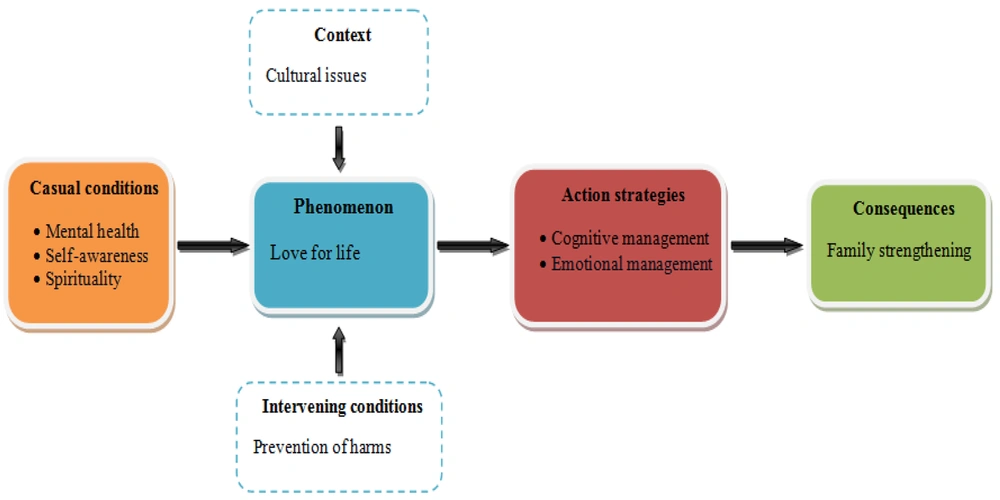
Figure 1.
Paradigmatic Model of Family Strengthening Components for Couples
5. Discussion
This study designed and validated a postmarriage educational model for strengthening families. Initially, the findings were validated for validity and reliability. Subsequently, out of 128 extracted statements, the coding results yielded 14 concepts in 7 categories, including self-awareness, cultural issues, mental health, spirituality, cognitive management, emotional management, and prevention of harm. These foundational values of couples can be categorized into 4 general components of family strengthening, including the couples' insight and awareness, communication and cultural literacy, mental and emotional health, and rational-emotional strategies. Each component, except for self-awareness communication and cultural literacy, has several dimensions. The mental and emotional health component has 2 dimensions (mental and spiritual health), and the rational-emotional management components include 3 categories (cognitive, emotional, and harm prevention management). Finally, by consolidating the data, the central category titled “love for life" can explain the 4 main components of family strengthening and education for couples.
These results are consistent with those of previous studies. For example, Iranizadeh et al. (21) selected 19 family counselors and specialists in Yazd, Iran, using purposive sampling and interviewed them. The interviews were semi-structured and based on Lazarus' theory and included details such as behavior, feeling, cognition, sensation, relationship, mental imagery, and physical sensitivity. The interviews continued until data saturation was reached. After typing and coding the interviews, the opinions of research experts were collected to determine the content validity of the extracted codes based on the results obtained from the native language model. Data analysis ultimately led to 14 subthemes and 7 themes. The subthemes included commitment to family, intimacy, effective communication, importance of counseling, forgiveness, introversion/extroversion, scheduling, sensory improvement, family visits, family ceremonies, self-confidence, media influence, diversity in nutrition, exercise, and recreation. Given that the family is the best emotional, social, and spiritual foundation for its members, this study provides a model for educating individuals with various problems on family strengthening. Additionally, this model can be adopted by family counselors and members.
According to Bahrami and Namazi (22), effective factors in strengthening the family foundation and happiness include:
• Marriage: This factor is recognized as one of the most important factors in strengthening the family foundation. It is important to ensure that the prerequisites for marriage are properly met.
• Good family relations: This important factor can be determined in legal and ethical domains.
• Attention to the position of the family by its members: The first step in regulating family relationships is paying attention to the position of the family and its members.
• Preserving the dignity and personality of individuals: Respecting the dignity and personality of each person in the family can be effective in strengthening the family foundation.
They also referred to other factors in strengthening the family foundation, including good family relations, attention to the position of the family by its members, preserving the dignity and personality of individuals, patience, forgiveness, honesty in the family environment, staying away from extravagance, and observing contentment (22).
According to Hasanzadeh (23), effective factors in strengthening the family foundation include marriage and ensuring that the prerequisites for marriage are properly met, good family relations determined in legal and ethical domains, attention to the position of the family by its members (which is the first step in regulating family relationships), and preserving the dignity and personality of individuals (based on respect, reflected in interactions with others). By observing these factors, especially by those who share a bond of friendship and intimacy, stronger relationships and more warmth can be achieved. The family is the most prominent example of this. Other factors that help strengthen the family foundation include patience and forbearance, forgiveness and mercy, honesty in the family environment, confidentiality and loyalty, peace and humility, patience and endurance, fear of Divine punishment, staying away from extravagance, and observing contentment. These factors strengthen family relationships, create intimacy and trust among family members, and improve the quality of family life. Therefore, paying attention to these factors can help strengthen the family foundation and its happiness. Salehi Mobarakeh et al. (24) showed that using a family counseling training package can increase awareness, strengthen the stability of marriage, and help make the right choices to reduce the tendency towards divorce.
5.1. Conclusions
Exploring the educational components for couples based on the context and culture of Iranian-Islamic society is an important challenge for marriage counselors and couple therapists. Therefore, this study developed and validated effective educational components for couples to strengthen Iranian families. The data obtained through semistructured interviews showed that 7 components (self-awareness, cultural literacy, cognitive management, emotional management, mental health, spirituality, and prevention of harm) play key roles in selecting the main components of the research, which include couples' insight and awareness, communication and cultural literacy, mental and emotional health, rational-emotional strategies, and family strengthening. These dimensions and components can be a guideline for premarital counselors and couple therapists to evaluate young people who are about to marry.