



1. Background
Marital relations constitute a major part of human life and strongly determine life satisfaction. Acquiring accurate information about the skills of marital relationship improvement, reinforcing a sense of responsibility toward one’s sex life, and gaining further awareness about healthy sexual relations help couples form energetic marital relations (1). The quality of marital relations is expressed through concepts such as adjustment, satisfaction, happiness, and evaluation. Marital adjustment refers to couples’ satisfaction with and happiness in their marriage (2).
The marked rise in marital conflicts in the modern world and the risk and consequences of divorce for the mental health of couples and children have led counselors and family therapists to examine various theories to improve major family functions (3). To this end, family therapists have proposed different views and theories to enhance family functions, attempting to identify and improve the dysfunctional patterns that cause conflicts in family relations by analyzing communication and interaction patterns in families (4). Evidence suggests that dissatisfaction with marital relations and an emotional breach between couples increase the risk of divorce (5, 6).
Intimacy is a major variable in marital relations. As intimacy is more fundamental than other human needs, promoting intimacy between couples is the first step toward an optimal marriage. Intimacy is the core of romantic relations, and researchers have conceptualized this construct (7). For instance, Kardan-Souraki et al. (8) consider intimacy to consist of nine dimensions, including emotional, social/recreational, sexual, intellectual, psychological, physical, spiritual, aesthetic, and temporal dimensions. Intimacy problems are an important reason for seeking marital counseling, and promoting intimacy is often a goal of couples therapy and marital counseling. Intimacy is a deep, potent human need with an intrinsic origin, which is rooted in the need for attachment and is based on mutual respect and trust (9). According to the literature, marital intimacy is a major contributing factor to stable marriages, and a lack of intimacy in marital relations leads to failed marriages (10, 11).
Marital harmony is another determinant and influential factor in the success of marital relations, which has been investigated in the present study. Marital harmony pertains to couples’ orientation toward daily changes and encompasses the regulation of couples’ lifestyle to manage life challenges (12). Harmony refers to a situation in which couples can exchange ideas and resolve the causes of their dissatisfaction. Maintaining harmony in marriage is essential to having a healthy family (13). Marital harmony is affected by factors such as couples’ expectations of each other, parenting styles, financial issues, friends and acquaintances, sexual relations, and relationships with relatives and family members. It is an extremely important, yet highly challenging topic in the domain of family counseling (14).
To date, researchers have adopted several approaches to improve marital intimacy. Such an example is the emotionally-focused approach, which is mainly focused on the nature of emotion as a key and potent factor of change in couples therapy (15). Emotionally-focused couples therapy is influenced by systemic therapies as it is based upon the fact that marital problems and conflicts arise from the interaction patterns/cycles between family members/couples. This therapy is a valid experimental approach to couples therapy and relies on the theory of attachment and understanding couples’ needs. The therapeutic goals of this method include fostering a safe and powerful bond between couples.
Emotionally-focused therapy highlights the integration of emotion, cognition, motivation, and behavior, which are activated by the therapist to modify emotions (16). In this method, the identification and improvement of emotion schemes are of utmost importance. Change requires a gradual process of emotional activation, which is mainly achieved by using specific techniques to overcome avoidance, reduce disruptive behaviors, and facilitate emotional improvement. Therapists help patients identify and express their primary feelings and access their intrinsic capabilities (17). This model distinguishes between primary and secondary emotions and also divides these states into structured, adaptive, maladaptive, complex, and social emotions.
Previous studies have confirmed the effectiveness of emotionally-focused couples therapy in the marital and family context and the mitigation of relationship distress. According to Wiebe et al. (18), this therapy helps couples foster safe attachment bonds and promote intimacy. In another study, Tie and Poulsen (19) reported that emotionally-focused therapy was effective in improving couples’ relationship, reducing marital conflicts, and increasing marital harmony. Furthermore, Zanganeh Motlag et al. (20) stated that acceptance and commitment therapy and emotionally-focused couples therapy could both effectively enhance marital intimacy, commitment, and psychological flexibility. Therefore, exploring the effects of emotion-based couple therapy on improving marital intimacy and harmony were the key purposes of our study.
2. Objectives
The present study aimed to investigate the effects of emotionally-focused couples therapy on the marital intimacy and harmony of maladjusted couples.
3. Methods
This quasi-experimental study was conducted with a pretest-posttest design and a control group. The sample population included the maladjusted couples vising the counseling centers in Behbahan, Iran in 2020. Based on structured clinical interviews and the inclusion and exclusion criteria, 30 couples who were willing to participate in the research were selected via convenience sampling and randomly divided into two groups of experimental and control.
The inclusion criteria of the study were as follows: (1) a below-average score on the personal assessment of intimacy in relationships (PAIR) inventory and the Marital Harmony Questionnaire (MHQ); (2) minimum education level of high school diploma; (3) marriage duration of more than one year; (4) age of 20 - 45 years; (5) written informed consent to participate; (6) at least one spouse being dissatisfied with their spouse/marital relations; (7) lack of distressing events (eg, divorce, death of a relative/close friend) within the past three months, and (8) not using other therapies simultaneously. The exclusion criteria were as follows: (1) use of psychiatric medications; (2) having extra-marital relations at during the study; (3) unwillingness to complete the questionnaires, and (4) absence in two therapy sessions.
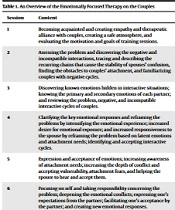
Emotionally-focused couples therapy was implemented in nine 90-minute sessions twice a week, and the control group received no intervention. The protocol of the therapy sessions was adapted from Johnson’s couples therapy model (21). The therapeutic sessions were conducted at Behbahan Counseling and Psychological Service Centers by a researcher who had been previously trained in specialized courses. Table 1 shows the contents and structure of the therapy sessions.
The participants were ensured of adherence to ethical principles, including the confidentiality of their identity and data analysis. After obtaining written informed consent from the participants, the pretest was administered, and the posttest was implemented after the intervention. After explaining the research objectives and procedures, the couples completed the questionnaires before and after the intervention. The study protocol was approved by the Ethics Committee of Islamic Azad University of Ahvaz Branch, Iran.
Table 1.A Brief Overview of the Content and Structure of the Emotionally-focused Couples Therapy Sessions (21)
| Sessions | Content of Sessions |
|---|---|
| 1 | Getting to know one another, establishing therapeutic alliance between the therapist and couples, creating a safe space for discussing marital problems, examining the motivation for treatment, therapeutic goals, and the implementation of the therapy |
| 2 | Discovering problematic interactions, evaluating the problems, tracking and describing repeating cycles that lead to persistent marital distress, finding obstacles to attachment, familiarizing the couples with negative interaction cycle |
| 3 | Clarifying key experiences related to attachment, accepting fundamental unaffirmed feelings through validation, self-talk, and reflection of secondary emotions, moving on from secondary emotions to access fundamental primary emotions |
| 4 | Clarifying key emotional responses: re-framing the problem by attending to the negative interaction cycle, increasing responsiveness to the spouse (re-shaping the problem based on hidden feelings and attachment needs, and the couple’s identifying and accepting the interaction cycles) |
| 5 | Expressing emotions, promoting the identification of attachment needs, accepting the emotions, increasing involvement with the emotional experience, and integrating these elements with communication interactions: helping couples enhance their awareness, involvement with each other, owning the vulnerabilities, injuries, and fear of attachment, and helping the other spouse listen to and accept them |
| 6 | Increasing the emotional involvement, promoting interaction methods, focusing on the self not the other person, re-defining attachment, creating and enhancing acceptance of the emerging experience of each spouse by the other spouse, expressing new emotional responses, expressing one’s expectation of the spouse by retelling the emotional experience to his/her, and facilitating one’s acceptance by the spouse |
| 7 | Reconstructing interactions to make each spouse more responsive: facilitating the expression of needs and desires in a new way, thereby creating new perceptions of each other and creating a safe bond, creating adjustment-oriented events, and beginning a new interaction cycle in the marital relationship |
| 8 | Reconstructing interactions, discovering new solutions to old problems, re-defining the relationship by each spouse, and creating a safe space in the marital relationship |
| 9 | Stabilizing and reinforcing new positions and interaction cycles, intimate involvement of the couple with each other, and accepting new interaction statuses; increasing accessibility, responsiveness, and emotional involvement of the couples. Creating secure attachment, stabilizing and integrating new interactional situations, ending the therapy. |
3.1. Research Instruments
3.1.1. Personal Assessment of Intimacy in Relationships Inventory
The Personal Assessment of Intimacy in Relationships (PAIR) inventory has been developed by Schaefer and Olson (22) to measure intimacy in emotional, social, sexual, intellectual, recreational, and conventional dimensions. In this study, 30 items of the questionnaire were used regarding the emotional, social, sexual, intellectual, and recreational intimacy subscales. By using this inventory, the respondents could explain their relationship intimacy based on their current experiences in their relationship (perceived intimacy) and their expectation of the relationship (expected intimacy). In this 36-item self-report tool, the items are scored based on a five-point Likert scale (Never = 1, Always = 5). The minimum and maximum scores of the entire PAIR inventory are 36 and 180 and six and 30 in each subscale, respectively; the higher scores indicate more intimacy. The reliability of the tool was estimated to be 0.71 (23), and the Cronbach's alpha coefficient was determined to be 0.78 for the entire questionnaire in the present study.
3.1.2. Marital Harmony Questionnaire
The Marital Harmony Questionnaire (MHQ) has been developed by Xu and Lai (24) with two indices of marital togetherness and satisfaction. The marital togetherness index has five items, which are scored based on a five-point Likert scale. The first two items are scored from one (strongly disagree) to five (strongly agree), and the other three items are scored from one (never) to seven (always). The higher scores of this index indicate a higher level of marital togetherness.
The marital satisfaction index in the MHQ consists of two items; the first item is scored from one (strongly disagree) to five (strongly agree), and the second item is scored from one (very dissatisfied) to six (very satisfied); the higher scores of this index indicate higher marital harmony. The reliability of the MHQ was estimated at 0.83 (25), and the Cronbach's alpha coefficient was determined to be 0.89 for the entire questionnaire in the present study.
3.2. Statistical Analysis
Data analysis was performed in SPSS version 25.0 using descriptive and inferential statistics, such as mean, standard deviation, and multivariate analysis of covariance.
4. Results
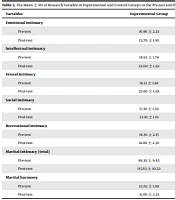
Based on the demographic data, the mean age of the participants was 35.05 ± 3.29 years in the experimental group and 36.47 ± 2.74 years in the control group. The mean duration of marriage was 23.15 ± 8.1 years in the experimental group and 8.68 ± 1.08 years in the control group. Table 2 shows the mean dependent variables of the study groups at the pretest and posttest.
Table 2.The Mean ± SD of Research Variable in Experimental and Control Groups in the Pre-test and Post-test
| Variables | Experimental Group | Control Group | P-Value |
|---|---|---|---|
| Emotional intimacy | |||
| Pre-test | 16.96 ± 2.23 | 17.50 ± 2.26 | 0.468 |
| Post-test | 23.70 ± 1.95 | 18.06 ± 2.23 | 0.001 |
| Intellectual intimacy | |||
| Pre-test | 18.93 ± 1.79 | 19.80 ± 2.15 | 0.630 |
| Post-test | 23.00 ± 1.92 | 20.50 ± 2.30 | 0.001 |
| Sexual intimacy | |||
| Pre-test | 19.13 ± 1.88 | 19.63 ± 1.72 | 0.889 |
| Post-test | 23.66 ± 1.98 | 20.10 ± 1.98 | 0.001 |
| Social intimacy | |||
| Pre-test | 17.36 ± 1.39 | 18.73 ± 2.37 | 0.824 |
| Post-test | 22.16 ± 1.61 | 19.26 ± 2.59 | 0.001 |
| Recreational intimacy | |||
| Pre-test | 18.36 ± 2.15 | 19.30 ± 1.88 | 0.368 |
| Post-test | 21.86 ± 2.38 | 19.96 ± 2.27 | 0.001 |
| Marital intimacy (total) | |||
| Pre-test | 89.36 ± 9.65 | 93.21 ± 8.89 | 0.480 |
| Post-test | 115.63 ± 10.22 | 91.39 ± 9.04 | 0.001 |
| Marital harmony | |||
| Pre-test | 22.63 ± 1.89 | 22.50 ± 2.04 | 0.832 |
| Post-test | 31.66 ± 2.21 | 22.93 ± 2.19 | 0.001 |
The Kolmogorov-Smirnov test was used to assess the normal distribution of the scores in the experimental and control groups, and the obtained results indicated that the significance level of the variables was > 0.05 at the pretest; therefore, this assumption was confirmed. Levene’s test was also applied to evaluate the homogeneity of the variances of the dependent variables in the study groups. The F statistic was estimated at 0.03, 0.46, 0.36, 1.07, 0.98, and 0.03 for the six variables, respectively (P > 0.05). Therefore, the assumptions of the homogeneity of the variances were confirmed.
In investigating the assumptions of covariance matrix homogeneity, the F value of Box’s M test was estimated at 22.54 (P > 0.05); therefore, the assumption was confirmed. In addition, the assumption of the lack of collinearity between the dependent variables was evaluated, and the value of the variance inflation factor (VIF) for the dependent variables confirmed the assumption (VIF < 10). The assumption of the linearity of the correlation between the dependent variable and the covariate (pretest) was also examined, and the correlation-coefficient confirmed the assumption (P < 0.05). To compare the two groups based on the posttest scores and after controlling the effect of the pretest, MANCOVA was initially performed on the data, and the research hypotheses were tested to determine the effects of the therapy on marital intimacy and harmony. The MANCOVA results indicated that the study groups significantly differed in terms of at least one dependent variable.
The F ratio of ANCOVA for the dependent variables was considered significant (P < 0.05). Therefore, a significant difference was observed between the study groups in terms of the dependent variables. In other words, emotionally-focused couples therapy affected marital intimacy and harmony, and all the six dependent variables increased at the posttest compared to the pretest (Table 3).
Table 3.Results of One-way Analysis of Covariance on Research Variables in Experimental and Control Groups
| Variables | SS | df | MS | F | P-Value | η2 |
|---|---|---|---|---|---|---|
| Emotional intimacy | 229.16 | 1 | 229.16 | 113.28 | < 0.001 | 0.83 |
| Intellectual intimacy | 52.14 | 1 | 52.14 | 30.27 | < 0.001 | 0.57 |
| Sexual intimacy | 87.02 | 1 | 87.02 | 54.31 | < 0.001 | 0.71 |
| Social intimacy | 98.33 | 1 | 98.33 | 129.79 | < 0.001 | 0.85 |
| Recreational intimacy | 43.75 | 1 | 43.75 | 43.83 | < 0.001 | 0.86 |
| Marital harmony | 723.23 | 1 | 723.23 | 176.73 | < 0.001 | 0.88 |
5. Discussion and Conclusion
The present study aimed to investigate the effects of emotionally-focused couples therapy on the marital intimacy and harmony of maladjusted couples in Behbahan city. According to the obtained results, emotionally-focused couples therapy affected various dimensions of marital intimacy in the maladjusted couples. Emotionally-focused couples therapy is an evidence-based approach with reportedly successful outcomes (18).
Emotional intimacy refers to couples’ need for communicating and sharing their feelings (both positive and negative) with their spouse. In this therapeutic approach, therapists focus on raising awareness about the mental content denied/distorted by the client and creating a new meaning affected by the client’s physical experience. Approaching unpleasant mental and emotional experiences is often difficult and overwhelming for clients. In such cases, the therapists’ mission is to train the client on emotion regulation skills and establish an efficient relationship. The developers of this approach believe that, more than being a specific educational program or protocol, emotion regulation is a process. Intellectual intimacy is a dimension of intimacy through which couples share their beliefs and thoughts (9). To achieve real intimacy, couples should respect each other's views, especially different or opposite views. According to our findings, emotionally-focused couples therapy could improve the intellectual intimacy of the maladjusted couples.
Sexual intimacy is another dimension of marital intimacy, which is a general perception of being part of sex-related excitement and activities. Creating a safe participatory unity, expanding and accessing emotional responses directing couples’ interactions, and reconstructing these interactions for accessibility and responsiveness are the three main tasks of emotionally-focused couples therapy (7). This approach aims to understand how couples could stop reacting from an emotional state to the events of the relationship that lead to negative interaction patterns. These negative patterns are formed by expressing secondary emotions (usually anger). Injured emotional bonding could be improved by changing the negative interaction cycle that dominates the marital relationship, and its solution lies in expressing fundamental primary emotions about attachment and identity (17). As such, the primary therapeutic goal would be to create a new pattern in the relationship. In the present study, emotionally-focused couples therapy could promote the sexual intimacy of the maladjusted couples.
Social intimacy is another dimension of intimacy, which is the perception of having mutual friends and similar social networks. Social intimacy encompasses activities and interactions with close friends or participation in social activities together. Recreational intimacy is also a dimension of intimacy, which plays a pivotal role in the sustenance of marital life. Social and recreational intimacy reflect the need to have pleasurable and recreational activities and experiences with one’s spouse. Such examples of social and recreational intimacy with the spouse are telling jokes/funny stories, participation in daily experiences, discussing the current events, eating in and out together, exercising, walking, playing, having shared entertainment, dancing, and spending the holidays together (15). Social and recreational intimacy may also include activities and interactions with mutual friends and other family members. According to studies regarding the effects of couples therapy, emotion-oriented couples therapy that highlights access to attachment needs and emotions exerts the greatest effect on the treatment of marital distress (15, 26). Therefore, this therapeutic approach significantly affects the social and recreational intimacy of the maladjusted couples in the current research.
Our findings indicated the effectiveness of emotionally-focused couples therapy in the improvement of marital harmony among the maladjusted couples. Marital harmony refers to the quality of marriage, marital satisfaction, and marital adjustment, and encompasses positive aspects or one’s positive evaluation of marital relations. It is affected by factors such as couples’ expectations of each other, parenting styles, financial issues, friends, sexual relations, and relationships with relatives. Notably, having a child and the associated stress are also considered as such.
Emotionally-focused couples therapy is based on a primary indicator system that forms the key interactions in the family and marital system. Systemic family therapies aim to stop negative and repetitive interaction cycles, such as problematic behaviors or their signs. By stressing empathy, self-disclosure, a deep understanding of the needs of oneself and the spouse, acceptance, expressing thoughts and feelings, and creating an emotional space as the essential elements of an intimate relationship, this therapy plays a pivotal role in enhancing marital harmony between spouses (25). The therapeutic strategies of this model help couples move on from their superficial emotions in a safer space and connect to their and their spouse’s deep, primary emotions. As a result, they will be able identify and closely connect to their and their spouses’ fundamental attachment needs to achieve a shared understanding of their needs, which will eventually increase relationship intimacy and improve marital harmony in their interaction cycle.
5.1. Limitations of the Study
The main limitations of this study was that the intervention was only focused on maladjusted couples, while adjusted couples may also experience problems and can benefit from this program. The small sample size and voluntary participation may have also affected the findings, thereby negatively impacting the internal validity of the research. This limitation should be taken into account while generalizing and interpreting the findings. In the future, this method could be compared with other therapies (eg, acceptance and commitment therapy, cognitive-behavioral therapy, systemic and solution-oriented therapies), as well as other models of couples therapy. Furthermore, it is recommended that families, couples’ therapists, and counselors be trained on this model.