Fulltext
Fulltext is availale in the PDF.
Zahedan Journal of Research in Medical Sciences
The Official Journal of Zahedan University of Medical Sciences
Image Credit:Zahedan J Res Med Sci
Authors
Background: Kidney transplantation is the best treatment option for kidney failure. Major medical progress has been made in the field of renal transplantation over the last 40 years. The surgical procedure has been standardized and the complication rate is low. Overall, the outcome of renal transplantation is excellent and has improved over time. Vascular complications after renal transplantation are the most frequent type of complication following urological complications. Renal artery spasm (RAS) following manipulation of renal artery is a common problem during live donor nephrectomy (LDN). The aim of this study was to determine whether or not it is necessary to wait for reverse of RAS and resumption of urinary flow before nephrectomy.
Patients and Methods: In this clinical trial 16 cases of LDN who developed RAS during surgery received intra-arterial injection of 40 mg papaverine. In 8 cases surgery continued towards nephrectomy and in other 8 cases we waited for reverse of RAS. All analyses were performed using SPSS-11.
Results: In both groups urinary flow started a few minutes (Mean, 12 min) after declamping of transplanted kidney and normal renal consistency and color were achieved. There was no significant difference between urinary volumes during 12 h after transplantation in two groups.
Conclusions: The results showed that it might not be necessary to wait for reverse of RAS before LDN. Both patient (less anesthesia complications) and hospital (less expenses) will benefit from this time saving.
© 2013, Author(s). This open-access article is available under the Creative Commons Attribution 4.0 (CC BY 4.0) International License (https://creativecommons.org/licenses/by/4.0/), which allows for unrestricted use, distribution, and reproduction in any medium, provided that the original work is properly cited.

Fahimi F, Saba M. Evaluation of the renal arteries in kidney donors by conventional. J Inflamm Dis. 2024;7(3):e154960. doi:
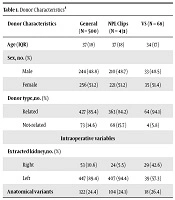
Pedraza NF, Garcia AE, Amaya JA, Baez Y, Giron F. Vascular Control of the Renal Pedicle Using Non-Absorbable Polymer Ligating Clips in Hand-Assisted Living Donor Laparoscopic Nephrectomies. Nephro-Urol Mon. 2019;11(3):e91761. doi: https://doi.org/10.5812/numonthly.91761
Moreno-Alarcón C, Server-Pastor G, López-González PÁ, López-Cubillana P, Ruiz-Morcillo JC, et al. Must We Still Be Worried About Multiple Arteries in Kidney Transplantation?. Nephro-Urol Mon. 2012;5(1):692-696. doi: https://doi.org/10.5812/numonthly.4928
Abbaszadeh S, Nourbala M, Alghasi M, Sharafi M, Einollahi B. Does Renal Artery Multiplicity Have Impact on Patient and Allograft Survival Rates?. Nephro-Urol Mon. 2009;1(1):. doi:
Neishabouri A, Torabinavid P, Kajbafzadeh A. Renovascular Hypertension and Seemingly Non-functioning Kidney Renewed Following Auto-transplantation: Pearls from Over Two Decades of Follow-up. Inn J Pediatr. 2023;33(2):e127243. doi: https://doi.org/10.5812/ijp-127243
More by these authors
Last Update: 1 week ago
Last Update: 1 week ago
Last Update: 1 week ago
Last Update: 7 hours ago
Last Update: 10 hours ago
Last Update: 5 days ago